
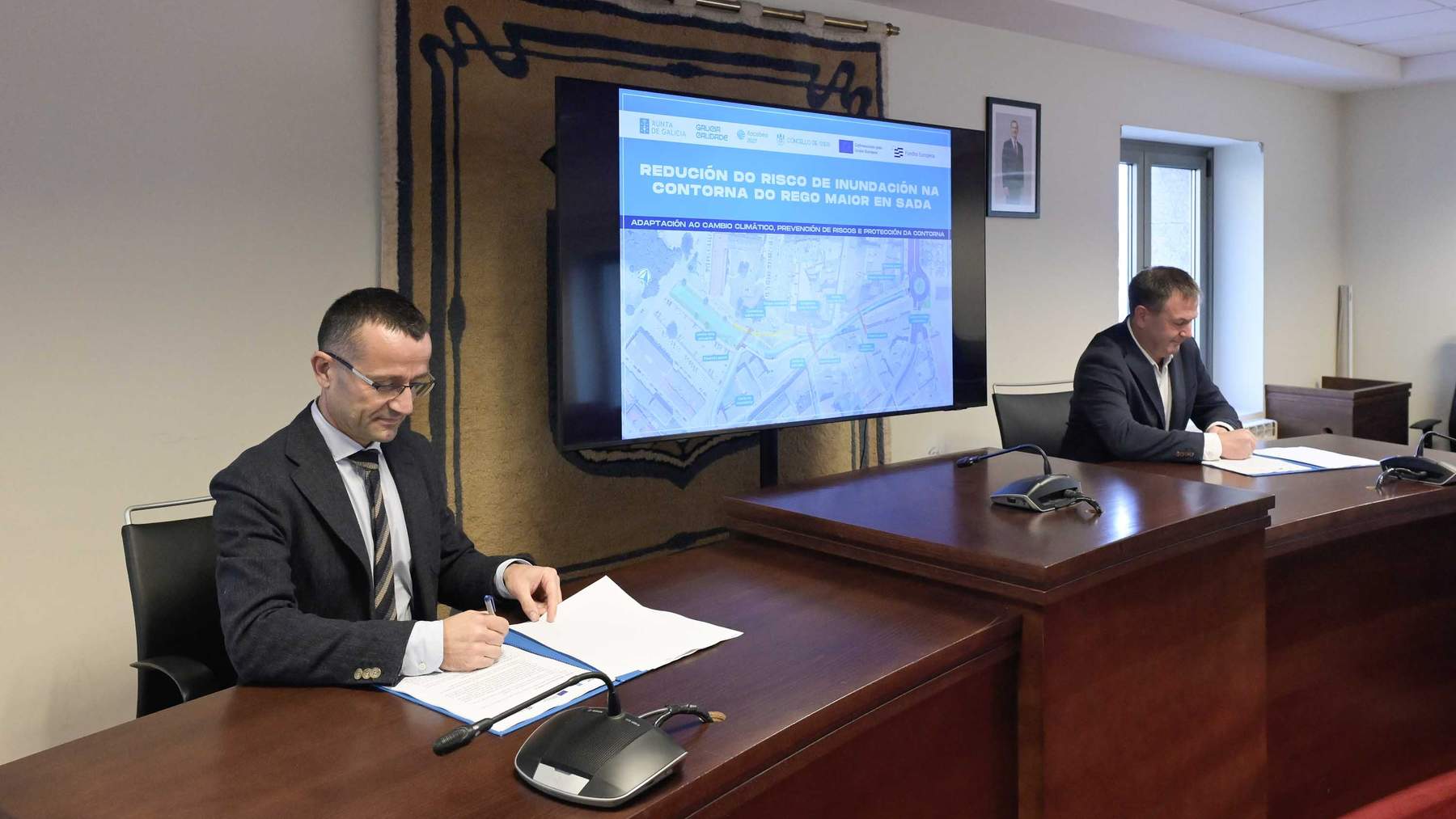
Residents of Sada’s town center live atop an unseen creek. Part of the Mayor Stream runs buried beneath the urban core, and that stretch limits its drainage capacity during heavy rainfall, according to the Xunta. To reduce floods in Sada and protect the town center from potential riadas, that section is going to be changed.
The Xunta and the council signed this November 19 an agreement to open stretches that are currently channelized and to create relief channels at the mouth. The investment amounts to 7 million euros, financed 50% by the regional administration and the local authority. The project also has European co-financing from the FEDER Galicia 2021-2027 programme.
The problem lies beneath the asphalt
The agreement was signed by the Conselleiro de Medio Ambiente y Cambio Climático, Nicolás Vázquez Iglesias, and the mayor, Benito Portela. According to the Xunta’s note, the work will solve the structural problem of the buried stretch. That section conditions drainage and can worsen the effects of episodes of heavy rainfall.
The solution chosen by the two administrations has two parts. On one hand, stretches that had been running channelized will be opened. On the other, relief channels will be built so that the water can exit more effectively at the mouth.
The project does not stop at the hydraulic side of the creek. It includes improvements in urban integration, pedestrian and vehicular mobility, recreation areas and gardens. Other cities have combined flood protection with public space, such as New York with its East River park.
An Official Risk Area
Augas de Galicia reviews every six years the preliminary flood risk assessment for the Galicia-Costa demarcation. In the 2021-2027 cycle, it marked the area of As Brañas and the mouth of the creek. They designated it as a Potential Significant Flood Risk Area (ARPSI).
The work is framed within the Galicia-Costa Flood Risk Management Plan 2021-2027. The plan covers prevention, protection, preparation, recovery and assessment. It also includes flood forecasting and early warning systems.
From 1.5 to 7 million
Behind this week’s signing lies a project that has been growing for years. At the end of 2020, Augas de Galicia and the council signed an initial agreement of 1.57 million. Of that amount, 75,000 euros were for drafting the project, borne by the council, and 1.5 million for the works.
In February 2021, the Xunta received 15 bids to draft that project. It was a contract of about 70,000 euros with a six-month term. First came an alternatives study to decide how to act in the final stretch.
In July 2023, after a meeting with the mayor, Augas de Galicia indicated that the project included renaturalization of the river. The required investment then rose to more than 6 million. The head of the agency asked the council to also seek funding from the Diputación de A Coruña.
A Dozen Works Across Galicia
On October 26, the Consello de la Xunta authorized this agreement within a broader package. They comprise a dozen flood-control projects in the Galicia-Costa demarcation, totaling 34.2 million. This is how the report presented that day to the Consello describes it.
Sada’s project appears among the highlighted interventions. Others with advanced processing are on the Miñor and Zamáns rivers in Gondomar (6.5 million), the Valga river (1.3 million) and the Tarrío stream in Padrón (1.1 million). The Xunta also promotes the first controlled-flood areas in Pontevedra and Ponteceso.
The Galician president, Alfonso Rueda, framed the package within the context of climate change. It is not a concern only for Galicia. Spain has already approved its climate adaptation program through 2030, with measures against heat and floods.
Getting Ahead of the Rain
In Sada, the Xunta highlights a structural problem, a buried stretch that limits drainage. But the context matters, because climate change has intensified torrential rains in Spain. And a buried stretch has little room for maneuver when the water comes all at once.
The conselleiro insisted that it is not enough to act only after the town has already flooded. We must anticipate and identify vulnerable areas. And carry out works that reduce risk to property and to the neighbors.
What Remains to Be Done
With the agreement signed, what remains is what the neighbors will see. The Xunta has not given in its note a start or end date for the works.
In 2023, Augas de Galicia reminded the council that, before starting, the project must be subjected to public information and the land made available. The note this week does not say at what stage that procedure stands.
The agreement and the project details have been published in a Xunta de Galicia press release.
Imagen: Xunta de Galicia
