
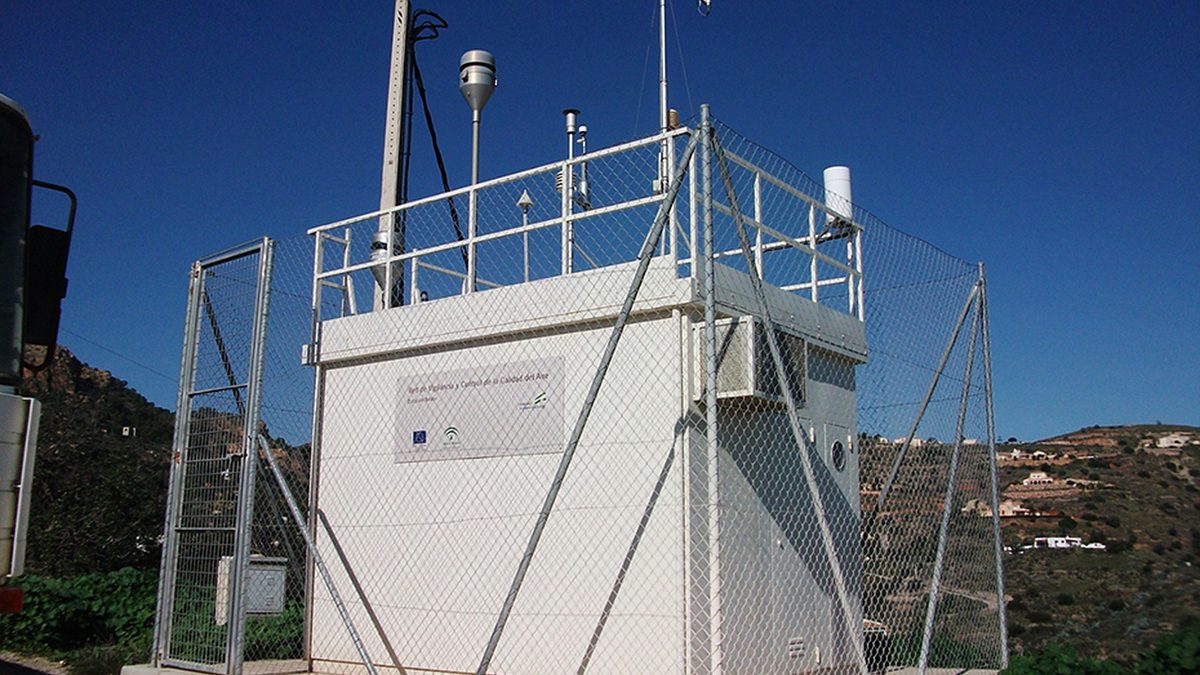
Do you know what the air quality on your street is like today? In Andalusia there are 92 fixed monitoring stations that measure it, producing more than 24 million data points each year. European limits will change in 2030, and the Junta is already working on how to adapt.
That was announced by the Department of Sustainability and the Environment in a press release this Sunday. According to the Junta, it is processing 11 improvement plans and three short-term action plans. And it is preparing a single plan for ozone.
What the Andalusian network measures
The 92 stations send their data to an operations center that monitors them around the clock. Each year, more than 129,000 measurements are taken with mobile units and 4,785 samples with diffusion samplers. There are also 7,041 analyses of pollutants.
The measurements are reviewed by the Andalusian Reference Laboratory for Air Quality (LARCA). According to the Junta, it is one of only two national reference centers in this field. It was a pioneer in obtaining ENAC accreditation.
The zones with improvement plans
The note this Sunday does not specify which areas are covered by the 11 improvement plans or the three short-term action plans. Consequently, the 2024 list is only indicative, since at that time there were 12 proposals. What is published are the proposals the Junta presented between March and May 2024 on its Environmental Portal.
Those proposals included improvement plans for Seville and Granada with their metropolitan areas, the urban area of Córdoba and Málaga with the Costa del Sol. There were others for the industrial zones of Huelva, Bay of Algeciras, Carboneras, and Bailén. Also for the Bay of Cádiz, Villanueva del Arzobispo, settlements with 50,000 to 250,000 inhabitants, and the new rural areas.
An improvement plan sets measures to reduce pollution where legal limits are exceeded. A short-term action plan is different, as it provides immediate measures when there is a risk of reaching alert thresholds. In 2024 the Junta proposed short-term plans of this second type for Seville, Málaga, Marbella, Granada, Córdoba, Almería, Jaén, Cádiz, Huelva and Algeciras.
The ozone problem
Tropospheric ozone is the ozone formed near the ground, distinct from the layer that protects us in the stratosphere. The Junta is preparing a specific plan for this pollutant, according to the note, due to its impact in the region.
The new European directive maintains an ozone target value of 120 micrograms per cubic meter. According to the Ministry for Ecological Transition (MITECO), it must not exceed 18 days per year, on average, over a three-year period. It also sets, for 2050, a long-term target of 100 micrograms.
What changes in 2030
Directive 2024/2881 brings European limits closer to the recommendations of the World Health Organization. According to MITECO, the new health-protective limit values must be met by January 1, 2030. Countries had two years to transpose it into their laws since its publication in November 2024.
PM2.5 will have an annual limit of 10 micrograms per cubic meter, down from the current 25. Nitrogen dioxide and PM10 will drop to 20 micrograms. They are half of the 40 that the current standard prescribes.
Air pollution has been linked to health problems, such as metabolic syndrome in children. The directive also provides for special stations for emerging pollutants, such as ultrafine particles or black carbon.
How Andalusia is preparing
According to the note, transposition into Spanish law is still pending. To prepare, the Department has carried out a preliminary assessment that will form the basis of a roadmap with the necessary measures. The current improvement plans will be revised once the new rule takes effect.
The Junta plans to allocate more than five million euros to fixed stations and new equipment through 2028. Among these projects is a major relocation of monitoring in Granada, in partnership with its University, to study the origin and composition of emerging pollutants and their potential health effects. In Europe, a link between air pollution and type 2 diabetes has also been detected.
Andalusia has had an Air Quality Strategy since 2020. According to the note, all plans in progress cover more than one municipality, and the ozone plan will be added to them.
Where to check the nearby air
The quickest way is the Andalusia Air Quality mobile app. According to the Junta, it shows the current situation and forecasts for each area, sends alerts, and provides health advice. It is especially useful for people with respiratory problems.
The Andalusian Environmental Portal offers hourly and daily reports, historical data, and the Air Quality Index. There are also 49 street panels distributed across the region. For now, transposition remains pending according to the note, and it remains to be seen what concrete measures the plans will bring.
Image: Government of Andalusia
