
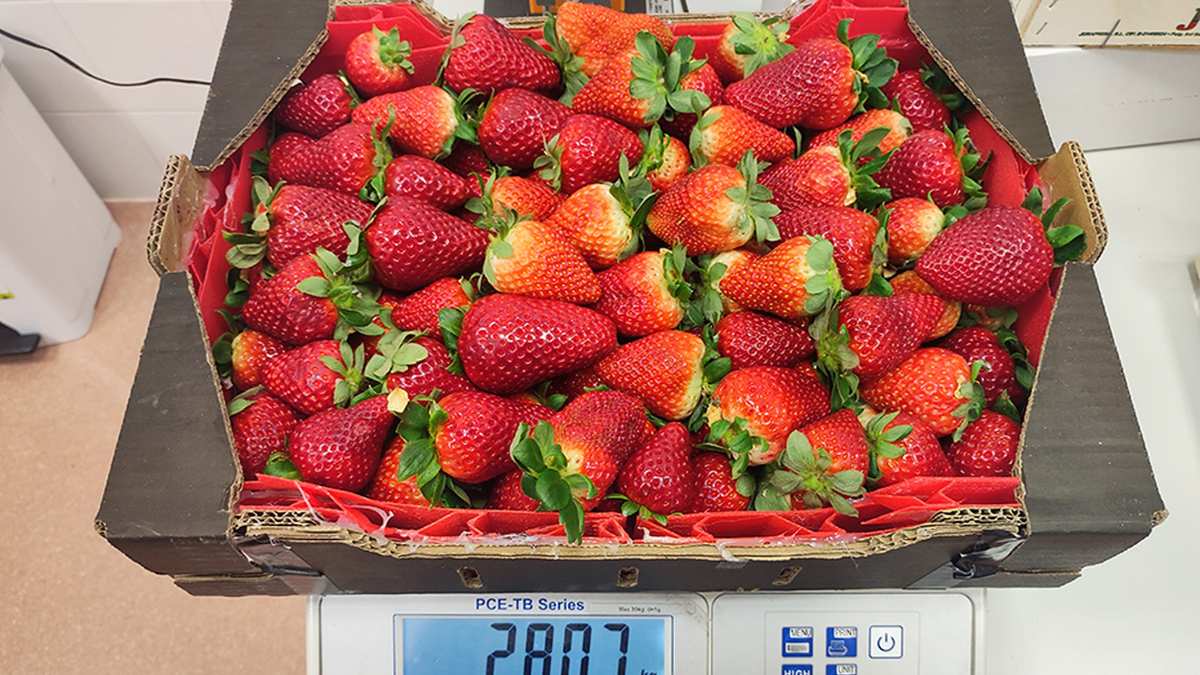
A bump in a rural road sends jolts that reach the strawberries long before they reach the fruit shop. Three Spanish universities tested a solution. It is a flexible sheet printed in 3D that sits at the bottom of the box, and with it the strawberries suffered about four times less damage on a real journey.
They did this work at the University of Córdoba, the Polytechnic University of Cartagena, and the Miguel Hernández University of Elche. The Junta de Andalucía highlighted the achievement in a press release on November 21. The study was published in the scientific journal Food Packaging and Shelf Life.
The problem of the thin skin
The strawberry is a very delicate fruit with a thin skin. The impacts and vibrations of transport cause bruising, weight loss, and changes in appearance. All of this lowers its value in the store.
«Strawberries degrade very easily, and part of that quality loss occurs before they reach the greengrocer and supermarkets,» explains Sergio Bayano Tejero, a researcher at the University of Córdoba. He notes that at harvest there is a wide variety of boxes and packaging systems.
What is special about the sheet
The sheets are made of thermoplastic polyurethane (TPU), a flexible plastic that returns to its shape after deformation. The key lies in the internal pattern with which they are printed, which absorbs part of the energy from the shocks.
Each piece measures one centimeter in height and can be inserted into a normal cardboard box. There is no need to overhaul the entire packaging system, because the industry already uses cardboard boxes.
Impacts up to four times smaller
First, the team subjected the packaging to vibrations and controlled impacts in the laboratory. The TPU samples dampened more than 21% of the vibrations. The cardboard stayed around 3% in one of the tests.
Then they dropped strawberries from 10 and 20 centimeters. From the lower height, the sheet reduced the impact by about three times compared with cardboard. From the higher height, the reduction reached four times.
The box lined with the sheet yielded results similar to those of the sheet alone. «It wouldn’t necessarily be necessary to replace the boxes that the sector already uses,» summarizes Bayano Tejero.
The test on a rural road
The missing step was to verify it outside the laboratory, on a real journey. The researchers loaded strawberries into boxes with the sheet and without it. They transported them from the harvest site to a warehouse along a rural road, at the same time and in the same vehicle to ensure identical conditions.
The result confirmed what was observed in the lab. The protected strawberries sustained about four times less damage, showed fewer bruises, and lost less weight. They also retained their color better in the days that followed.
In the standard packaging, berries at the bottom of the box accumulated more damage. With the sheet, the difference between the top and bottom layers was smaller, according to the researcher.
From 85% to 36%
Over four days, the team monitored weight, color, and damage in the strawberries. By day four, those in cardboard boxes had on average 85% of their surface bruised. Those protected with the sheet remained at 36%.
Strawberries are also kept under surveillance for pesticides. ecoticias.com reports that, according to a European analysis across eleven countries, organic strawberries do not contain pesticides.
What still needs to be known
The system is not yet deployed at commercial scale. The 3D-printed plastic could be used for contact with food if it meets regulatory standards. Nonetheless, the team wants to study molded, production-ready sheets to confirm the conditions required for contact with food.
It remains to be determined how many times each sheet can be reused, how it is cleaned, whether it can be recycled, how long it lasts, and what it would cost at an industrial scale. This is not a minor detail in a country where Eurostat shows that each person generated 43.55 kilograms of plastic packaging in 2024. The researchers will analyze economic viability against foam protectors and other cushioning materials.
The work, from the AGR-126 group at the University of Córdoba, received funding from the Junta through the Loadfru project. For now, the team plans to fine-tune the shape and thickness of the pieces and adapt the design to other delicate fruits, such as blueberries, cherries, or grapes.
