
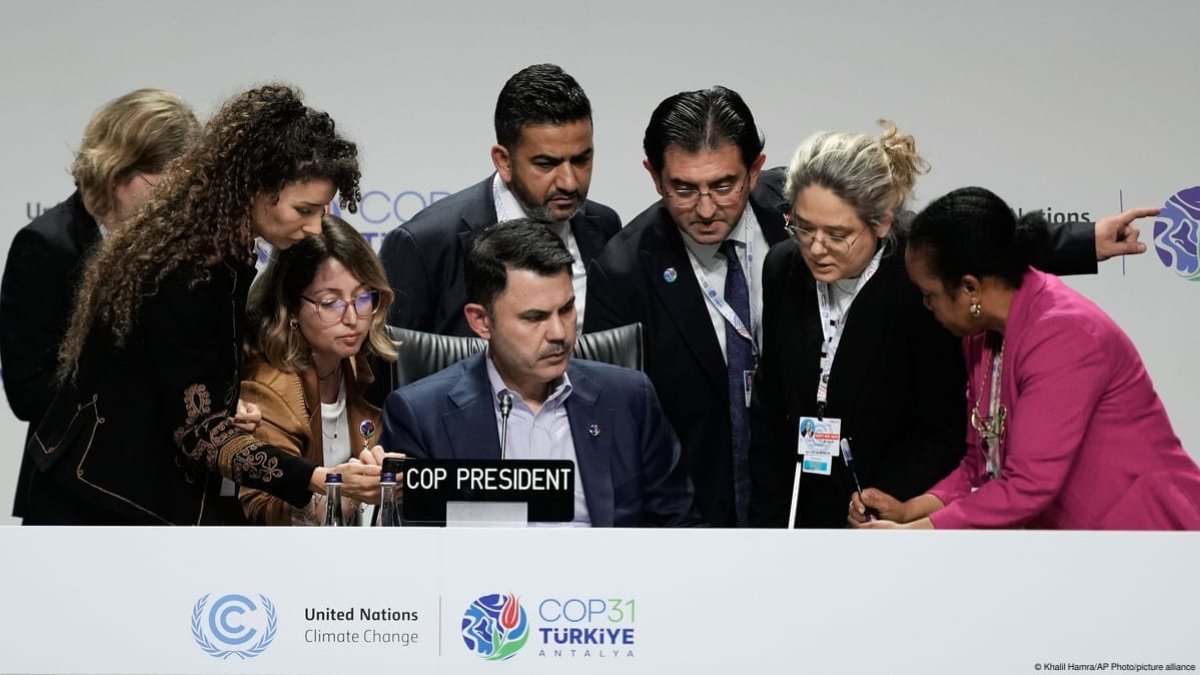
The Antalya COP31 ends without the political agreement needed to respond to the climate emergency, despite the urgency imposed by science and the increasingly severe impacts of global warming. The most significant meeting for advancing one of the planet’s most urgent challenges concludes without achieving the consensus required to approve the two major political decisions of the ‘Antalya Pact’ proposed by the Turkish presidency of the summit, which for the first time shared leadership with Australia tasked with directing negotiations. Although some technical and sectoral agreements have been adopted, the final outcome highlights the deep divisions among governments and the incapacity of the current multilateral process under the UNFCCC to respond with the urgency and ambition needed to the climate crisis.
Antalya COP31 Hits Fossil Fuel Interests and Leaves the Energy Transition in the Air
Faced with political gridlock, SEO/BirdLife underscores the role played during COP31 by environmental and social organizations, the scientific community, youth, Indigenous peoples, and representatives of the most vulnerable countries. Their mobilization has prevented the rollback of the climate agenda, proving that the failure of a negotiation does not equal the failure of climate action.
“There is something Antalya could not block, a civil society that understands the scale of the challenge, that demands climate justice and is not willing to accept that the political floor set by the minimum common denominator determines the maximum of our ambition,” says Asunción Ruiz, executive director of SEO/BirdLife.
Spain Announces 45 Million, but SEO/BirdLife Warns that Climate Financing Barely Grows
SEO/BirdLife values the active role of Spain at COP31 and its contribution to driving international climate action, with announcements such as mobilizing 45 million euros to support adaptation to climate change, address losses and damages, and strengthen meteorological and climatic observation systems. However, the organization notes that this amount simply continues the commitments announced at COP30 and does not represent a substantial increase in resources for this area: according to SEO/BirdLife, it amounts to barely a 3.4% rise relative to the 1.35 billion annual commitment. Therefore, it considers it necessary for Spain to bolster its ambition with additional, stable, and sufficient public funding, and to accompany its international leadership with national policies coherent with the goals of combating climate change and protecting biodiversity.
The Multilateral System in the Service of Humanity
SEO/BirdLife argues that Antalya’s failure should not lead to less multilateralism, but to a stronger, more democratic, and effective multilateralism capable of responding to an emergency that cannot be indefinitely subjected to the veto power of a few.
The organization believes that defending multilateralism means working to make it function, to serve in solving humanity’s problems. Governments can block a text, but they cannot block the climate reality nor ignore a society demanding answers. Science sets the limits, citizens already suffer the consequences, and policy must rise to the challenge.
Alejandro Quecedo, representative of SEO/BirdLife at COP31 notes: “Yes, diplomacy can reduce the ambition of a text; but the laws of physics do not negotiate. The planet is warming and species are disappearing. And yes, multilateralism has stood up to the task this time, but count on this: from SEO/BirdLife we will not lower our struggle until we achieve global climate justice.”
“We have seen how some governments have placed their economic and political interests above the safety of millions of people, especially those living in the most vulnerable countries that have contributed least to climate change. It is hard to accept such a lack of responsibility when we know the consequences of delaying decisions. But there is still time to change course. Countries like Spain, which already suffer droughts, heatwaves, and other impacts of global warming with particular intensity, must take a step forward and push the European Union and the international community to react,” adds Quecedo.
Civil Society Halts Reversals and SEO/BirdLife Calls to End the Blocking Power of a Few Governments
10 Key Points for SEO/BirdLife
1. The physics are unforgiving: science does not permit further delays. As SEO/BirdLife reminded at the outset of COP31, the physical laws governing global warming are not negotiable. It is essential to ensure that the upcoming IPCC reports are available on time to guide the second Global Stocktake of the Paris Agreement in 2028, with targets through 2040. Yet the scientific community has already provided more than enough evidence to act, and with much greater speed. Waiting for new reports cannot become an excuse to postpone decisions with lasting effects—every ton of CO2 emitted, avoided, or absorbed counts.
2. There can be no meaningful climate progress if fossil fuels are not left behind. The political deals at COPs must translate into clear, verifiable, and urgent commitments to progressively phase out coal, oil, and gas, accelerate the decarbonization of the economy, and deploy nature-friendly renewable energy. The inability to reaffirm and robustly develop the commitment reached at COP28 in Dubai shows how fossil fuel interests continue to constrain the ability to reach international agreements.
3. Protecting and restoring ecosystems is as indispensable as reducing emissions. The major natural sinks on land and in the oceans absorb about half of our CO₂ emissions, but they are threatened by warming, acidification, and environmental degradation. Conserving and restoring forests, wetlands, soils, coastal and marine ecosystems is essential to preserve carbon sequestration capacity, help stabilize atmospheric concentration, and strengthen societal adaptation and resilience. Nature must gain the same strategic prominence in climate policies as emission reductions, without replacing them.
4. The three major Rio Conventions must act jointly. Even the political recognition of the need to address climate, biodiversity, and desertification crises together did not survive Antalya’s failure. Initiatives such as the deforestation roadmap promoted by the Brazilian presidency of COP30 keep channels of cooperation open, but they do not substitute for a coordinated institutional response among the three United Nations conventions.
5. False technological solutions cannot distract from the transformations needed. The push to massively expand carbon capture, utilization, and storage, promoted by industrial sectors and oil and gas producing countries, risks prolonging dependence on fossil fuels and diverting resources and attention from proven solutions. These technologies remain questioned for their cost and doubtful feasibility. In any case, their adoption, even in limited circumstances, will never justify delaying emission removals nor stand in for protecting natural sinks.
6. Climate finance remains a matter of trust and justice. Deep differences over funding, adaptation, and a just transition decisively contributed to Antalya’s failure. Developed countries, including the European Union, must take greater responsibility to rebuild trust with developing countries through adequate, predictable, and accessible public funding. This effort should be accompanied by a reform of the international financial architecture to address the real needs of the most vulnerable nations.
7. Climate multilateralism needs to reclaim its ability to decide. Geopolitical and economic divisions will not disappear on their own. It is essential to work between COPs to bring positions closer, build trust, and prevent annual negotiations from ending in deadlock again. But it is also urgent to address reform of the UNFCCC decision-making procedures: consensus seeking must ensure the participation of all, not allow a minority to indefinitely paralyze the collective response. As in other treaties, there must be an option to adopt texts by majority.
8. Work toward COP32 starts now, especially at home. Antalya’s failure does not suspend the Paris Agreement commitments or governments’ responsibilities. Spain and the European Union must demonstrate leadership through real emission reductions, an energy transition compatible with biodiversity, preservation and restoration of ecosystems, ambitious adaptation policies, and greater international financial solidarity. We cannot afford to wait for the next conference to act.
9. Civil society has shown that scrutiny and mobilization are indispensable. Environmental, social, scientific, and human rights organizations have decisively helped to expose the shortcomings of the proposed texts and to prevent them from being presented as progress that could entrench unacceptable backsliding. Rejecting a bad deal does not in itself constitute a climate victory, but it demonstrates the importance of an independent, informed, and demanding civil society.
10. COP31 ends without the decisions humanity needs, but climate action cannot be halted by it. SEO/BirdLife will continue to work to ensure that the protection of climate and biodiversity, justice among countries and generations, and the defense of effective international cooperation translate into real commitments before COP32.
