
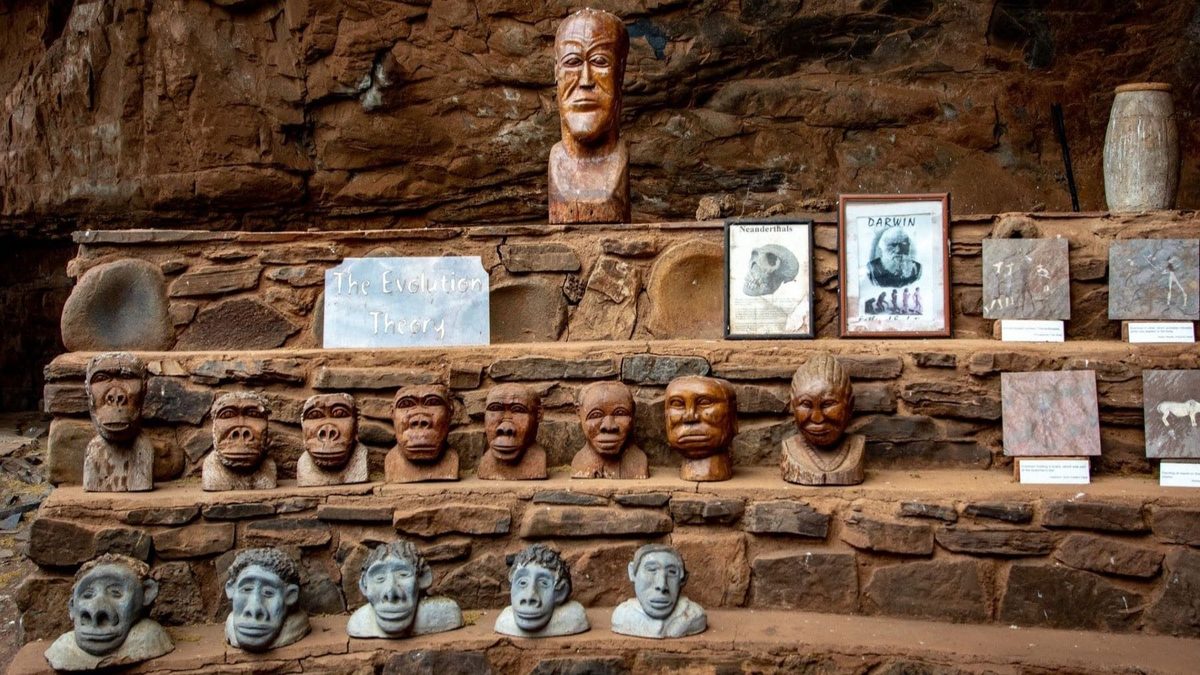
World Evolution Day 2026 commemorates the publication of «On the Origin of Species» in 1859 and the discovery of Lucy in 1974, two milestones that transformed our understanding of life and the origins of humans.
The World Evolution Day 2026, observed on November 24, links two events separated by 115 years. On that day in 1859, «On the Origin of Species» was published by Charles Darwin. On the same date in 1974, Donald Johanson and Tom Gray found in Ethiopia the first remains of Lucy, one of the most important fossils for studying human evolution.
Darwin explained how natural selection can favor heritable traits that enhance survival and reproduction in a given environment. Evolution occurs in populations over generations and helps us understand both the diversity of living beings and their kinship relationships.
World Evolution Day 2026, in homage to Charles Darwin
November 24 marks World Evolution Day 2026, whose purpose is to recall two important events for humanity. The first, the 1859 publication of «On the Origin of Species« by Charles Darwin, and the second, the 1974 discovery of the skeleton of a very ancient hominin, a finding made by archaeologist Donald Johanson.
Charles Darwin was a scientist and naturalist of British origin who dedicated his life to the study of species and who is today worldwide known for his masterwork «On the Origin of Species».
In his book, Darwin states that every form of life on the planet would have a descendant with a common ancestor. The scientist arrived at this conclusion after years of meticulous observation and research and asserts that everything arises through natural selection, which evolves over time into the organisms we know today.
The Famous Theory of Evolution
The theory of evolution explains a body of knowledge, findings, and scientific evidence that describe how the evolution of humans, animals, and all species on the planet has occurred.
This theory, grounded in the observations of one of the most influential figures in history, asserts that all living beings originate from a primordial source and that they gradually transform and evolve over time.
Additionally, changes that occur within a single organism can appear in two other distinct species, with entirely different characteristics that allow them to be differentiated from one another, and over time this is what is defined as evolution.
This evolution is possible thanks to «natural selection», where one species is able to adapt while another may become extinct. Over the years, this theory has expanded and scholars continue to investigate its different facets within the complex field of biology.
Lucy
Thus was named the hominin found on November 30, 1974, in Ethiopia by the archaeologists Tom Gray and Donald Johanson. It was a fairly well-preserved skeleton of the species «Australopithecus afarensis» and it made headlines worldwide.
Lucy contributed evidence about a portion of that story. This female of Australopithecus afarensis lived about 3.2 million years ago and combined the ability to walk on two legs with traits useful for climbing. Her importance lies in what her skeleton reveals about our ancient relatives; calling her the “mother of all hominins” attributes to the find a meaning that science has not proven.
Evidence that our ancient relatives walked upright also left imprints on the ground. At Laetoli, Tanzania, a track discovered in 1978 preserves about 70 footprints across nearly 27 meters, laid down on damp volcanic ash roughly 3.6 million years ago.
