
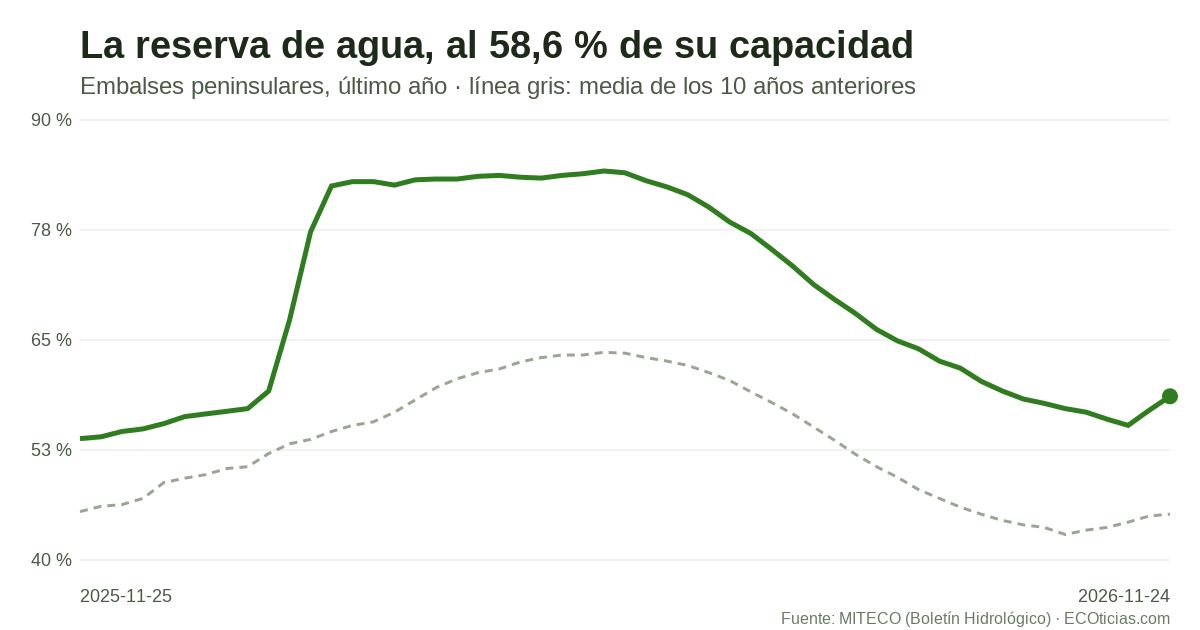
Spain’s water reserve stands at 58.6% of its capacity. The reservoirs hold 32,819 cubic hectometers, 869 more than a week ago. This is the figure from the weekly hydrological bulletin published by the Ministry for Ecological Transition (MITECO) on Tuesday, November 24.
The increase corresponds to 1.6% of the total capacity. A week ago the reserve was at 57%, and now it sits 13.4 percentage points above the ten-year average for this time of year, which stands at 45.2%.
More Water than a Year Ago
Compared with 2025, the situation also looks favorable. At the end of November last year, the reserve was at 53.8%, so the current level is 4.8 points higher.
The difference with the decade’s average is even larger. With a 13.4-point lead, the reservoirs finish autumn above what has been typical in the last ten years.
Where It Has Rained Most
According to MITECO, rainfall in the last week was abundant on the Atlantic side. On the Mediterranean side, rainfall was much lower. The maximum was recorded in Vigo, at 167.9 liters per square meter.
Galicia Costa and Miño-Sil, the basins in that area, remain below 50% nonetheless, at 48.5% and 49.7% respectively.
The Fullest Basins
The Internal Basins of Catalonia are the ones storing the most water relative to their capacity, at 78.1%. They are followed by Guadalete-Barbate at 74.5%, and Guadiana at 73%.
Also clearly above the national average are the Guadalquivir (69.2%), Tinto-Odiel-Piedras (62.4%), the Andalusian Mediterranean Basin (Cuenca Mediterránea Andaluza) (62.1%), and the Internal Basins of the Basque Country (61.9%). The Tagus is at 58%, almost at the average.
Those Still Below
At the other end is the Duero, with 44.9%, the lowest percentage of all basins. Very close is the Segura, at 45.8%, followed by the Ebro at 47.3%.
In the north, the Eastern Cantabrian is at 47.9% and Galicia Costa at 48.5%. The Cantabrian Western and Miño-Sil share 49.7%, and the Júcar reaches 52.5%.
In total, seven of the sixteen basins remain below 50%. Five of them are in the north and northwest, and the other two are the Ebro and Segura.
What the Figures Do Not Say
The percentages measure the water stored relative to each basin’s total capacity. They do not indicate how much water is available for irrigation or supply, which depends on the reserves of each system and its management rules.
They are also not a forecast, because a dry or wet week can change the distribution. The data for each week can be followed on our reservoirs page in the green data section, and the full bulletin is in the MITECO note.
Image: Confederación Hidrográfica del Guadiana