
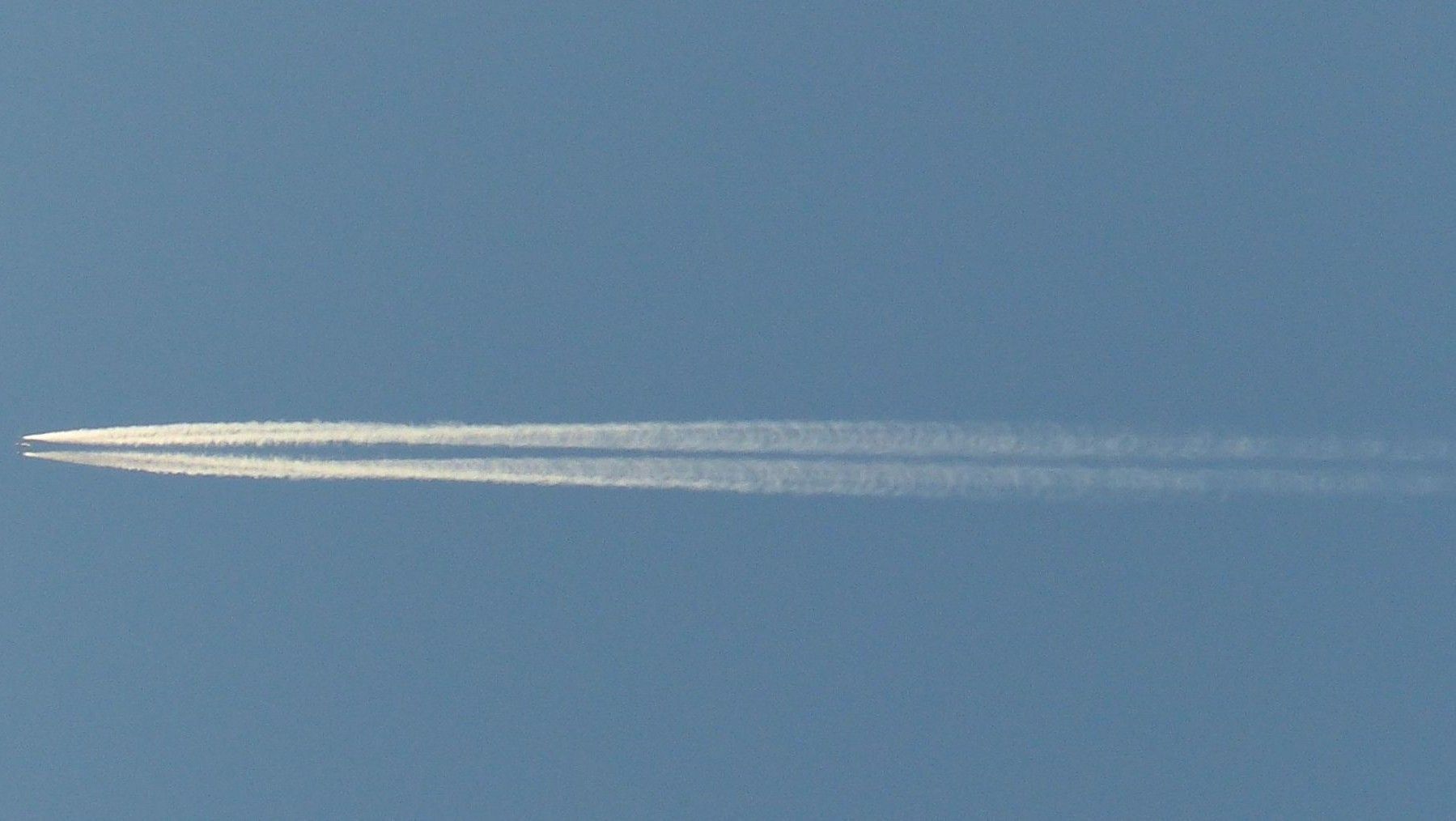
Avoiding aircraft condensation trails on a small share of flights could delay by about ten years a portion of the warming attributed to the sector, and would only require adjusting some routes and schedules.
The aircraft condensation trails are the white clouds that many flights leave behind, and according to a recent study, if they were avoided, the global warming directly linked to the aviation sector would decrease in a truly significant way.
Each of these aircraft condensation trails generates a considerable amount of heat, but the number of flights that emit them is quite small. Therefore, if those routes could be adjusted, according to experts, between 67 and 225 million tonnes of CO2 would stop being emitted into the atmosphere.
Fewer Aircraft Condensation Trails Would Reduce Global Warming
Avoiding the formation of aircraft condensation trails on a small portion of flights, i.e., those white streaks left by planes in the sky, could delay by about ten years the portion of warming attributable to aviation.
According to a study prepared by Klima Consulting for environmental group Transport & Environment (T&E) and signed by former IPCC scientist Olivier Boucher, this measure linked to reducing the aircraft condensation trails would reduce the projected temperature increase for 2050 by up to 0.025 degrees.
The report released on Tuesday estimates that, from 2030 onward, if the warming generated by these aircraft condensation trails were halved, aviation’s contribution to the global temperature rise would reach 0.08 degrees by 2050, instead of reaching that level a decade earlier, in 2040.
By 2070, the cumulative reduction would be about 0.049 degrees, according to the study, which estimates that avoiding the trails would free up between 3 and 5 percentage points of the global warming margin available between 2025 and 2050 to limit the temperature increase to 2 degrees.
Not All Aircraft Generate Them
Aircraft condensation trails form when the water vapor emitted by the engines condenses and freezes under certain humidity and temperature conditions at high altitude, and they can give rise to clouds that trap heat in the atmosphere.
Their climate effect is also highly concentrated on a small number of routes. In 2019, barely 3% of flights were responsible for 80% of the warming associated with contrails, according to research cited by T&E, with particular impact from overnight flights and in winter.
Therefore, the report considers that slightly adjusting the routes or schedules of certain flights to avoid atmospheric zones conducive to the formation of aircraft condensation trails could be one of the most economical ways to reduce the near-term climate impact of aviation.
A Necessary Adjustment
At current air traffic levels, reducing by half the warming caused by the contrails would amount to avoiding annually between 67 and 225 million tonnes of CO2 equivalent, i.e., between 7% and 23% of the world’s aviation CO2 emissions in 2025.
“Diverting or re-scheduling just a few flights could delay ten years the aviation industry’s contribution to global warming,” said Diane Vitry, the aviation director of T&E, who called aircraft condensation trails one of the most accessible opportunities to reduce the sector’s climate impact.
The European Union began in 2025 to monitor aviation emissions other than CO2 and the European Commission has proposed, within the framework of revising the European carbon market, to grant free emission rights to airlines that successfully avoid the formation of aircraft condensation trails.
Furthermore, this winter there are plans to conduct in the North Atlantic the first-scale oceanic airspace trial to reduce that phenomenon, an initiative in which, among others, the British government and air traffic control services participate.
The study stresses, however, that the temperature benefit only lasts as long as the measures to avoid the aircraft condensation trails are maintained and that acting on them does not substitute for reducing aviation CO2 emissions.