
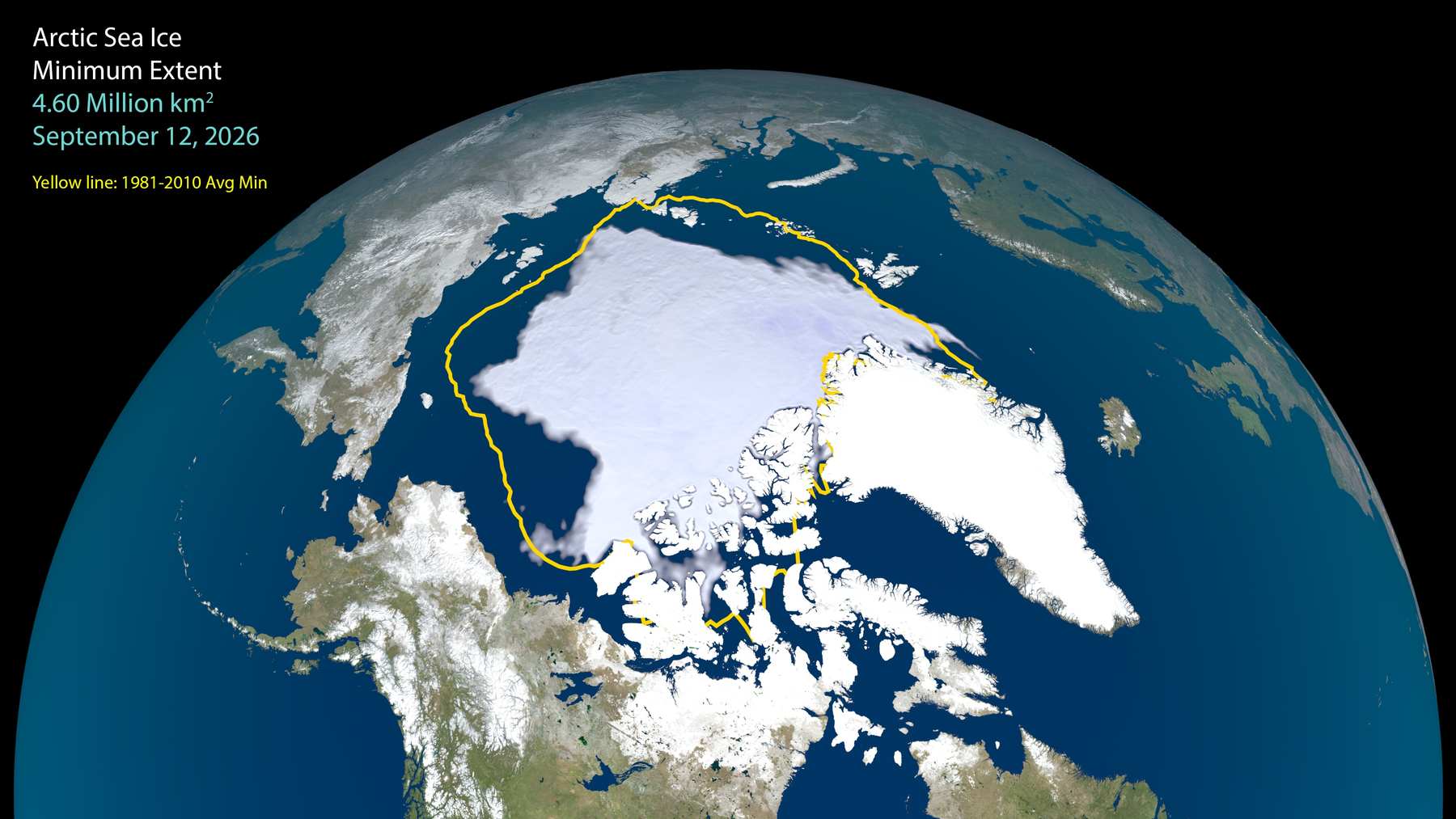
This summer, the Swedish icebreaker Oden reached the North Pole with scientists and tourists aboard, aided by a patch of loose sea ice that on the Atlantic side stretched almost to the pole. By the end of that summer, Arctic sea ice had bottomed out: on September 12 it covered about 4.60 million square kilometers, according to the U.S. National Snow and Ice Data Center (NSIDC) and NASA.
That figure matches 2008, 2010, and 2025 as the tenth-lowest minimum since satellite measurements began in late 1978, according to NSIDC’s preliminary announcement. On the opposite side of the globe, the ice surrounding Antarctica reached its winter maximum on September 14 at 17.59 million km², the third lowest on record.
In its season-end analysis, published on October 7, NSIDC scientists, based at the University of Colorado Boulder, described the 2026 Arctic melt season as «extremely unusual».
A minimum that repeats from 2007
According to NSIDC, the 20 lowest minimums of nearly 48 years of records have all occurred between 2007 and 2026. This year’s minimum was 1.21 million km² above the record low of 3.39 million km² on September 17, 2012, and 1.62 million below the 1981–2010 average, a difference the center compares to the size of Alaska.
“We have stagnated, but we remain well below what was seen in the early part of the record,” summarized Walt Meier, NSIDC senior research scientist, in NASA’s note on the minimum.
Two decades of a plateau at a very low level
From 1979 to 2026, the minimum has fallen by 11.8% per decade relative to the 1981–2010 average, about 73,200 km² of ice per year. NSIDC itself notes that in the last two decades there has not been a significant decline and that the causes of this flattening «are the subject of active debate in the Arctic science community.»
Linette Boisvert, a sea-ice scientist at NASA’s Goddard Space Flight Center, points to the clouds. Over the last decade, increased cloudiness has prevented solar radiation from accelerating melt any further, according to the agency.
Alaska climate specialist Rick Thoman adds in his Alaska and Arctic Climate Newsletter that ice surviving into late summer tends to remain mostly north of 76 degrees north, where intense solar warming lasts much shorter.
“It may not sound very dramatic, but it’s still almost 15% below the minimum of ANY year prior to 2007,” Thoman writes, estimating that today’s typical minimum is about 34% lower than the early-1980s average.
A cold and stormy summer over the Arctic Ocean
Global air temperatures were at record levels or near them in June, July and August, while over the Arctic Ocean the summer was cool and stormy. A low-pressure zone lingered near the North Pole for months, and NSIDC scientists note that “the persistence of this cyclonic pattern was notable.”
Zack Labe, a Climate Central scientist, explained to Carbon Brief that these low-pressure systems “brought cloudier, cooler conditions that limited surface melt.”
On the Atlantic side, the summer was far more extreme. According to Labe, the Barents Sea registered its “earliest complete melt on record.” Lettie Roach, polar climatologist at Germany’s Alfred Wegener Institute, reminded that the record heat in August reached Arctic shores close to areas with substantial ice loss.
Less old ice and more routes open
That the ice ended up melting during a relatively cool summer relates to its age. In the Beaufort and Chukchi seas, first-year ice dominated—the ice that forms in a single winter, which is thinner and melts away completely more easily.
Since 2007, at the end of summer, multi-year ice (ice that has survived at least one melt) has occupied between 1.3 and 1.9 million km², compared with about 3.5 million in the 1980s, according to NSIDC.
“Although this summer was relatively cool over the Arctic Ocean, the long-term warming trend has caused more melt and a faster redistribution of sea ice, meaning the ice does not survive nearly as long as before,” the center’s scientists write.
Roach summed it up for Carbon Brief: “Human-caused climate change has reduced the extent and thickness of Arctic sea ice, so the region is fundamentally different from a few decades ago.”
Thoman noted that the Northern Sea Route, along the Russian coast, and the Northwest Passage, between the Arctic Canadian islands, were open toward the end of summer, something rare in the 20th century. This Arctic navigation has its limits, because by early October NSIDC still saw a lot of ice in the southern route of the Northwest Passage.
Antarctica, near record lows
Around Antarctica, sea ice grew through the austral winter, staying below the usual range but above the 2023 record, until reaching a maximum on September 14.
In August it had lost about 300,000 km² in six days before rebounding. Meier attributed this to weather that pushed and compacted the thin outer-edge ice. “Those kinds of things happen all the time,” he told NASA. “But the magnitude is, undoubtedly, unusual.”
After the maximum, the decline was steep. NSIDC notes that since October 2 the daily extent has been recording record lows, below 2023, with losses in the Ross and Amundsen seas and in the Indian Ocean sector.
According to NASA’s Earth Observatory, Antarctic ice grew by about 1% per decade from 1979 to 2014, and since 2016 Antarctic sea ice has diminished and remained mostly below normal. Roach says, “after decades of relatively stable or rising Antarctic winter sea ice, it is worrying to see these low values persist.”
What is still unknown
NSIDC described both figures as preliminary and noted that Antarctic ice fluctuates greatly near its peak. The ranking also depends on the dataset. With the European OSI SAF index, the UK Met Office places the Arctic minimum in the 14th position, because several recent minima are very close to each other.
In Antarctica, Roach urges caution. “Compared with the Arctic, it is less clear to what extent recent changes in Antarctic sea ice can be attributed to human-caused warming or natural variability. We need more years of observations to better understand whether this is truly a structural change,” she said.
Thickness is also lacking. The PIOMAS system, which reconstructs thickness since 1979, stopped updating after NOAA canceled in March 2026 an atmospheric pressure data set on which it depended, according to Carbon Brief.
After the minimum, the Arctic has begun freezing again rapidly, though by early October its extent remained in the satellite record’s lowest decile.
Image: NASA’s Scientific Visualization Studio
