
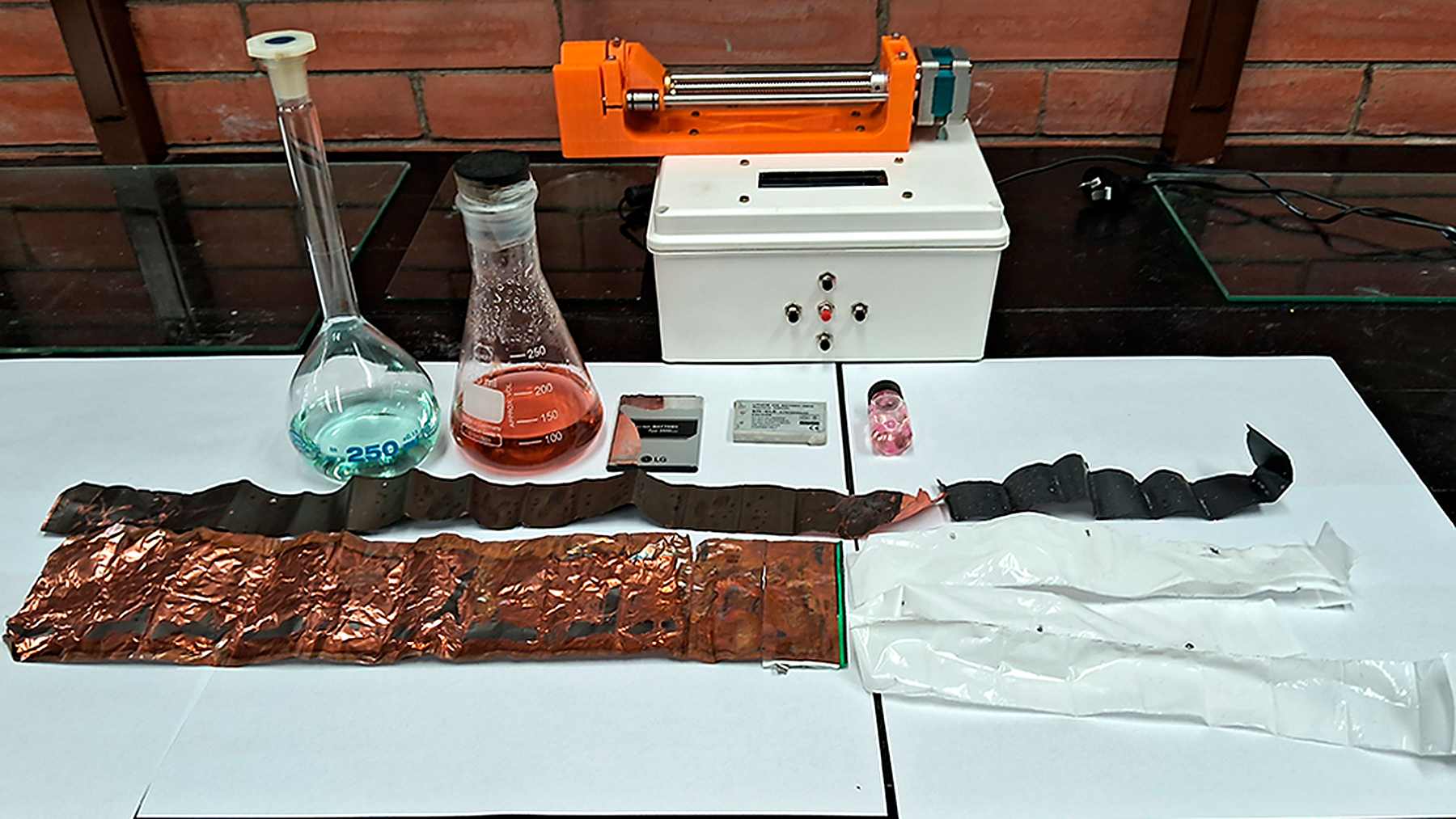
A team at CONICET, the country’s major public scientific institution, has tested in the laboratory how to recycle used lithium batteries using capsules made from cellulose derived from invasive plants. The project aims to recover five highly sought-after metals (aluminum, lithium, nickel, cobalt, and manganese) and return them to industry.
With smartphone batteries the method has already proven successful. Now the leap to car batteries is on the agenda, and the group is already in talks with an automaker, according to CONICET’s statement of October 20, 2026. Who doesn’t stash an old mobile phone in a drawer without knowing what to do with it?
A Franco-Argentine Award for Negri
Leading the project is Martín Negri, a researcher at CONICET. He heads the Laboratory of Composite Materials and Energy at INQUIMAE, a jointly run institute with the University of Buenos Aires (UBA).
In September 2026 he received, for this work, the Franco-Argentine Distinction in Innovation, in the Senior category. It was the tenth edition of the prize, organized by CONICET and the Institut Français d’Argentine, under the auspices of the French Embassy, with support from TotalEnergies Argentina. For an idea that still sits on a laboratory bench, it’s quite an achievement.
Negri is not alone. In the research, the Polymer Laboratory of the Center for Research in Gas Hydrates—a CONICET center affiliated with the UBA—also participates. According to the organization, the two groups have been collaborating on energy with companies for years.
Metals Too Valuable to Throw Away
When a battery is exhausted, metals with substantial market demand remain inside. For the researcher, the key is “being able to recover elements in high demand.” He envisions not only new batteries but also semiconductors, paints, glass, and medical materials.
A prime example is cobalt, common in mobile phones and many household appliances. According to Negri, it is more valuable as a raw material than lithium itself. It is used in ceramics, paint, and electronics.
That is the logic of the circular economy, which Negri cites as the starting point. Instead of using and discarding, the old battery becomes raw material for other products. This also prevents its metals from ending up in a landfill without any processing.
Neutralize, Disassemble and Dissolve
Before handling them, spent batteries undergo a safe neutralization of their electrical charge. Without this step they could explode during handling, and that is the last thing anyone wants in a laboratory.
After that they are dismantled, either by crushing or disassembly, and the electrodes and membranes are separated. “We apply different chemical processes to these parts,” explains Negri. The result is liquids in which lithium, nickel, or cobalt are dissolved.
The problem is that those liquids form a mixture. There can be a lithium salt and a cobalt salt in the same container. And that is where the challenge begins.
Capsules that Trap a Salt
According to the researcher, the question now is “not only to remove them from that medium, but to separate them.” Ideally, one would obtain one salt per metal, without one contaminating the other. To achieve this, the team uses capsules that act as “smart sponges,” each designed to capture a specific salt.
The most remarkable part is the material. The capsules are made from biopolymers, such as cellulose from invasive native plants that hold no commercial value. In other words, what is left in the field is used to salvage what is left in the drawer.
Towards Car Batteries
For now, the technique has only been tested in the lab with lithium-ion batteries from mobile phones. In cars, Negri explains, there are two types of batteries. Some are lithium-ion, and others are nickel–metal hydride.
The latter contain mostly nickel, but also rare earths such as lanthanum or neodymium. These are metals with strong futures in semiconductors. Moreover, the project intends to work with urban recyclers and take what has been learned out of the laboratory, a step that many laboratory projects never reach.
This is not the only idea of its kind. In Singapore, orange peels have already extracted up to 92.2% of several metals from spent batteries. And in Europe, battery recycling could cut the need for new lithium by up to 50% by 2040.
No Performance Figures Yet
The press release does not state how much metal is recovered or with what purity. It also does not cite a published study, name the interested company, or set a date for the car-battery tests.
Moving from the laboratory to an industrial plant is another story, of course, because volumes, costs, and controls change. Still, Argentina already faces concerns about the impact of lithium mining on amphibians. Getting more use from existing batteries makes a lot of sense.
The official announcement about the project has been published on the CONICET’s website.
Photo: courtesy of Martín Negri / CONICET
