
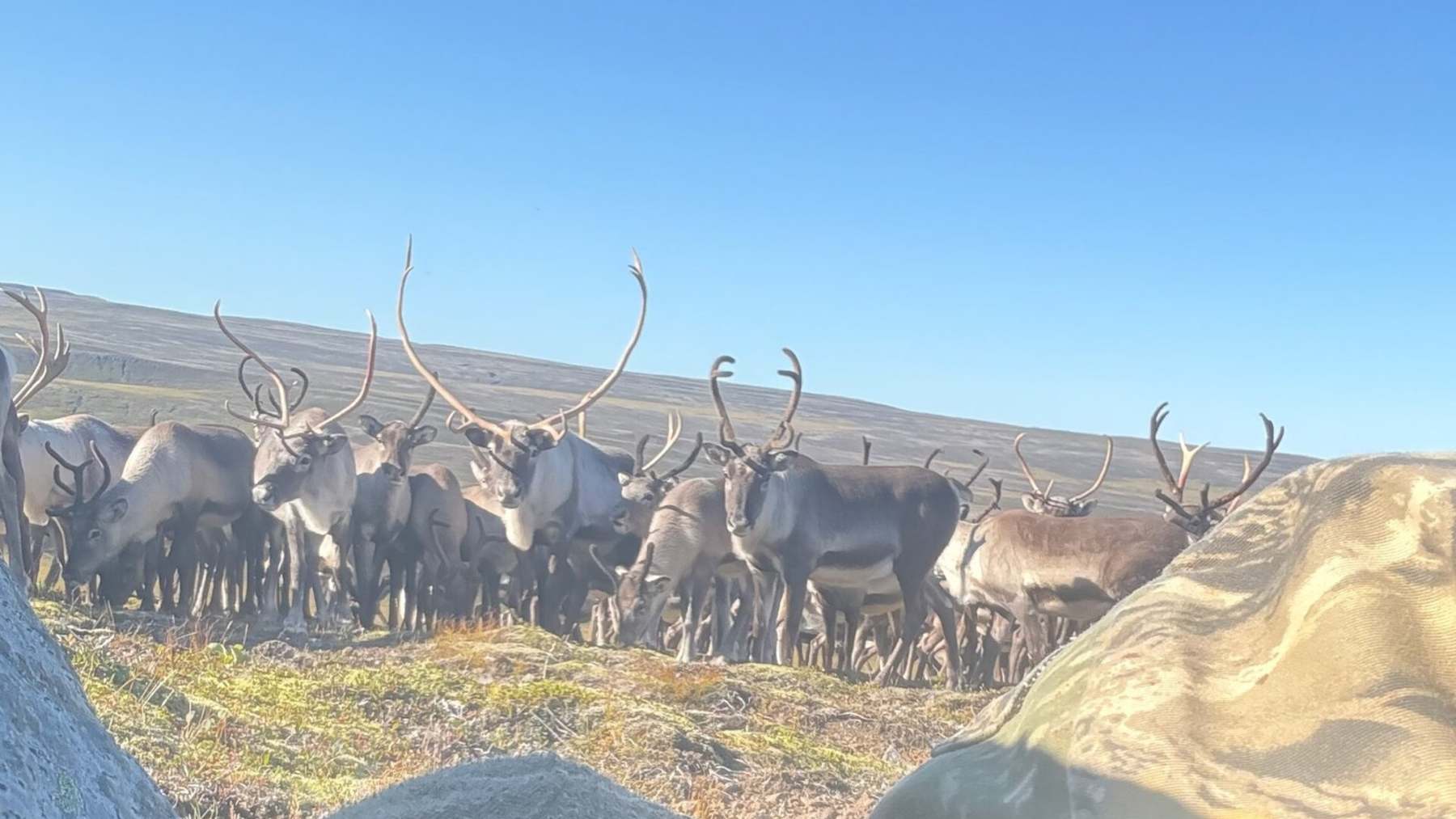
Anton Freyr Birgisson had gone out to photograph wild reindeer from a distance in a remote part of northern Iceland when the herd, estimated at about 400 animals, suddenly turned and began advancing toward him. The photographer crouched behind a rock and kept filming with his iPhone as the animals passed by him.
Birgisson is a nature photographer and a guide with Geo Travel Iceland, a company that organizes small-group tours in the north of the island. His account, collected by the photography magazine PetaPixel, describes a calm passage of the herd that ended with a calf approaching to sniff him.
The herd changed direction and passed by the rock
That day, Birgisson was accompanying a group of local hunters with the sole aim of observing and photographing the animals, as he explained to PetaPixel, which published his story on September 18, 2026. His plan was to watch from a distance and without disturbing a herd of large herbivores that is usually seen from afar.
“My plan was not to approach the herd, but the reindeer had other ideas,” he told journalist Pesala Bandara. When the animals turned toward his position, he threw himself behind a rock to avoid scaring them, though close enough to keep filming.
“They were very calm. They had been startled and came upwind, which is not a usual behavior,” the guide explained. “And I hid behind the rock because I thought they would turn back.”
“But they did not, and they simply walked past calmly. A calf even came to sniff me! It was a beautiful herd of about 400 animals,” he added.
They arrived from Norway over two centuries ago
The Icelandic reindeer live in the wild, although their presence on the island is the result of human introduction. According to the Iceland Institute of Natural Sciences, they were brought from Norway in four waves between 1771 and 1787 and came from semi-domesticated reindeer in Finnmark, in the far north of that country.
The plan was to use them in farming, but, as the institute notes in the species profile, the animals have lived in the wild from the start. A 2021 NASA Earth Observatory article adds that they were brought by royal decree after several diseases wiped out around 60% of the island’s sheep, and that reindeer breeding never took off due to harsh winters, competition with sheep farming, and little local interest.
Today the species occupies the highlands and the eastern fjords of Iceland, from Melrakkaslétta in the north to Suðursveit in the south. The institute describes them as herd animals with seasonal movements, and the ratio of males, females, and calves in each group shifts according to the time of year.
In summer they graze in the highlands near Snæfell mountain and in winter they descend to the milder coastal valleys, according to the same NASA article.
A population counted every year from the air
Since 2000, the East Iceland Nature Research Center (Náttúrustofa Austurlands) has had a legal obligation to study and monitor these animals each year. Its 2022 monitoring report, signed by Skarphéðinn G. Þórisson, Rán Þórarinsdóttir, and Fríða Jóhannesdóttir, defines the reindeer as “an introduced species that is found only in the eastern part of the country.”
The report divides that area into nine hunting zones numbered from north to south, and PetaPixel places the sighting in northern Iceland without specifying the exact location. The monitoring combines ground and airplane observations: fertility is studied in April, birthing zones in May, recruitment and herd composition in July, and rut in September and October.
Recruitment is the number of calves added to the population each summer, and in 2022 it varied a lot from one zone to another, from 47 calves per 100 females and yearlings in zone 7 to 63 in zone 8. Hunters also provide the weight of carcasses and dorsal fat of the animals shot, which are used to gauge their physical condition.
With this data, the center calculated 4,065 reindeer in the winter of 2022–2023 and about 5,106 at the start of the 2023 hunting season, assuming a 26% rise. The reindeer numbers doubled between 2000 and 2008, but since then “they have fluctuated and decreased overall,” the authors write.
With no predators, hunting quotas set the population size
The Icelandic reindeer “have no natural enemies,” the report notes, and PetaPixel explains that is why the Icelandic government regulates their hunting to keep the population in check. Each year, the center proposes a quota which is then approved by the Minister of Environment, Energy and Climate and implemented by the Icelandic Environment Agency, according to the 2022 report.
According to the authors, the aim of the monitoring is to gather enough information for sustainable hunting and to ensure that in every zone there are fewer than one animal per square kilometer of suitable habitat, the threshold set to avoid exceeding the maximum acceptable pressure on the pastures on which wild herbivores depend.
“To prevent overgrazing, we keep winter population density below one animal per square kilometer,” explained Skarphéðinn Þórisson, from the East Iceland research center, to NASA Earth Observatory in 2021. “Most of the overgrazing that occurs in Iceland is related to sheep farming, not reindeer, and occurs mainly in areas away from eastern Iceland,” he added.
The 2022 quota was 1,021 animals and 966 were hunted, i.e., 95%. For 2023, the center proposed 901 reindeer, 475 females and 426 males, i.e., 120 fewer than the previous year, partly due to low recruitment in some zones and due to the uncertainty about how many animals were in those zones.
Watching reindeer in the wild can take hours
Birgisson guides trips in northern Iceland on snowmobile, on foot, in a Super Jeep, or in a UTV, a small utilitarian off-road vehicle. “We’re trying to raise awareness of trips to northern Iceland and all the incredible opportunities and adventures it offers,” he told PetaPixel.
“Here the reindeer are wild and they are usually visible from quite a distance. Sometimes we take people out to look for them. Birdwatching is also very popular here,” he added.
In the excursion brief, the company explains that the guide plans each outing considering the weather, wind direction, visibility, and the herd’s movements, and that binoculars and terrestrial telescopes are used to observe wildlife. “Hours can pass before we see a herd, but that’s part of the experience,” it warns.
The company also notes that “reindeer are wild animals” and that “sightings and proximity can never be guaranteed.” Its rule is to use the wind and the terrain to avoid disturbing them and not to rush, chase, or interfere with the herd.
What the video cannot reveal
The figure of around 400 reindeer is an estimate by the photographer himself and describes only the group that passed by him that day. Such a large concentration is striking, but it does not indicate whether the Icelandic population is growing or declining, something that only aerial counts and the center’s annual monitoring clarify.
The video also does not prove that approaching a herd is safe. Birgisson planned to stay back, and it was the herd that changed direction, with a behavior he himself described as unusual, so it does not allow us to assume that another encounter will end the same.
The 2022 report also acknowledges its own gaps, since movements of reindeer between zones and an unexpected drop in zone 2 hindered accurately estimating population size. To resolve this, the center planned a full winter count in March 2023.
The full account was published by PetaPixel on September 18, 2026, and the original recording can be viewed on Birgisson’s Instagram account.
Image: Anton Freyr Birgisson / Geo Travel Iceland