
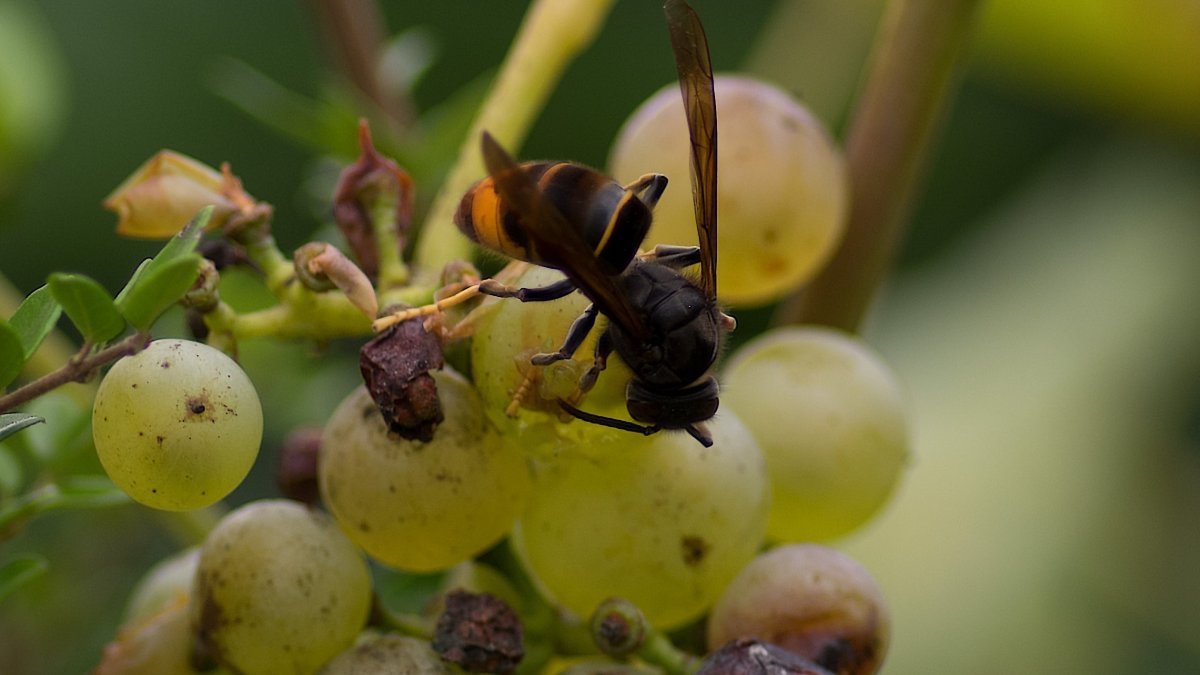
Liquid-bait traps catch other insects and did not reduce damage from the Asian hornet in the Galician vineyards studied. The thesis by Yaiza R. Lueje, from the University of A Coruña, found that anti-hail nets effectively protect the grapes by blocking the Asian hornet‘s access to the clusters.
Anti-hail nets close the passage to the Asian hornet and protect the clusters
A study by the University of A Coruña, conducted by Yaiza R. Lueje, examines the impacts of the Asian hornet in agricultural and urban settings, as well as the effectiveness of different measures to manage the presence of this invasive species.
The results of the research, as detailed this Friday by the Universidade da Coruña, show, in the viticultural sphere, that anti-hail nets constitute a highly effective measure to prevent damage to the grapes, by blocking access by both the Asian hornet and other agents that can affect the clusters. Moreover, the thesis develops a simple methodology, based on visually evaluating the clusters, which allows estimating harvest losses.
Mass trapping captures other insects and leaves the grapes just as exposed
Conversely, the results indicate that widespread campaigns of trapping with liquid attractants are not effective at reducing damage in vineyards and cause the accidental capture of numerous insects.
The research also studies the distribution of the species in urban spaces through models that allow analyzing its relationship with different environmental characteristics, such as vegetation cover, air and light pollution, and noise. In A Coruña, the wasp was more abundant where there was less vegetation, more noise, and more air pollution; light pollution did not show a clear relationship.
The Asian hornet also settles in cities and Galicia needs to sharpen surveillance
The results show that Velutina velutina is capable of persisting in highly urbanized landscapes and that certain environmental factors typical of cities may be linked to its distribution. This information can contribute to the development of predictive tools and to identifying areas where strengthening surveillance should be a priority.
Thus, the thesis highlights the need to revise the strategies for controlling the Asian hornet in densely invaded territories, such as Galicia, where the eradication of this invasive species is no longer a realistic objective.
The cost of trapping and alternatives to containing the Asian hornet in Galicia
In the study published in Pest Management Science, each trap captured on average per day 25 insects other than the target and 0.72 Asian hornets. Among the accidental captures, dipterans predominated.
The team also did not observe a reduction in damage to the clusters when doubling or tripling the density of traps. That result gives vintners a concrete reason to invest in physical barriers.
The Xunta allocated 1.77 million euros in 2026 for Seaga to remove and destroy nests. Protecting the clusters can be complemented by that intervention, which in Galicia is activated by calls to 012.
