
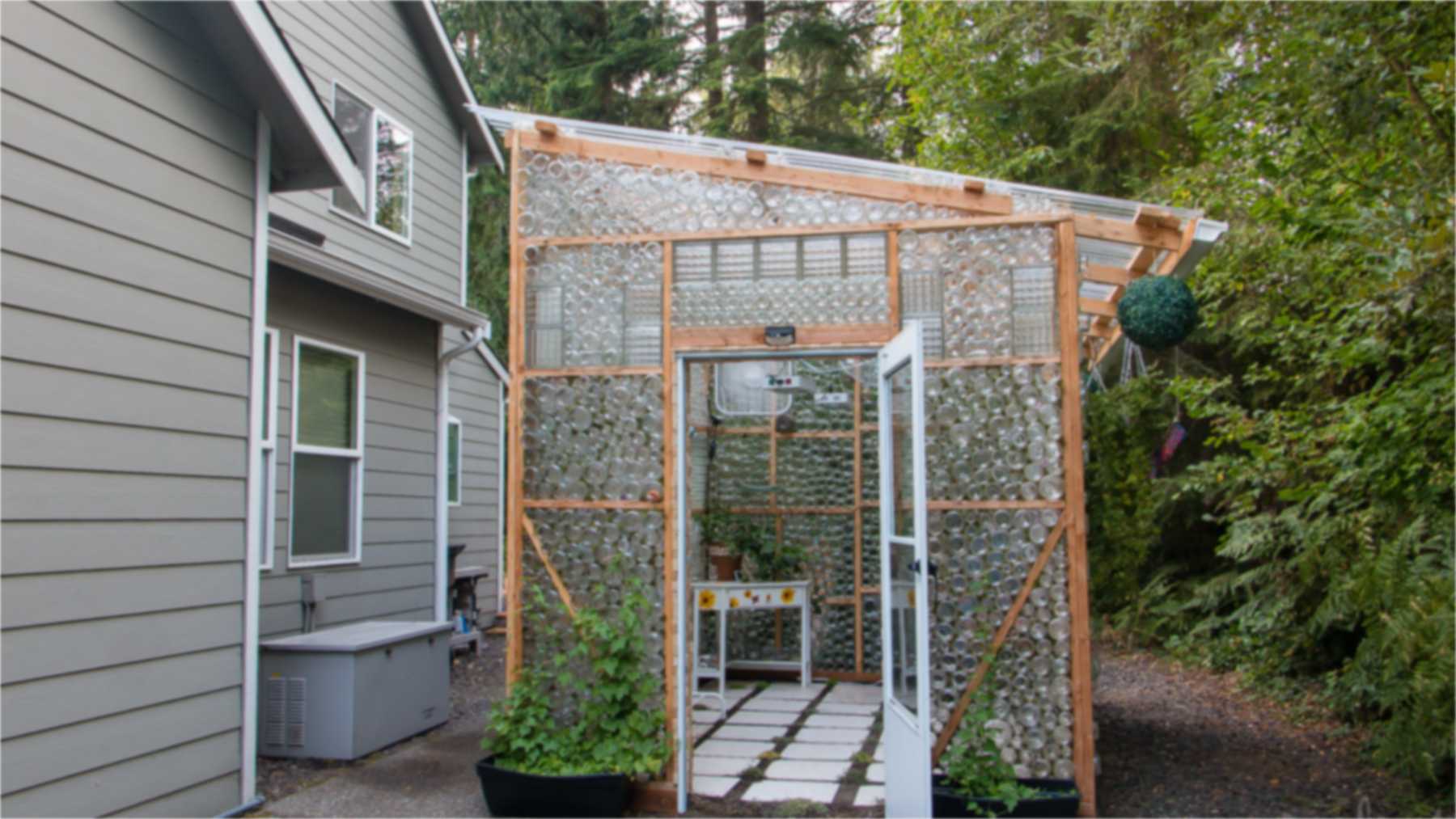
A blank pickle jar can have another life far from the kitchen. In Duvall, Washington, USA, Axton Burton gathered 4,516 glass containers to build a greenhouse on his parents’ farm, with family help and contributions from the community.
The structure sprang from a concrete need: to create space for a tropical plant collection. Although Hunker picked up the story in September 2026, the original interviews document a construction that began in January 2020 and was practically finished in September 2021, a detail important to place this striking example of reuse in its context.
The Figures of the Glass Jar Greenhouse
| Data | Value |
|---|---|
| Jars used | 4516 |
| Start of construction | January 2020 |
| Near completion | September 2021 (about 20 months later) |
| Approximate dimensions | 2.44 × 3.66 × 3.66 m (about 9 m² of floor space) |
| Declared cost (2021) | About $3,500 |
| Compared shed | About $6,500 (46% more expensive) |
A Banana Plant Too Big for the Apartment
Burton’s apartment had grown too small to accommodate the plants. Moreover, many home greenhouses did not offer the height required for his banana plant, so the design had to adapt to what he truly wanted to cultivate.
The first option was to repurpose used windows, but gathering pieces with the right measurements complicated the project. The jars offered another approach: filling the gaps in a wooden frame with containers of varied shapes and sizes.
The project progressed through the lockdown months of the pandemic. “I don’t know when it will really be finished,” Burton told Le Jardinet in October 2021, when most of the greenhouse was already in place.
4516 Jars on a Wooden Frame
Burton’s father built the wooden frame, and the containers were placed and glued within their receptacles. There were large canning jars and others much smaller, including glass nail polish bottles.
The variety gave the walls a mosaic-like appearance, but it also left gaps. Burton began filling them with moss, a DIY solution whose insulating capacity isn’t quantified in the reports consulted.
The assembly wore a plastic cover and measured roughly 2.44 by 3.66 by 3.66 meters, according to dimensions published by the Seattle Daily Journal of Commerce. The wood, the roof, and the adhesive were among the materials that had to be purchased.
Jars Donated by Neighbours and Social Media
How do you obtain more than 4,500 containers without first emptying the pantry? Burton sought help in Facebook groups and on Nextdoor, and received contributions from friends, neighbors, and others interested in the project.
Reuse also extended to decorative details. Corks framed the entrance, while tin cat-food cans served as small candle holders, and some lids became supports for drawings and messages from visitors.
In this way, the donated materials left a visible mark beyond the walls. The hanging caps reminded visitors of those who contributed, giving the greenhouse the character of a collaborative work.
Rainwater in a Wine Barrel
The interior was equipped with grow lights, fans, and a misting system to tend plants like banana trees, finger limes, and carambolas. An old wine barrel was converted into a catchment for rainwater.
The system used that water to provide humidity, and a free source completed the interior environment. The result blended salvaged objects with plant-care equipment, beyond the visual effect of the walls.
$3,500 Versus a $6,500 Shed
Burton told the Snoqualmie Valley Record that the overall project cost around $3,500 in 2021. In that interview, he compared that amount with the $6,500 needed to buy a smaller shed. By those numbers, his greenhouse came out about 46% cheaper.
The comparison reflects his experience, but it is not a budget for two equivalent greenhouses. Donations and family labor were essential to the project, so the figure also does not allow calculating how much it would cost to reproduce today in Spain.
What the Environmental Figures Do Not Say
The most evident environmental value lies in extending the life of materials that already existed. The U.S. Environmental Protection Agency explains that reducing and reusing helps save raw materials and energy, though those general benefits do not equate to a calculation of emissions avoided by this greenhouse.
For anyone looking to be inspired by the idea, it also matters what happens after you build the walls. The University of Georgia notes that a greenhouse needs a suitable location and control of temperature, humidity, and ventilation—factors that influence plant care and operating costs.
Burton’s case offers a tangible way to reexamine the empty containers in our homes. The feature with images and statements about the project was published on KING 5.
Image: Le Jardinet Designs