
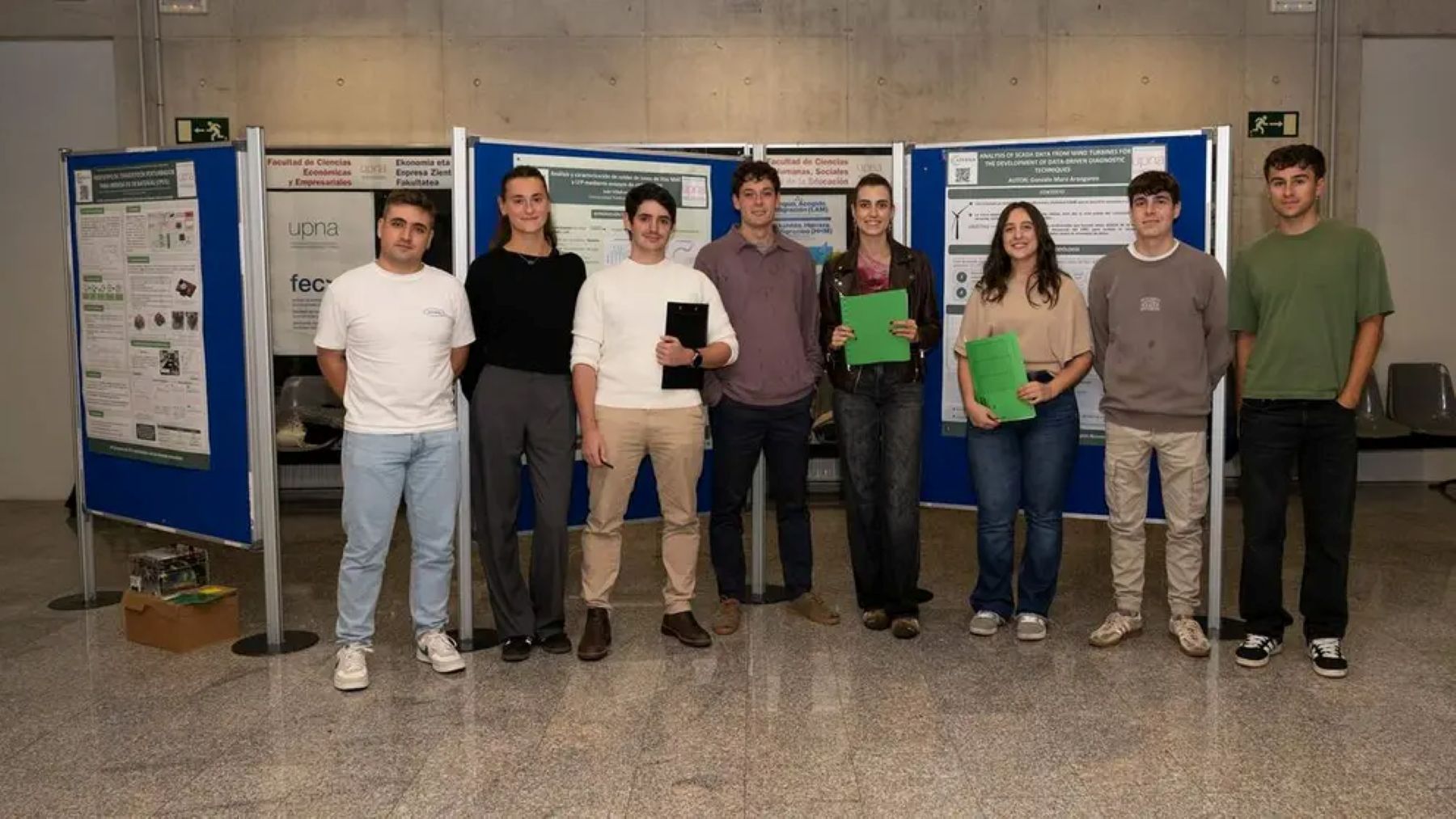
The diagnosis of batteries while they are still operating centers on Unai Arriazu’s project, developed with Ingeteam and tested in the laboratory to generate the signals that allow studying their internal state.
A battery can continue to operate while researchers study what happens inside it. That possibility lies at the heart of Unai Arriazu’s project, in which he has designed and built a prototype to generate the electrical signals required for the battery diagnosis without stopping its activity. The work has won the first prize in the renewable energy poster competition at the Public University of Navarra (UPNA).
Developed in collaboration with Ingeteam Power Technology, the device introduces controlled variations in current. A measurement system records how the battery responds to these signals, enabling information about its internal state to be obtained. Its aim is to facilitate the study of equipment that stores electricity from renewable sources.
Arriazu, who has completed UPNA’s Master’s degree in Renewable Energies, has finished the design, construction, and programming of the prototype’s control. The laboratory tests have confirmed that it reproduces the required signals, a result recognized with the 300 euros prize for the first place in the XII edition of the competition.
Innovative Battery Diagnostics
The design and construction of a prototype that generates the electrical signals necessary to analyze the state of batteries, by Unai Arriazu, has won the first prize in the XII edition of the Poster Competition on Renewable Energy-related Final Degree and Master projects at UPNA.
Arriazu has completed the master’s degree in “Renewable Energies: Electrical Conversion and Grid Integration of Wind and Photovoltaic Systems” from UPNA, after which he carried out the work in collaboration with Ingeteam Power Technology, awarded with a prize of 300 euros.
The awarded project by Unai Arriazu focuses on a technique that enables battery diagnostics without interrupting its operation. To that end, controlled variations in electric current are introduced and the battery’s response is analyzed. That response provides information about its internal state.
The prototype generates these current variations so that a measuring system records the battery’s response and allows its study to be analyzed. The work has included the device’s design, its construction, the programming of its control and the laboratory tests, which have confirmed that it reproduces the required signals.
This type of battery diagnostic tools contribute to the study of those used to store electricity from various renewable sources.
Storage Batteries and the Growth of Renewables
The relevance of these tools grows with the needs of the electricity system: in its 2024 report, the International Energy Agency placed the global battery storage capacity required by 2030 at 1,200 GW within its net-zero-by-2050 scenario.
Batteries would account for 90 % of the projected growth in storage in that scenario. This deployment strengthens the interest in studying their state while they operate: expanding solar and wind power also requires understanding how the storage systems respond, and a battery diagnosis without stopping them would be an excellent solution.
