
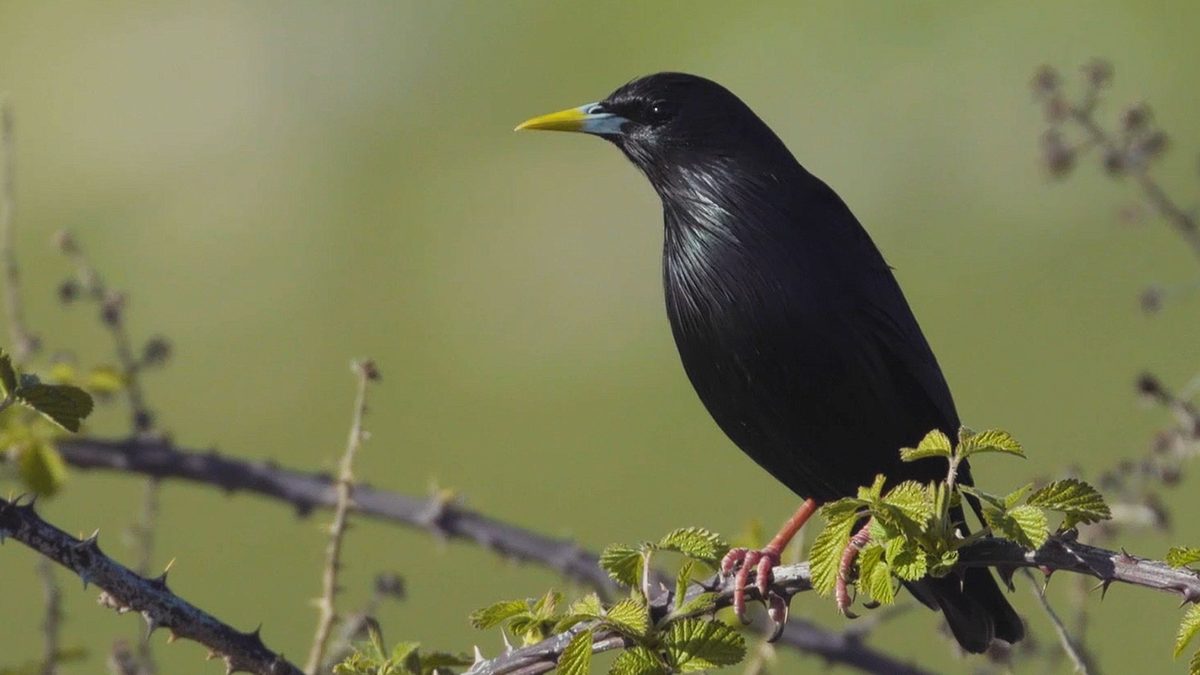
Black starlings do not wait for spring to pair up. A study conducted by the National Museum of Natural Sciences (MNCN-CSIC) shows that more than half of new pairs begin forming months before breeding, in the depths of winter. And this is a species capable of forming enormous flocks.
In these flocks, the two birds were already the closest social partners to each other since the previous winter. Moreover, many pairs persist from one year to the next, according to an MNCN note published on November 26.
Microchips at the Feeders
The team studied a population of black starlings (Sturnus unicolor). They marked the birds with microchips that identify each individual. They then installed radio-frequency readers at the feeders.
Whenever a bird approached to feed, the reader recorded who it was and what time it arrived. This provided a continuous picture of when each starling visited. They also observed how the makeup of its companions changed over time.
In total they analyzed more than 400,000 records. The work has been published in the journal Animal Behaviour. Participating institutions also include the Autonomous University of Madrid, the University of Zurich, the Australian National University, and the Institute for Research on Game Resources (IREC).
Meeting Up Is Not the Same as Being a Pair
The challenge was to distinguish a close relationship from a simple coincidence. Two starlings may coincide at a feeder merely because they are searching for food. In a species capable of forming massive flocks, that momentary coincidence does not prove a close bond.
Therefore the researchers compared several methods. Some grouped the birds that fed in the same cluster, even if they were not at the feeder at the same time. Others measured how long two individuals spent together.
The chosen method combined the two ideas in two successive steps. First it identified feeding groups, then analyzed the coincidences between each pair of birds within those groups.
Instantaneous Relationships or Priority Bonds
Roger Fusté, a researcher at the MNCN-CSIC, argues that this system fine-tunes more than the earlier approaches. He explains that it identifies “beyond the general social network of a population, more effectively the meaningful associations among its members.”
“This work, in which we analyzed more than 400,000 records, has allowed us to determine whether the relationship between individuals was fleeting or prioritized,” adds Fusté. That difference made it possible to identify the strongest bonds.
What Winter Already Foretold
Even from the winter behavior alone, the team correctly identified most of the pairs that later bred. They had not formed at the start of the breeding season; a preexisting link was already in place.
Diego Gil, also from the MNCN-CSIC, explains that they were seeking a method capable of detecting those key ties. It should even enable “predicting which male-female pairs would breed together in the following spring.”
Not all pairs followed the same path through winter either. Some bonds appeared early in winter and others later. There were winter ties that dissolved before spring.
And What About Song and Plumage?
The finding prompts a reevaluation of an idea about how these birds court. It is assumed that these birds court using traits such as their song or their plumage displays, which are barely present in winter.
For Fusté, the study reinforces the notion that forming a pair “is a complex process that can begin long before the onset of reproduction.” He also adds that it makes us rethink what role those traits play in mate choice, without the study ruling them out.
Why Winter Matters
For the authors, the winter social relationships are important for these birds. They reflect pair bonds that could influence their survival and reproductive success.
The next time you see a flock of starlings in a field or near a feeder, it may not just be a group looking for food. Within it, according to this study, there may already be pairs that will breed together in spring.
Photo: Diego Gil / MNCN-CSIC
