
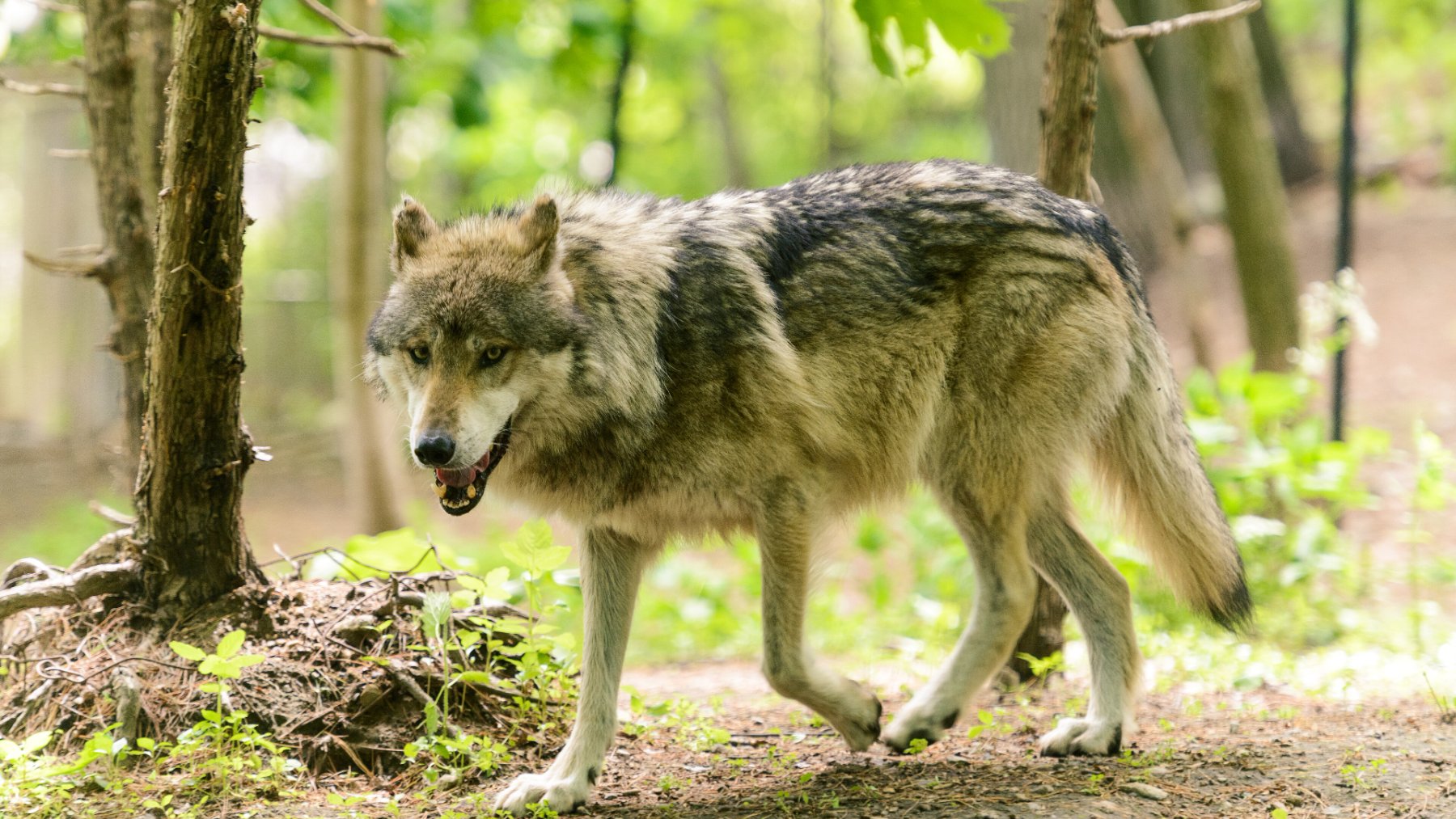
Northern Minnesota wolves could be playing an underappreciated role in the reproduction of wild blueberries. An experiment has shown that seeds recovered from their scat germinated earlier and more successfully than seeds extracted directly from the fruit. In total, 96% of the seeds recovered from feces germinated, compared with 69% of those taken from the fruit.
The finding points to a relationship between this predator and the plants it preys on that goes beyond simple predation. But the figures should be interpreted with care, because they come from a laboratory setting and the magnitude of the advantage varies quite a bit depending on which seeds were used for comparison.
A Clue from Five Feces
The study, led by Alex D. Gross and conducted by researchers at the University of Minnesota and Hope College, focused on the Voyageurs National Park environment. There, five fresh wolf scat samples were collected during the summers of 2017 and 2018, consisting mainly of digested fruit.
Afterwards, the seeds were extracted by hand and a subset was selected to test whether they could germinate. As a reference, seeds were taken from berries collected on ten wild plants per year, between 2017 and 2019.
They placed the seeds on damp paper in laboratory plates, under controlled light and temperature cycles. A seed was considered germinated when its first root appeared at about 0.5 millimeters, a concrete sign of the start of growth.
More Seeds and Shorter Waiting
In total, they planted 802 seeds derived from feces and 484 seeds extracted directly from blueberries. The germination rates of 96% and 69% correspond to a 27-percentage-point difference, a detail that’s important for correctly interpreting the result.
The waiting time also changed. Half of the seeds that had passed through a wolf germinated by day 19, while the control group reached that point by day 26. Under the testing conditions, that was a seven-day advance.
The Nuance of the Comparison
The three control batches yielded very different results, showing 42% germination in the 2017 batch, 91% in 2018, and 81% in 2019. When comparing seeds from wolves with the best control batch, the advantage narrows to about five percentage points.
The authors acknowledge this in the article, noting that “we have less certainty about the magnitude of these increases.” They suspect that differences in seed extraction and storage influenced the results, although the exact cause of the poor performance in 2017 remains unknown.
The advantage persisted against the best control in terms of speed as well. Seeds ingested by wolves reached half germination at day 19, versus day 23 for the 2018 batch. The observed benefit is noteworthy, but its size needs to be refined through further testing.
Fruit on the Wolf’s Menu
Why would a predator end up eating blueberries? Although wolves primarily feed on large herbivores, they take advantage of other resources when available. In this region, blueberries are abundant from early or mid-July through mid-August.
During that period, the berries can make up a substantial portion of the diet. A previous study of a northeastern Minnesota pack found them accounting for 83% of the biomass consumed in a single week, a measure of the amount of food ingested.
There have also been observations of an adult regurgitating blueberries to feed its pups. These precedents help explain why the researchers wanted to investigate what happens to seeds after they pass through the digestive system.
A Journey Still Unmeasured
Scientists propose that passage through the intestine could wear down the seed coat and facilitate water uptake or trigger germination signals. It is a plausible explanation, but the exact mechanism was not demonstrated in the experiment.
Moreover, wolf movements could transport seeds between blueberry patches. The article presents GPS data from three animals in the same pack that moved between those areas during the summer of 2024.
However, it remains unknown how long blueberry seeds stay inside a wolf. Therefore, a definitive distance for that travel cannot be assigned, nor can it be claimed that it will necessarily lead to new shrubs.
The Remaining Test in the Woods
Outside the laboratory, the result could depend on where the seeds fall and how many end up clumped in a single deposition. Additionally, the five samples analyzed came from an unknown number of wolves, which limits how broadly the findings can be generalized.
Whether the advantage holds under natural conditions with a larger sample remains to be seen. For now, the study opens a pathway to a better understanding of the relationship between wolves and the vegetation of these forests.
The research was published on August 26, 2026 in Biology Letters. The full study can be accessed on the journal’s website via its official link.