
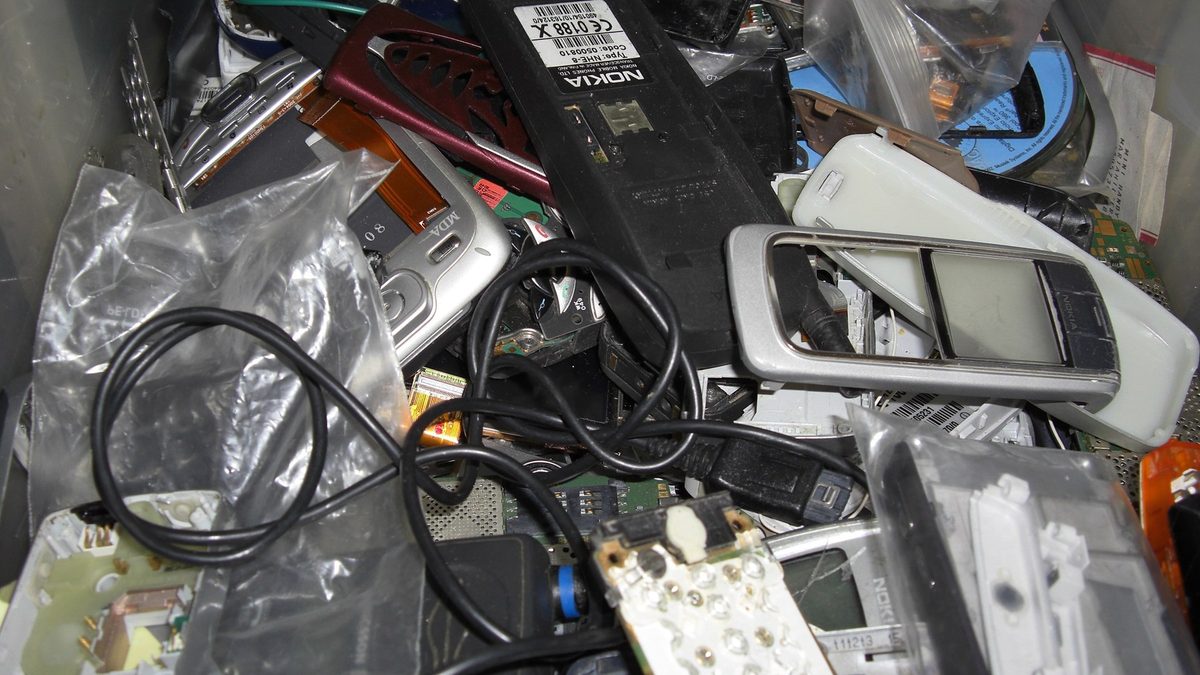
This Friday brings Black Friday. In many drawers, the old mobile phone or charger awaits, sometimes alongside a broken shaver. A national regulation requires large stores selling electrical and electronic equipment to collect these small devices for free, even if the customer does not buy another item.
It affects shops with a minimum of 400 square meters dedicated to selling devices. The rule is in Article 22.2 of Royal Decree 110/2015 on waste from electrical and electronic equipment, published in the Official State Gazette (BOE) on February 21, 2015 and in force the following day. It is relevant now because every device that is new these days tends to leave behind an old one at home.
What Article 22 Exactly States
The text is brief and addresses distributors with a sales area of at least 400 square meters. These “must plan for the collection at their retail points, or in their immediate vicinity, of very small WEEE,” states the royal decree.
The same sentence adds that this collection is carried out “free of charge for end users, and without any obligation to purchase an equivalent type of EEE.” You can walk in with a broken mouse in your pocket, leave it there, and walk out without passing through the checkout.
What Counts as a Very Small Appliance
The decree itself defines it in Article 3. They are devices and their waste “that have no external dimension exceeding twenty-five centimeters.” This applies to length, width, and height.
If even one side exceeds that figure, the device is excluded. A mobile phone fits within this size, and the regulation’s preamble cites it as an example. Chargers, headphones, remote controls, mice, or an electric toothbrush also comfortably fit within this size.
Large Appliances and Small Stores
For the remaining cases, the same article establishes the so-called one-for-one rule. Any shop, regardless of its size, must accept for free an old device of the same type when selling a new one. This applies at the counter and also upon delivery to the home when receiving the order.
If the old device is not handed over at the moment, the store must set in writing a deadline for bringing it in with the invoice. That deadline cannot be shorter than thirty natural days.
Online purchases are not exempt either. Section 4 obliges distance selling to collect the equivalent device at home or at the delivery location.
If the old device is handed over together with the purchase, the store must provide a receipt or delivery note. It should include, among other details, the date and the type of device, according to Article 23. It is advisable to request it and keep it.
Why Take It Out of the Drawer
According to the Ministry for Ecological Transition, these waste items contain hazardous components. They also carry other materials of high economic value that are lost when waste is mishandled.
According to Recyclia’s Seventh Annual Report, the collection of electronic waste, batteries, and accumulators has grown by 24% in Spain. But collecting is not enough, because those materials have to be reused.
Before handing over a mobile phone or a small tablet, it is prudent to back up data and erase it. Then you should remove the SIM card and the memory card. If the device still works, the regulation also anticipates its delivery to second-hand shops.
What the Regulation Does Not Specify
The royal decree requires collection, but does not say how the container should be. It also does not specify where in the store it must be located. It is enough that it is in the shop or very close by, so sometimes you have to ask customer service.
With large devices that are not replaced by another, such as a washing machine with no substitute, you must go to the recycling center or municipal collection. The full text has been published in the Official State Bulletin (Boletín Oficial del Estado).
Image: MikroLogika / Wikimedia Commons, CC BY-SA 3.0
