
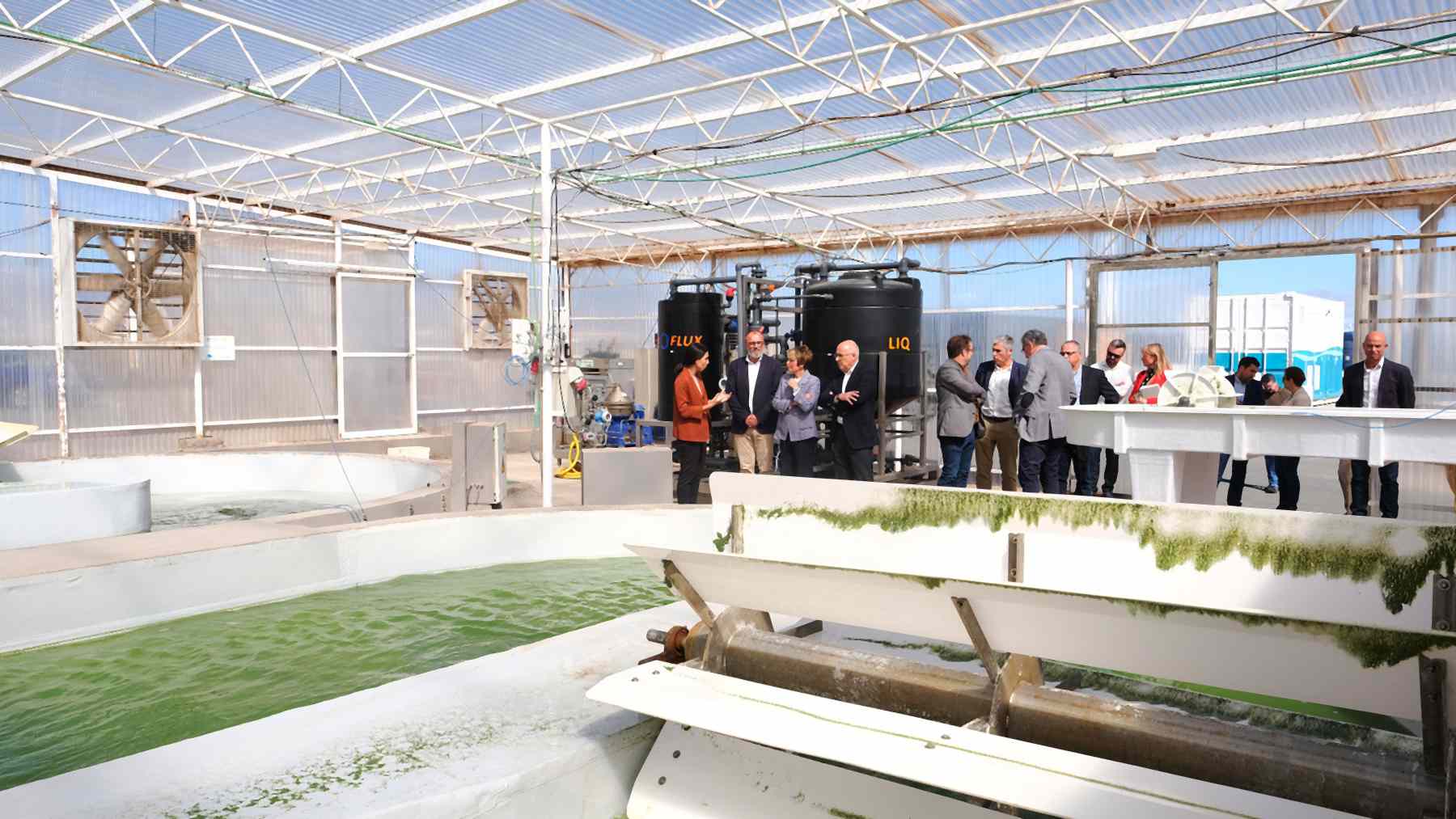
The desalination plants of the Canary Islands discharge brine, and the cities generate wastewater. The Canary Islands government wants to test whether marine microalgae can make use of these two awkward leftovers. And, in doing so, the CO₂ that industry emits.
The Canary Agency for Research, Innovation and Information Society (ACIISI) has allocated 5 million euros for this to the Canary Islands Institute (ITC). The project is called BIOSTEP and is planned to run until June 2029, according to the notice published on November 20.
Three Wastes, One Crop
The idea is to cultivate marine microalgae for bioremediation, that is, to clean up or make use of waste with living organisms. The cultivation will combine treated urban wastewater with the saline discharges from desalination. And industrial-origin carbon dioxide will be added, which the algae can use as they grow.
According to the Canary Islands government, the technology will allow studying alternatives to reduce the impact of certain discharges. It will also recover resources and obtain raw materials through biological processes.
From that cultivation would come biomass and natural compounds. They could be useful in energy, agriculture, nutraceuticals and new materials. Other groups have already seen how microalgae convert wastewater into tailor-made biomass.
Why It Matters in the Islands
The Councillor for Universities, Science, Innovation and Culture, Migdalia Machín, frames it within the territory’s own challenges. “In islands where water, energy and the protection of the marine environment are essential concerns, it becomes particularly important to study how to make the best use of the available resources,” she states in the note.
Machín also highlights the importance of linking scientific knowledge with the needs of the environment. “Collaboration between scientific centers, administrations and companies is necessary for technological solutions to progress and find real-world applications,” the councillor notes.
Water is a serious matter in the archipelago. A few months ago we reported that the Canary Islands could lose a substantial portion of their natural water before the end of the century. Therefore, every liter that can be reused counts.
From Pozo Izquierdo to a Larger Scale
The starting point is Pozo Izquierdo, in the Gran Canaria municipality of Santa Lucía de Tirajana. There, according to the note, the ITC has already demonstrated that certain native microalgae grow in real conditions and produce biomass. The next step is to verify that these systems operate at a larger scale.
The institute, with more than 30 years of researching these algae, has long been on that path. In a 2023 study, its Biotechnology department argued for using brine and wastewater in the crops. It also proposed CO₂ and wind and solar energy, within a circular economy model.
In that same document, the ITC provided data on one of its native strains, Tetraselmis striata. Cultivated outdoors with conventional fertilizers, not with waste, in ponds up to 300 square meters, it yielded an average of 38.8 tons per hectare per year.
Pozo Izquierdo, however, is not starting from zero in this field. In 2023, the Canary Islands Government and the Cabildo of Gran Canaria described it as one of the largest research and semi-industrial microalgae cultivation plants in Spain. It had more than 16 million invested, according to the note from that inauguration.
Sun, Wind and Artificial Intelligence
BIOSTEP will operate mainly with solar and wind energy, according to the note. And it will use artificial intelligence systems to control and optimize production.
The funds will go to equipment to cultivate and treat the microalgae, to gas capture systems, and to water management. It isn’t the island’s only carbon trial. Gran Canaria is already testing CO₂ capture at sea using crushed concrete.
The distribution of the money is already set, according to the note. It will arrive between 2026 and 2028, with 1.25 million in the first year and 1.875 million in each of the next two. The project has European financing through the Canarias FEDER 2021-2027 program.
What Remains to Be Known
The project still has to prove the essential. The work will determine whether these solutions are technically and economically viable. Only after that would their possible commercial-scale application occur.
The results will be made available to the scientific community and to public administrations, according to the Canary Islands government. BIOSTEP is part of the European Strategic Technology Platform (STEP). This supports areas such as biotechnology and the efficient use of resources.
Image: Government of the Canary Islands
