
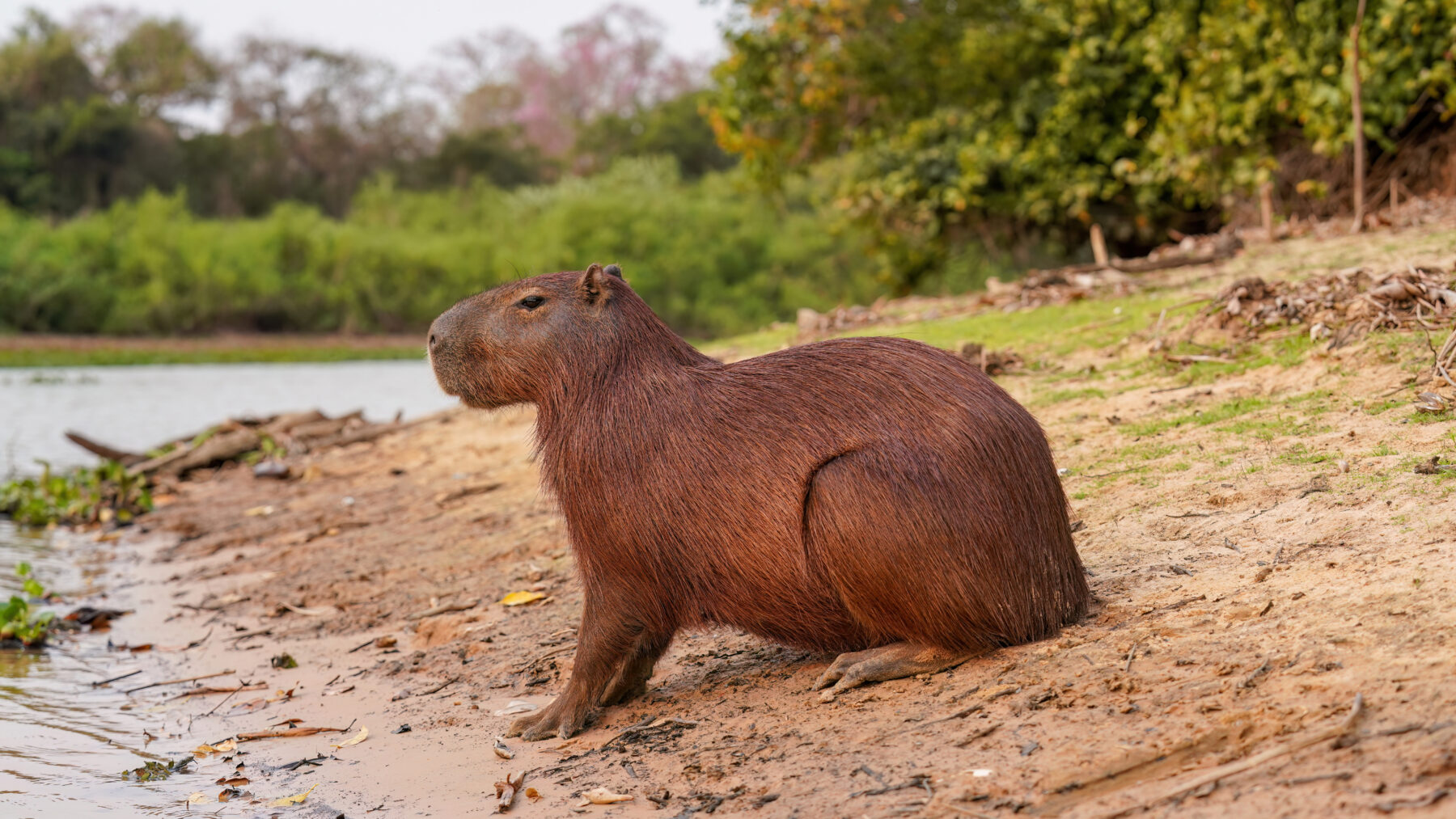
No living rodent is as large as the capybara (Hydrochoerus hydrochaeris). An adult weighs between 35 and 66 kilograms and measures 1.06 to 1.34 meters in length, according to the entry in the Animal Diversity Web, from the University of Michigan Museum of Zoology. It lives across much of South America, from Colombia and Venezuela to Uruguay and Argentina, always near water, and the International Union for Conservation of Nature (IUCN) classifies it as Least Concern, the lowest-risk category.
In Spain it is known as capibara; in Argentina, as carpincho; and in Colombia, as chigüiro. It belongs to the same family as guinea pigs and maras, and its living closest relative is the moco (Kerodon).
| Data | Capybara |
|---|---|
| Scientific name | Hydrochoerus hydrochaeris (Linnaeus, 1766) |
| Weight | 35–66 kg in the wild; up to 100 kg in captivity |
| Length | 1.06–1.34 m |
| Height at the shoulder | Up to about 60 cm |
| Lifespan | About 6 years on average in the wild (up to 10); up to 12 in captivity |
| Group size | From 3 to 30 animals, typically around 10 adults |
| Young per birth | 2–8, average 4 |
| Gestation | About 150 days |
| Predators | Jaguar, green anaconda, spectacled caiman, and humans |
| IUCN status | Least Concern (2016 assessment) |
Sources: University of Michigan, Christiane Denys (weight in captivity), Mammal Diversity Database and IUCN.
Females tend to weigh somewhat more than males. In a study of 39 wild capybaras in an agricultural area of eastern São Paulo (Brazil), adult males averaged 54.1 kilograms and females 62 kilograms (Ferraz, Bonach and Verdade, Biota Neotropica, 2005); it is a single site, so it serves as an example rather than a rule. In captivity, they can reach up to 100 kilograms, according to Christiane Denys, emerita professor at the French National Museum of Natural History, in a August 2025 article in The Conversation. Their fossil relatives were larger: Phugatherium and Protohydrochoerus, which lived between 4 and 2.5 million years ago in present-day Argentina and Bolivia, could weigh between 110 and 300 kilograms, depending on who does the calculation.
Where it lives and what it eats
The Mammal Diversity Database, run by the American Society of Mammalogists, places it in Argentina, Bolivia, Brazil, Colombia, Ecuador, French Guiana, Guyana, Paraguay, Peru, Suriname, Uruguay and Venezuela. Panama is not on the list, because there lives another species, the lesser capybara (Hydrochoerus isthmius).
Within that map, look for wetlands: river and lake shores, estuaries, and marshes with nearby grasses. Water is its refuge. It has membranes between the toes, it swims and dives well, and when a predator appears the group raises alarm cries and dives into the water, explains Denys.
It is herbivorous. It feeds on grasses, aquatic plants, and seeds, and occasionally bark and fruit. Its teeth are hypsodont (high-crowned) and have no visible roots. In addition, it re-ingests part of its own feces, like rabbits, in order to better extract nutrients from its food. The Argentine Ministry of Environment indicates that it feeds mainly at dusk and at night, though the schedule shifts with the location: it can be diurnal or nocturnal depending on hunting pressure or the season, adds Denys.
A male in charge and groups of up to 30
Like flamingos, another species that lives in groups in wetlands, the capybara lives in herds, usually with one male and several females. Denys explains that the dominant male defends a territory of between 10 and 200 hectares, and that density can reach up to 15 animals per hectare. In reproduction, sources do not fully agree: Michigan lists one litter per year of 2 to 8 offspring, with weaning at three months and maturity at 18, while Denys mentions up to two litters per year of 3 to 5 offspring and maturity between 14 and 18 months.
Why it seems friendly with everyone
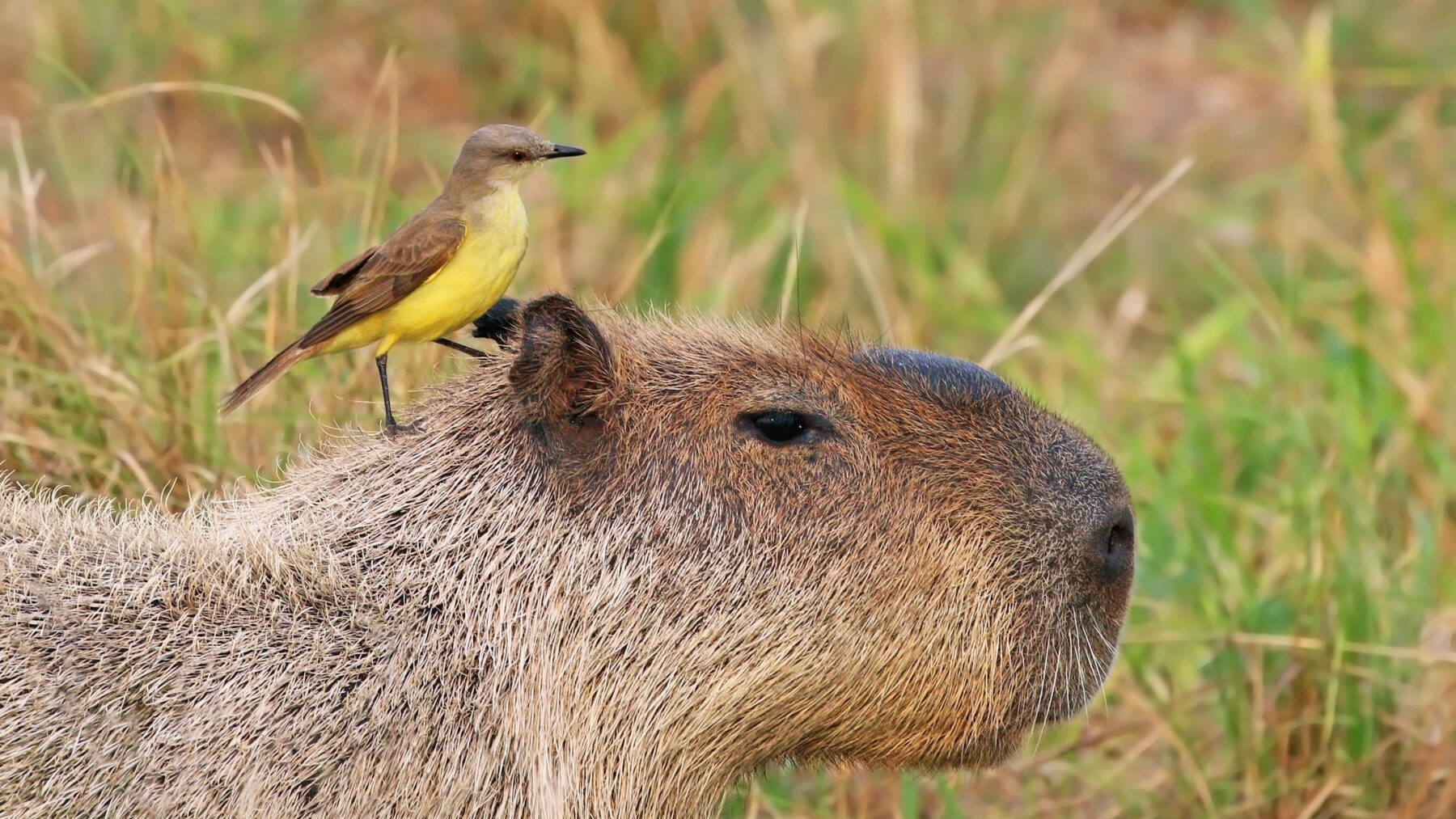
There are many images of capybaras lying beside caimans or with birds on their backs. Studies on how they respond to predation risk point to risk management rather than friendship.
A 2022 study in Animal Behaviour compared capybaras from the Brazilian Pantanal, where jaguars and caimans are abundant, with those from the Iberá Marshes in Argentina, where large predators disappeared by the mid-20th century. The Pantanal capybaras formed smaller groups, spent more time eating, and stayed closer to water, their escape route (Avila et al., 2022). The authors propose that selecting safe sites is what reduces their risk.
In the southern Pantanal, moreover, jaguars hardly prey on them. Ten jaguars tracked with GPS collars between 2001 and 2004 killed 438 prey: 31.7% cattle, 24.4% yacarí caimans, 21% peccaries, and only 2% capybaras (Cavalcanti and Gese, Journal of Mammalogy, 2010). There they preyed on yacarés more than ten times as often as capybaras.
With caimans there is more of a truce. Zoologist Elizabeth Congdon, of Bethune-Cookman University, explained to Earth.com that it is very rare to see a crocodile or caiman hunt a capybara in the wild, because a healthy adult does not offset the risk of being injured. The young are vulnerable, and indeed the spectacled caiman is listed among capybara predators in Michigan. We discuss this in more detail in the piece about why a capybara can sleep beside a crocodile without incident.
Birds that perch on its back are not exactly friends either. Sazima and Sazima described jacanas, thrushes, cattle tyrants and caracaras removing ticks and horseflies from capybaras, and one even laid on its side to be cleaned (Biota Neotropica, 2010). The study speaks of a cleaning symbiosis and does not measure whether the capybara gains, which would be necessary to talk about mutualism, the relationship in which both species benefit. Its reputation as a peaceful animal says more about how shore-sharing species coexist than about its own character.
Neither aggressive nor a good pet
It is not an aggressive animal. When threatened, its first instinct is to flee, though it can attack if cornered or if it defends its offspring, as documented by Mongabay Latam in a August 2021 report. In that same piece, the president of the Argentine Society for the Study of Mammals (SAREM) warned that it can serve as a reservoir for diseases such as brucellosis and leptospirosis, so direct contact is not a good idea.
Having it at home is also not advisable. Denys speaks of a “capibaramania” on social media since 2020, with capybaras kept as pets in China, Canada, or Russia, and she argues that that resembles mistreatment, since the animal needs a lot of space, water, and to live with others of its kind. That fame, fed by its calm appearance, has made it a very popular animal, much as the axolotl is in Mexico.
Least Concern, according to the 2016 assessment
The capybara is not endangered. The IUCN assessment on file, signed by F. Reid, is from 2016 and places it in the Least Concern category. Denys maintains that wild populations do not appear to be shrinking, but lists threats: hunting for meat and skin (breeding farms alleviate some of that pressure), the decline in rainfall since 2020, Pantanal fires, deforestation in the Llanos, and hydroelectric dams that dry out some areas. The Argentine ministry adds that it has declined in some regions due to hunting pressure and that populations are often affected by infectious and parasitic diseases. Hunting and wetland loss were already reviewed on the occasion of Capybara Appreciation Day 2026.
Nordelta, the neighborhood built on its wetlands
In Argentina, the carpincho has become famous for Nordelta, a complex of gated communities in Tigre, north of Buenos Aires, built since 1999 on top of a wetland. The capybaras did not arrive there; they were already there. In 2021, specialists from CONICET and the University of Buenos Aires, with the endorsement of SAREM, reminded that the neighborhood lies within the species’ original range, in “one of the most suitable habitats,” and attributed the increase in sightings to the low foot traffic during the pandemic, the Paraná’s lower water level, the Delta fires, and the lakes and lawns of the neighborhood itself. Their recommended approach was not to relocate them, as that is complex and costly, but to install signs, cameras, berms, fences to protect pets, and grassy zones.
The population has grown since then. The cumulative environmental impact study of Nordelta, led by Daniel Loponte, counted 266 capybaras in 2021 and 803 in 2025, and warned that they might be approaching what the system can sustain. In January 2026, biologist Ignacio Crudele (CONICET) spoke of more than 700. Here is how the conflict has progressed:
- 2025. A pilot relocation of about 70 animals to a 60-hectare reserve on an island in the Delta is announced, with contraceptive vaccines delivered by darts. Environmental organizations reject it.
- October 2025. Judge María Paula Venere, of San Isidro, overturns Judge Guillermo Ottaviano’s injunction that halted works, fumigation, and chemical castration, and speaks of “overpopulation.”
- January 12–13, 2026. A Flora and Fauna operation of the Buenos Aires province begins in Barrio Silvestre to capture capybaras and transport them to a private reserve in Tigre. According to the protectors, on January 13 six were removed, three females and three males; there are no official data because the monitors were not present.
- January 16, 2026. The San Martín Administrative Litigation Chamber, after an appeal by the Callejero Casa Quiere association, bans new relocations until there is an accumulative environmental impact study, according to Cadena 3 that day.
- August 2026. Public hearing on that study, opened by the Tigre Government Secretariat, with more than 40 speakers. Most criticize the urbanization’s effect on the wetland and call for greater protection of capybaras; others, including some neighbors, raise concerns about population growth and accidents.
The account of that hearing records no decision. As of October 29, 2026, that is the most recent information we could verify, and the last judicial decision we could confirm is the ban on new relocations from January 2026.
