
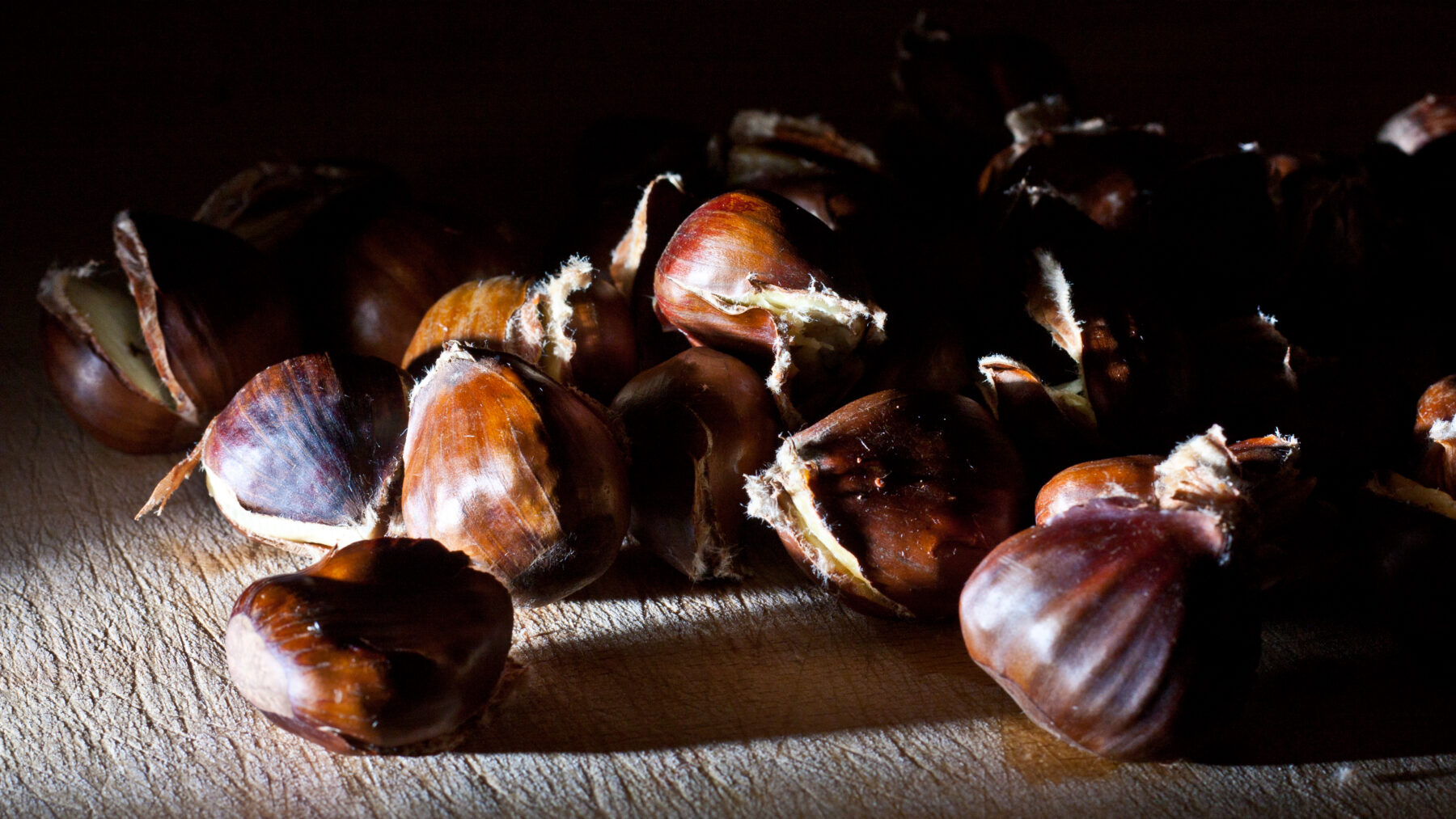
Chestnuts arrive at the table at the end of October because that is when the fruit of the chestnut tree (Castanea sativa) matures and falls to the ground, and several Spanish regions have turned that harvest into a festival with its own name. In Catalonia it is the castanyada (castanyada), the night of October 31, the eve of All Saints’ Day. In Galicia it is the magosto, which in Ourense has its big day on November 11, Saint Martin. In Asturias it is the , which does not have a fixed date. Behind the three there is a harvest that in 2024 reached 92,350 tonnes in Spain, about four out of five gathered in Galicia, according to the data from the Ministry of Agriculture published by Mercasa in its Alimentación en España report.
The Castanyada, a Feast for the Dead That Moved to October 31
The Gran Enciclopèdia Catalana defines the castanyada as a “meal of chestnuts, normally roasted,” i.e., a chestnut meal, almost always roasted, and it links it to the night of All Saints. Its origin is more deeply rooted than the current festival would suggest. It used to be a family dinner held after the November 1st evening meal, accompanied by the rosary for the departed, and over time it was brought forward to the night of October 31, which is what is celebrated today (although there are also castanyadas on November 1). By the end of the eighteenth century it was already widespread.
On the table, chestnuts share the scene with roasted sweet potatoes (moniatos) and with panellets, those almond sweets of the season; if you want to make them at home, here is how to make panellets. For drinks, tradition prescribes sweet wines, rancio or cava. By the end of the twentieth century Halloween arrived, and the encyclopedia notes that today the two celebrations coexist on the same night. The date is not accidental, since the castanyada is the eve of All Saints’ Day; anyone seeking the religious and historical context can read why November 1 is All Saints’ Day.
Be wary of something that is repeated often: the idea that castanyada descends directly from a Celtic festival such as Samhain. It is a popular interpretation that sources do not share, so at best it should be read as a hypothesis.
Magosto and Amagüestu: Chestnuts by the Bonfire
In the northwest, the chestnut leaves home. The Galician magosto is a gathering around the fire where chestnuts are roasted to be eaten in company, and it does not have a single fixed date. The best known is the one in Ourense, linked to Saint Martin. According to the Festivals of Spain calendar, in 2026 it will be celebrated from November 8 to 11, with the main day on Wednesday 11 and free chestnuts distributed from 18:00 hours, and it has been a Festa de Interés Turístico de Galicia since 2008 (it is advisable to confirm schedules in the official Concello de Ourense program, which by the end of October 2026 had not yet been published).
The Asturian amagüestu, according to Tourism Asturias, is the festive and communal roasting that follows the “gueta,” the local name for chestnut gathering. It is accompanied by seasonal sweet cider or “duernu.” It does not have a fixed date, and amagüestu celebrations take place throughout autumn.
Thus, the difference between these celebrations lies more in the mood than in the fruit: the castanyada revolves around panellets and sweet wine, while magosto and amagüestu are gatherings by a fire with freshly roasted chestnuts.
How Many Chestnuts Are Produced in Spain, and Why the Figure Fluctuates So Much
The 92,350 tonnes recorded in 2024 were distributed as follows, according to the Ministry of Agriculture’s table cited by Mercasa: Galicia, 73,420; Castilla y León, 9,400; Extremadura, 6,700; Andalusia, 2,200; and the remaining regions, about 600. Galicia accounts for around 80% of the total (a rough calculation from that table). The same Mercasa report states in its narrative that production is concentrated “primarily in Andalusia and Galicia,” but its own table contradicts this: Andalusia is the last of the large producers.
The harvest depends greatly on the year. In 2023 only 32,600 tonnes were gathered, 81% less than the 174,000 of 2022, and in 2024 it recovered somewhat. Therefore any production figure must be read in the context of the year to which it refers (the 2025 figure has not yet been published). In 2024 Spain had a total of 25,251 hectares of fruit chestnut trees; exported 11,360 tonnes of chestnuts (with and without shells) and imported 3,730. Globally, 2.7 million tonnes were produced, and in the European Union 390,000, according to FAO, Eurostat, and the ministry cited by Mercasa.
Not all of those chestnuts end up roasted in a cone. According to Mercasa, they are mainly destined for animal feed, while the healthiest fruits go to direct consumption or are transformed into dried chestnuts (pilongas), jam, or marron glacé.
There are chestnuts with a quality seal, though not always the one attributed to them. The IGP Castaña de Galicia is the protected geographical indication for the sector. The Castaña del Bierzo, however, is not an IGP, but a brand of guarantee. According to the characteristics published by Alimentos de Calidad del Bierzo, it covers the entire comarca and Castrillo de Cabrera, accepts all varieties and only allows collecting naturally fallen fruit, with a minimum weight of 7 grams per chestnut and a maximum moisture of 60% at harvest.
How to Roast Chestnuts in the Oven Step by Step
The Directo al Paladar recipe sums up the most reliable home method:
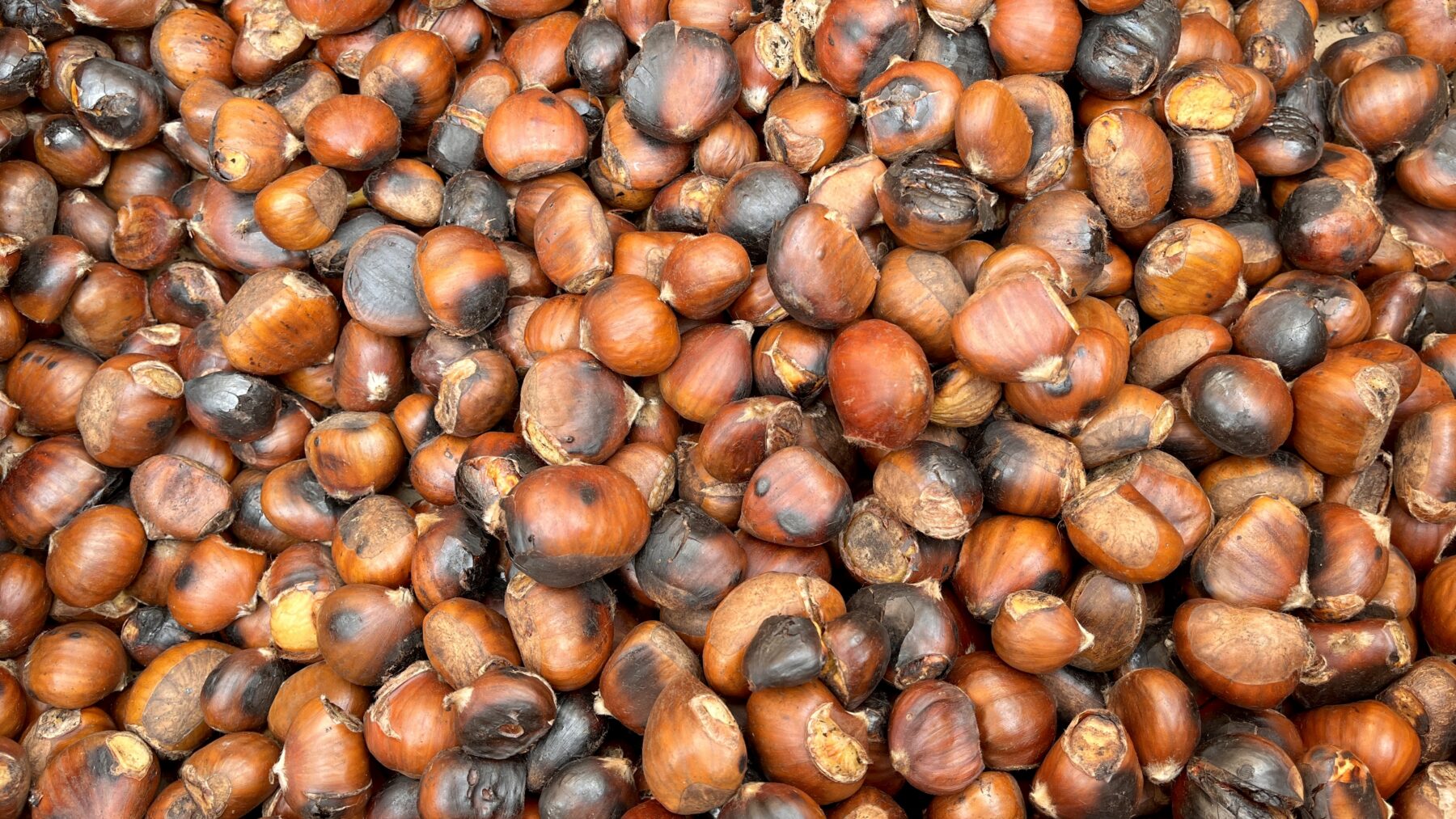
- Preheat the oven to 200 °C (180 °C, without fan, if yours is very powerful).
- Make a small cut on each chestnut, or a cross, only in the outer skin. Without that cut, the steam inside will make them burst.
- If you like, soak them for 15 minutes to an hour before putting them in; optional.
- Place them in a single layer on a baking tray, on the central rack of the oven, for 15 to 20 minutes. Start checking at 15 and don’t go past 20, because they harden.
- Peel them while hot, as that is when the skin and the inner membrane detach most easily.
In a skillet or in an air fryer the principle is the same: cut into the skin, high heat, and move them around so they cook evenly. The times vary a lot depending on the appliance and the size of the fruit, so the rule of thumb is to look for the skin opening and the tender pulp when pierced.
To store them, raw chestnuts keep in the fruit compartment of the fridge; it is advisable to buy them without mold or worms and check them from time to time. Any roasted chestnuts that remain can be kept for a few days in an airtight container in the fridge. If you are curious about their nutritional value, you can find it in this article on the properties of the chestnut.
