
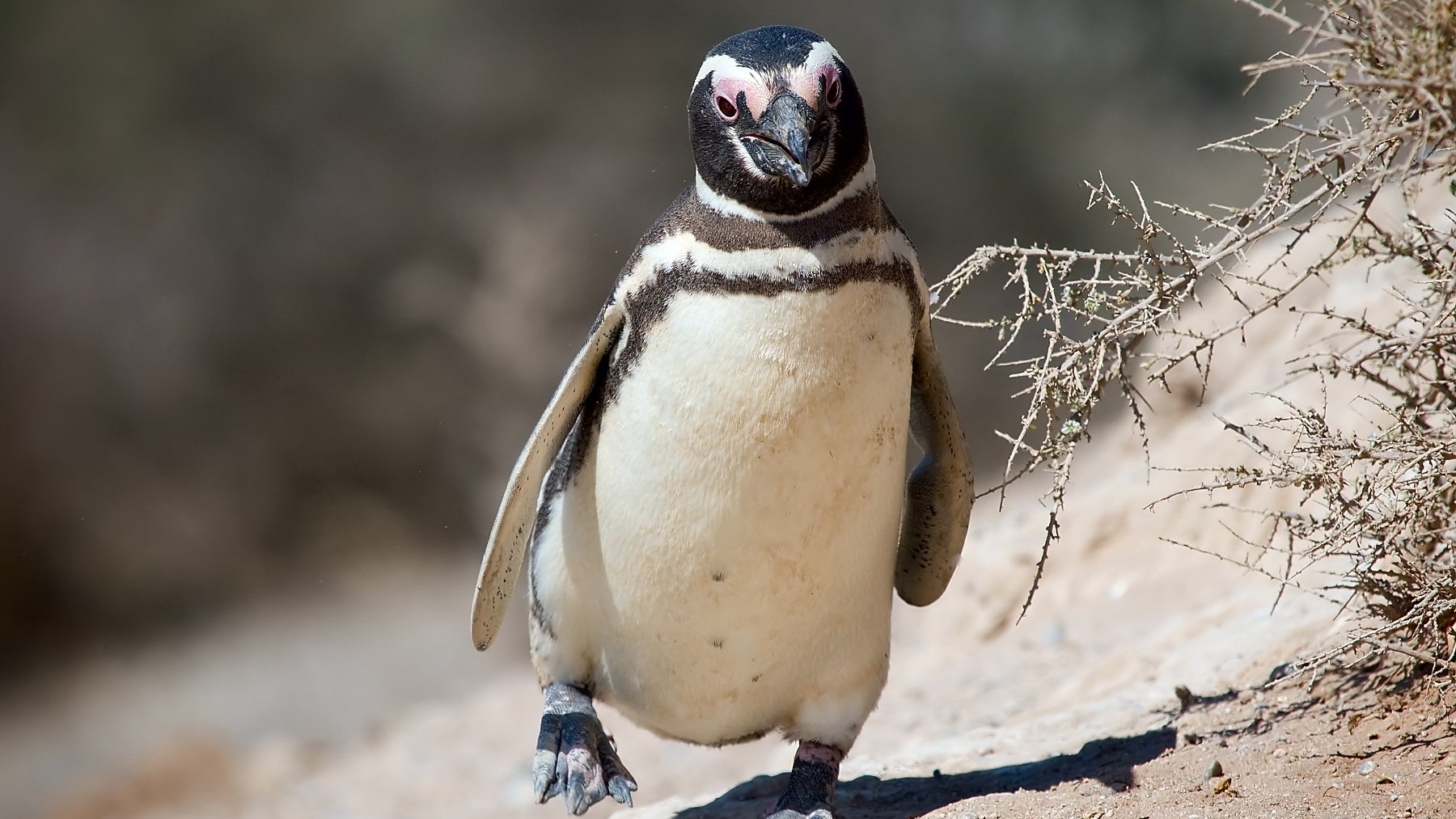
In Coquimbo, Chile, recovering penguins wear red suits embedded with copper and zinc particles. The garments aim to protect the wounds after surgery and prevent the birds from pulling out stitches with their beaks. The effort is a collaboration between Humboldt Conservation, the Catholic University of the North, and the textile company Kimba Vet.
The experience as reported by Reuters includes five Magellanic penguins, four of them with injuries apparently linked to fishing nets. The approach combines a physical barrier with a technology intended to aid healing, though its effectiveness in these birds remains under evaluation. The challenge is to get them back to the sea in good condition.
The problem after surgery
Closing a wound is only part of the work. Tomás Pino Damke, a veterinarian and president of Humboldt Conservation, explains that these animals have very flexible necks and can reach the operated areas with their beaks. Thus, a sutured area can end up open again.
Some specimens arrive with serious injuries that require cleaning and surgery. After that, the area must be protected during recovery, when the animal’s own behavior can hinder healing. That everyday problem became the starting point for the suit.
A design for two legs
The idea comes from garments used for dogs and cats during postoperative care. However, the change in anatomy required modifying the design because the penguin’s posture presents a different securing challenge.
Pino explained to Cooperativa Ciencia that, in four-legged animals, the suit is held in place more easily. In penguins it tended to slip downward, so the pattern had to be adjusted to keep the protected area covered.
The team worked with photographs and size references to measure the neck, flippers, and tail. Buin Zoo aided in the initial fitting tests before its use at the rescue center. A useful garment had to adapt to the patient.
What the metals contribute
Although the outfits are described as copper suits, they resemble fabric in appearance and are red. Microscopic copper and zinc particles are embedded in the fibers, inside the thread, rather than forming a superficial coating.
Estefanía Guidotti, head of marketing at Kimba, attributes to this technology properties that help control bacteria, fungi, and mites. She also explains that zinc promotes the formation of new blood vessels, a process related to repairing damaged tissue.
These explanations describe the benefits the company hopes to harness during rehabilitation. Guidotti herself told Reuters that applying this to penguins starts from a hypothesis they are testing, after prior experience with mammals.
Five initial patients
The veterinary technique by Yubisa Torres told Reuters that the five animals in this trial were Magellanic penguins. Four had arrived with wounds seemingly caused by human activity, probably entanglements in fishing nets.
The center also treats Humboldt penguins, but they are a different species. Identifying the patients helps understand to which animals the initial observations refer and how far the learning may go for now.
What remains to be verified
Humboldt Conservation states clearly on its official website: «The project is in the development and evaluation stage,» acknowledging that tests remain to determine its real reach in rehabilitation.
Public information about the project does not offer a comparison that would allow calculating how many days of recovery would be saved thanks to the suit. Therefore, it still cannot quantify an improvement over standard care.
To assess that potential benefit, it would be necessary to distinguish the garment’s effect from the rest of the veterinary treatment. It would also be necessary to consider the severity of each injury and how each patient progresses. These are issues that future evaluations will need to clarify.
Recovery to return to the sea
Another practical advantage highlighted by Pino is to facilitate wound care and reduce handling of the animals. As he explained to Cooperativa Ciencia, removing the suit, attending the wound, and reapplying it simplifies work that previously required complex bandaging.
The center also treats Humboldt penguins, a species particularly threatened in Chile. Its national classification as «Endangered» was officially formalized by a decree published on March 5, 2026.
«The ultimate goal is to release them,» Pino told Reuters. Official information about the development and evaluation of these suits is published on the Humboldt Conservation website.