
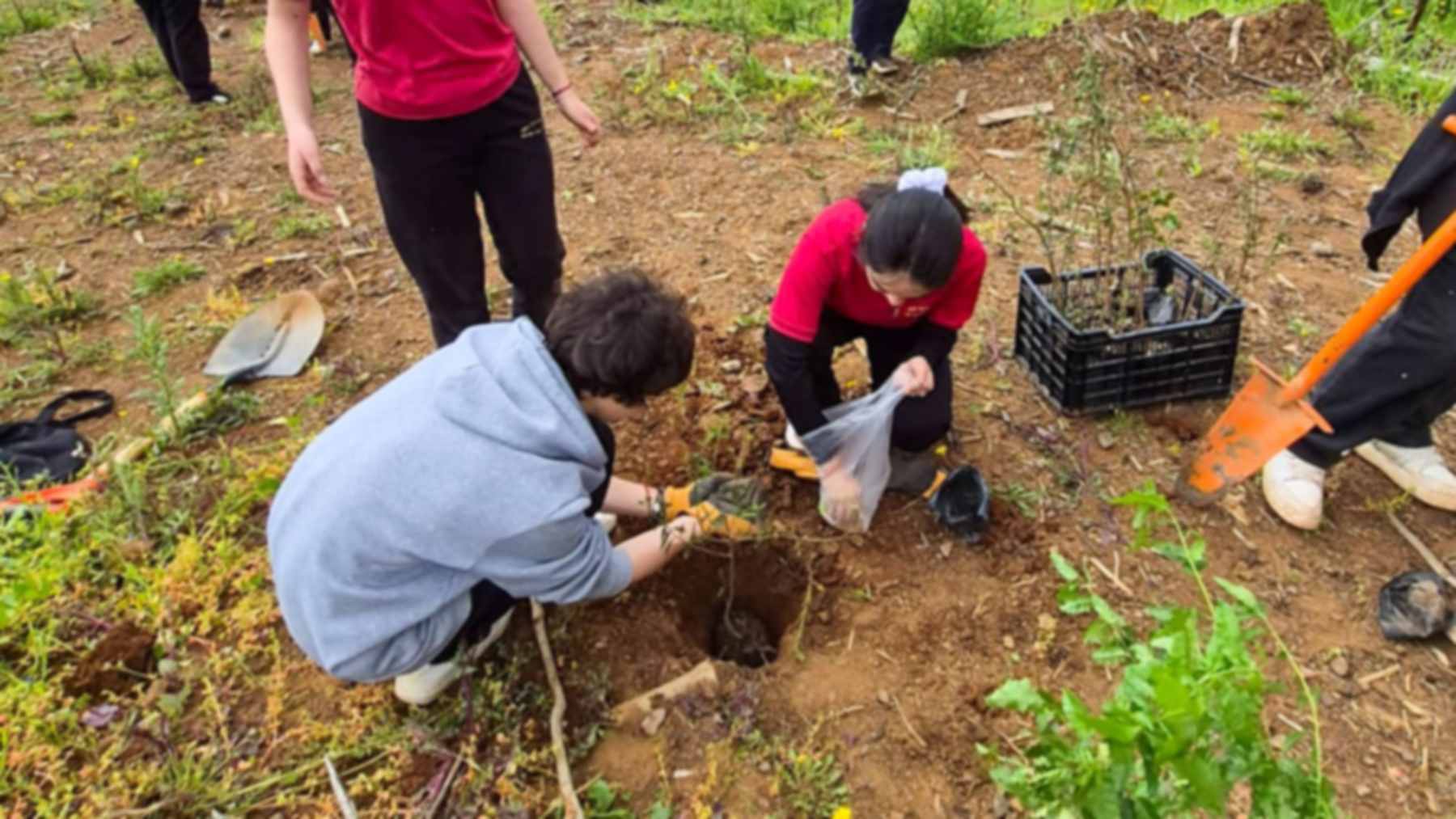
Altos de Ninhue, a dry-hilled area in Ñuble, Chile, has already surpassed 300 trees planted to recover its native forest. The latest push arrived on Tuesday, October 27 at Fundo Curahuén. There, students from the forestry branch of the Arturo Prat Chacón Bicentennial High School planted about 120 specimens, according to Chile’s Ministry of the Environment.
Far from being a lone planting, this marks the fourth volunteer cycle of the Landscape Restoration Project funded by the GEF. It aims to revive life on degraded lands in a municipality with scarce water and high fire risk. And the trees chosen carry names that sound unusual outside Chile.
Espino, litre, quillay and peumo
The youths are in first and second year of secondary school (the start of Chilean high school). They planted Espino, Corcolén, Litre, Huingán, Quillay, and Peumo. These are species from the sclerophyll woodland of the interior drylands of Ñuble, i.e., trees and shrubs with tough leaves that endure long summers and scarce rainfall.
Why these and not others? Because they are the typical species of this corner of Chile’s drylands, the ones the landscape recognizes as its own. According to the ministry, the idea is to enrich the vegetation in damaged areas so that they recover.
This forest has suffered for years, as we’ve already noted when discussing Chile’s sclerophyll forest and its struggle with drought. The saplings were donated by the NGO Núcleo Nativo. The land belongs to the Curahuén Sanctuary Foundation.
Four cycles on the same site
Those more than 300 trees have been added across several mornings of work. On September 5, a community day with neighbors and volunteers left around 120 specimens on the same site.
On October 13, students in the third and fourth year of a high school in neighboring Quirihue, Carlos Montané Castro, arrived. They planted another 120 trees in the third volunteer cycle and received a certificate for their work.
After the session on October 27, the ministry counts more than 300 trees in the sector. The three publicly disclosed sessions each hovered around 120 specimens. Little by little, the slope is changing color.
A municipality with little water
Ninhue is not an ordinary place to plant. María Soledad Ruiz Pinto, the municipal administrator, spoke on behalf of the mayor and summed it up plainly: “Ninhue faces a critical water shortage and risks such as forest fires and mass movement events,” she explained.
Chile knows well what that means after this year’s forest-fire catastrophe. That is why the ministry emphasizes native forest. It protects the soil, regulates the water cycle, and helps endure drought and other extreme episodes.
Ñuble’s regional Environment Secretary (seremi), Angélica Cuevas Palominos, also focused on climate. For her, “recovering our native vegetation is essential to strengthening biodiversity” in a region as exposed as Ñuble.
Students with shovels and gloves
The day had a touch of outdoor classroom. María de los Ángeles Tapia Romero runs the school’s Ecology workshop. She said, “the kids leave incredibly proud of what they did.”
For Cuevas, restoration “requires continuity and, above all, community participation.” In practice, a forest does not return with a single day’s photo, but with years of care. A similar trend has been observed in Argentina, where 20,000 native trees are returning to Chubut.
A project through 2028
Behind these days there is a much larger international project. It is funded by the Global Environment Facility (GEF) and implemented by FAO, together with the ministry and CONAF. It runs from February 2023 to February 2028, with seven pilot landscapes in Chile’s Mediterranean zone.
Two of those landscapes are in Ñuble. One is Altos de Ninhue, comprising Ninhue, Quirihue, San Nicolás, and San Carlos, and the other is Cayumanque, including Quillón, Ránquil, and Florida (this one already in Biobío). In both, local restoration plans with residents are being prepared.
How many trees will survive
One question remains that the official note does not answer. It does not say how many trees remain alive or how many hectares have been restored. And in a dryland, the first summers are the harshest for a sapling.
The note also does not clarify how many sessions remain this year. What it does make clear is that this is a long-term effort. It is about returning the landscape to its ecological functions with the help of those who live there.
The official statement about the planting has been published on the Chilean Ministry of the Environment’s website.
Foto: Ministerio del Medio Ambiente de Chile
