
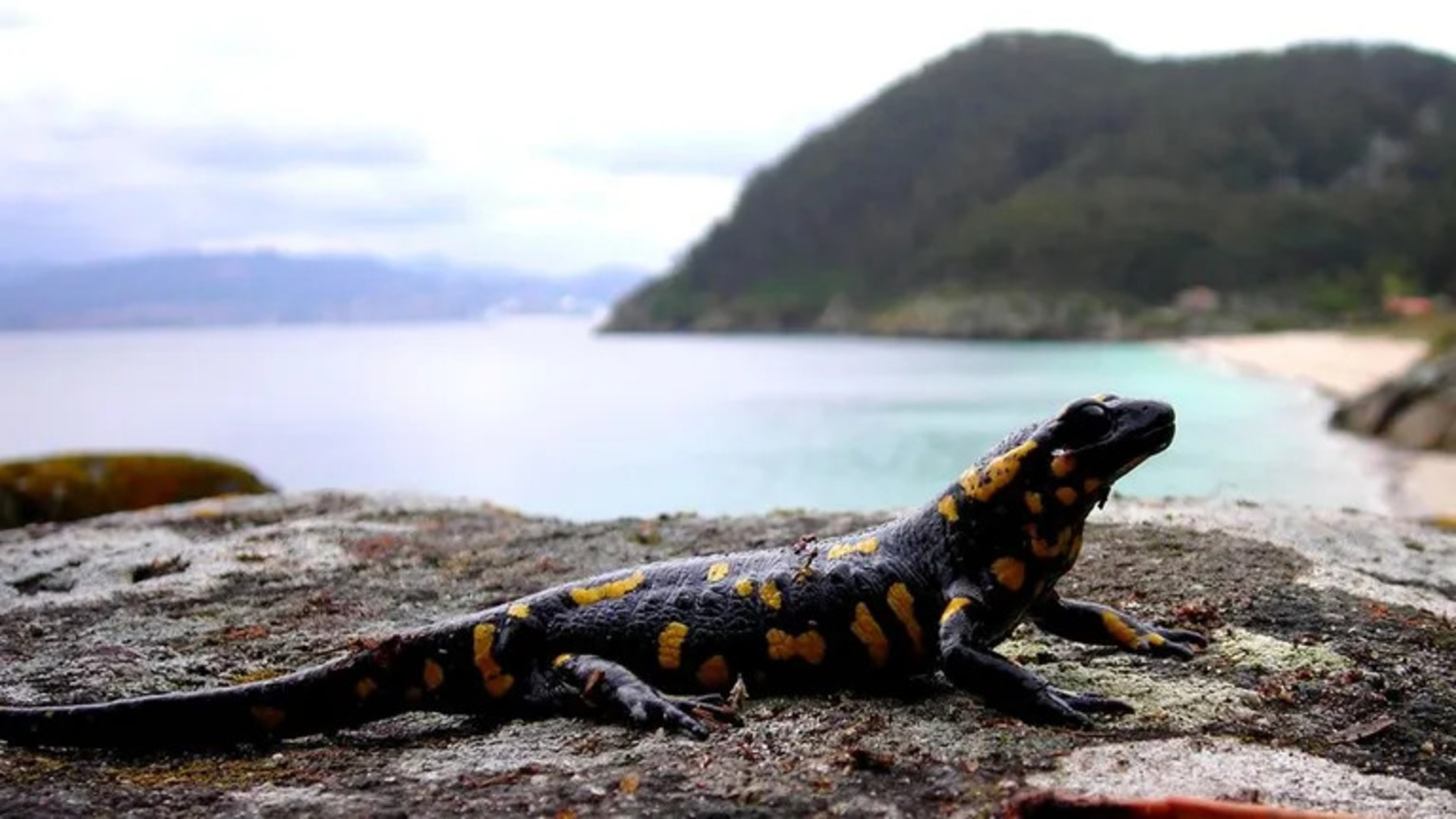
The salamanders of the Cíes and Ons islands are making headlines for having shaped a reproductive strategy hitherto unseen, through which they are able to produce offspring that are fully formed and adapted to terrestrial life.
A surprising finding as part of a study involving the University of Vigo, which has noted changes in the activity of maternal genes in the uterus. And this is precisely what aids the development of the offspring before their mothers give birth.
The study, published in the journal Molecular Ecology, analyzes populations of the common salamander from Ons and San Martiño, in the Cíes archipelago. “Using high-throughput RNA sequencing techniques, the research team has detected coordinated changes in gene expression, increased vascularization of the uterus, and activation of the MCM6 gene, related to the acceleration of embryonic development,” explain its leaders.
This adaptation enables salamanders to complete the development of their offspring without relying on water for the larval stage, a significant advantage in island environments. Undoubtedly, these are important conclusions that help to thoroughly understand how modifications in maternal gene activity can favor the evolution of new reproductive strategies.
The Galician salamanders
A scientific study in which the University of Vigo participates has revealed the keys to a unique evolutionary adaptation of the salamanders of the Cíes and Ons islands, which are part of the Atlantic Islands of Galicia National Park (Parque Nacional Marítimo-Terrestre de las Illas Atlánticas de Galicia).
According to the Vigo academic institution in its official bulletin, EcoEvo group researcher Guillermo Velo Antón is one of the authors of the study that has managed to identify why the female salamanders of these islands give birth to individuals “completely formed and terrestrial,” rather than larvae, as happens in the ancestral reproductive mode of this species.
This evolutionary adaptation also occurred “independently,” on each of these islands as well as along the Cantabrian coast, making the common salamander the only amphibian species in the world with two reproductive modes arising at different evolutionary times.
This has allowed the research team to identify, using high-throughput RNA sequencing techniques, “evolutionary convergences” in this adaptation to the terrestrial environment, which enables salamanders to “colonize or persist in habitats without available bodies of water.”
The results of this research are presented in an article published in the scientific journal Molecular Ecology, with Guillermo Velo and Kevin P. Mulder, from the Center for Biodiversity and Genetic Resources at the University of Porto (Cibio), as the lead authors.
“This work demonstrates for the first time that the shift from bearing aquatic larvae to terrestrial offspring can be regulated by changes in the expression of maternal genes in the uterus,” notes the EcoEvo group researcher, based at the School of Forestry Engineering and professor at the Faculty of Biology.
Results of a line of work started nearly a decade ago, this study also involved researchers from the Doñana Biological Station (CSIC), from Cibio, the Autonomous University of Madrid, the Smithsonian Conservation Biology Institute, and the Columbia University Museum of Natural History.
As Velo Antón recalls, most amphibians have a “dual life cycle,” in which females lay eggs or larvae in water, “where they grow before transforming into terrestrial adults.”
The evolutionary innovation of salamanders
This evolutionary adaptation likewise occurred “independently,” on each of these islands as well as along the Cantabrian coast, making the common salamander the only amphibian species in the world with two reproductive modes that arose at different evolutionary times.
In contrast, Salamandra salamandra and its sister species Salamandra algira are the only amphibians with variation in reproductive mode within the same species, since there are cases where females entirely skip the aquatic phase.
Moreover, the common salamander is the only species in which this “adaptive innovation” developed independently in different times and places, making them “a truly exceptional study system”, as acknowledged by the UVigo researcher.
This phenomenon occurred, on one hand, in the mountains of the northwest Iberian Peninsula during the Pleistocene and, much more recently, in the subspecies Salamandra salamandra gallaica, whose continental specimens give birth to larvae, while the island populations of Ons and San Martiño give birth to terrestrial offspring.
It identified, explains Velo Antón, “key genes that change their activity in the uterus in a coordinated way,” and, specifically, the study’s conclusions point to, on one hand, greater vascularization and the activation of the gene MCM6, which contributes to accelerating development.
The genetic key does not necessarily consist of having new genes, but rather in how existing ones are used differently. Studying their expression reveals which genes increase or decrease their activity during gestation. This difference helps explain the finding: the maternal uterus participates in the conditions that allow development to be completed before birth. Comparing populations that give birth to larvae with those that give birth to terrestrial offspring can help identify which changes make that transition possible.
