
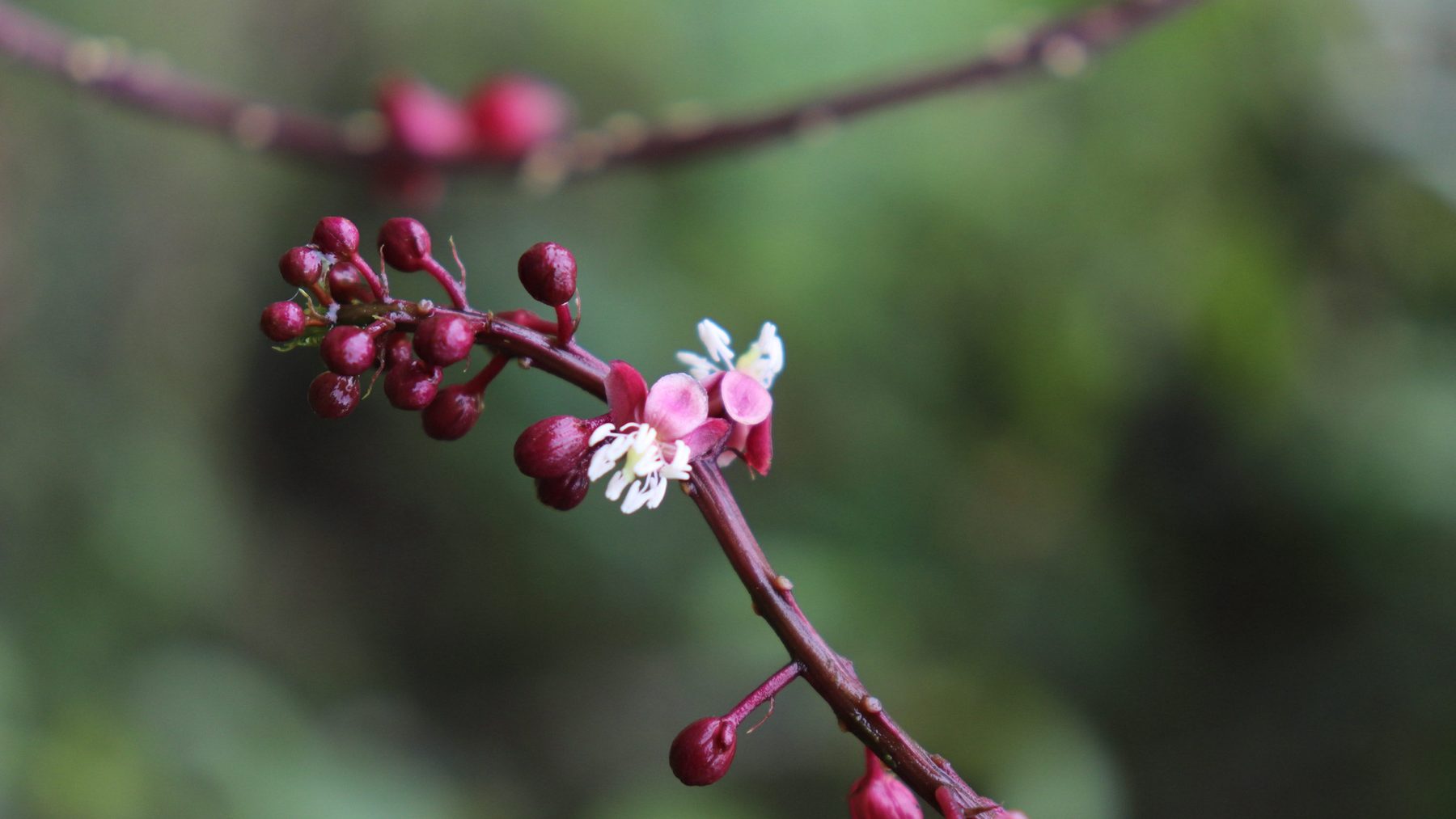
A new shrub species bearing reddish-magenta flowers has just entered botanical catalogs, currently known only from Cueva de los Guácharos National Natural Park, in southern Colombia. It is named Trichostigma guacharense, grows to about three meters, and its description appeared on October 23, 2026 in the journal Brittonia.
Colombia’s National Natural Parks announced the finding on November 3 in an official note, but the oldest specimens date back to 2009. How does a plant like this go so many years without a name? Perhaps it helps to know that its genus is little studied and that the last in-depth review dates from 1909.
Three meters tall, magenta-colored
This shrub grows in wet montane forests, between 1,800 and 2,150 meters in elevation and near mountain streams. Its leaves can reach up to 25 centimeters in length. But what really grabs the eye dangles from the branch tips.
They take the form of clusters that typically measure 30 to 40 centimeters and, according to the scientific description, can stretch to about a meter. Among its climbing relatives, the diagnostic characters usually leave them between 5 and 25 centimeters. In other words, they do not go unnoticed.
However, what appear to be petals are not. The flowers in this group lack petals, and the color is produced by four sepals of about six millimeters. Inside, pale anthers peek out, and later comes a fruit in a very dark purple shade.
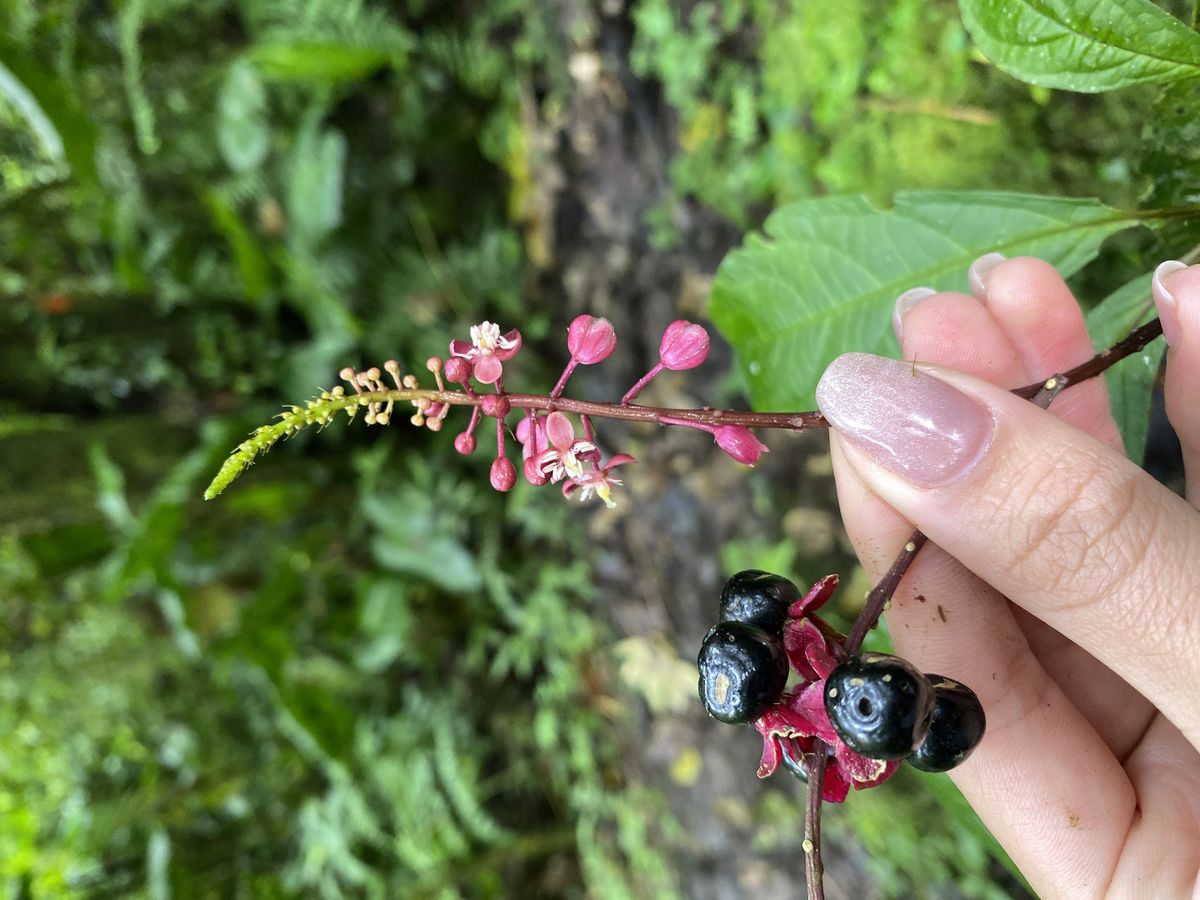
Specimens preserved since 2009
In August 2009, Pablo Stevenson and his team collected a specimen with flowers and fruits within the park. It ended up in Colombia’s national herbarium and in another in Missouri. More than fifteen years would pass before the plant received a name.
The specimen that now serves as the official reference for the species was collected on March 24, 2024, along the Cristales cascade trail, at 2,150 meters. The work bears the signatures of Andrés Majín-Ladino, Alejandra Jaramillo, Laura Ramos, Gerardo Aymard, and Stevenson himself. The project involved Nueva Granada Military University and the University of the Andes, with assistance from park rangers.
Until now, the genus encompassed three accepted species, spread from Mexico to the Caribbean, Central America, northern Argentina, and the northwestern Amazon. There are more new plants in the Andean forests, and this park, according to the authors, remains only partly explored. And that is despite it having enjoyed protection for more than six decades.
A bird that laments
The epithet guacharense pays homage to the Cueva de los Guácharos National Natural Park, a 7,134.93-hectare expanse spanning Huila, Caquetá, and Cauca. Declared in November 1960, it was the country’s first protected area. Its raison d’être was a cave where the guácharo, a bird that lives in caverns, breeds.
According to the authors, Humboldt noted that the word guácharo roughly means “the one who cries and laments.” It is notable that a striking shrub inherits its name from a bird famed for that reputation. Colombia had already added other plant species in Nariño and Chocó, but this one carries its name in the species epithet itself.
Ten stamens and smooth leaves
Its closest relative is T. peruvianum, from the Amazon. The new species, however, has nearly hairless leaves, smooth racemes, and ten stamens instead of twelve. These are microscopic details, yes, but in botany they decide whether a plant is new or not.
In contrast to T. octandrum, the matter is easier still, because that one is a vine with white or green flowers. With its flexible stems, baskets are woven in Cuba and other parts of the Caribbean, though the article says nothing about uses for the Colombian plant.
For the National Natural Parks, findings like this demonstrate that protected areas “are not isolated borders, but living centers of research.” The agency frames it within the Government’s ABC Agenda, focused on water, biodiversity, and communities.
No data to classify its risk
With the available specimens, the authors estimate an extent of occurrence of 2.98 square kilometers and an area of occupancy of 8 square kilometers. These are two different IUCN metrics, so they do not coincide. And neither figure indicates how many individuals remain, only where they have been found to date.
Hence the preliminary assessment leaves the species as Data Deficient, because population size and trends are unknown. Within the park there is no clear evidence that deforestation is affecting it, but outside the park deforestation and the expansion of crops persist. Until someone counts them, no one can say whether they are safe, and Colombia already has other plants that are endangered.
The study has been published in the journal Brittonia.
Photo: Andrés Majín / PNN Cueva de los Guácharos
