
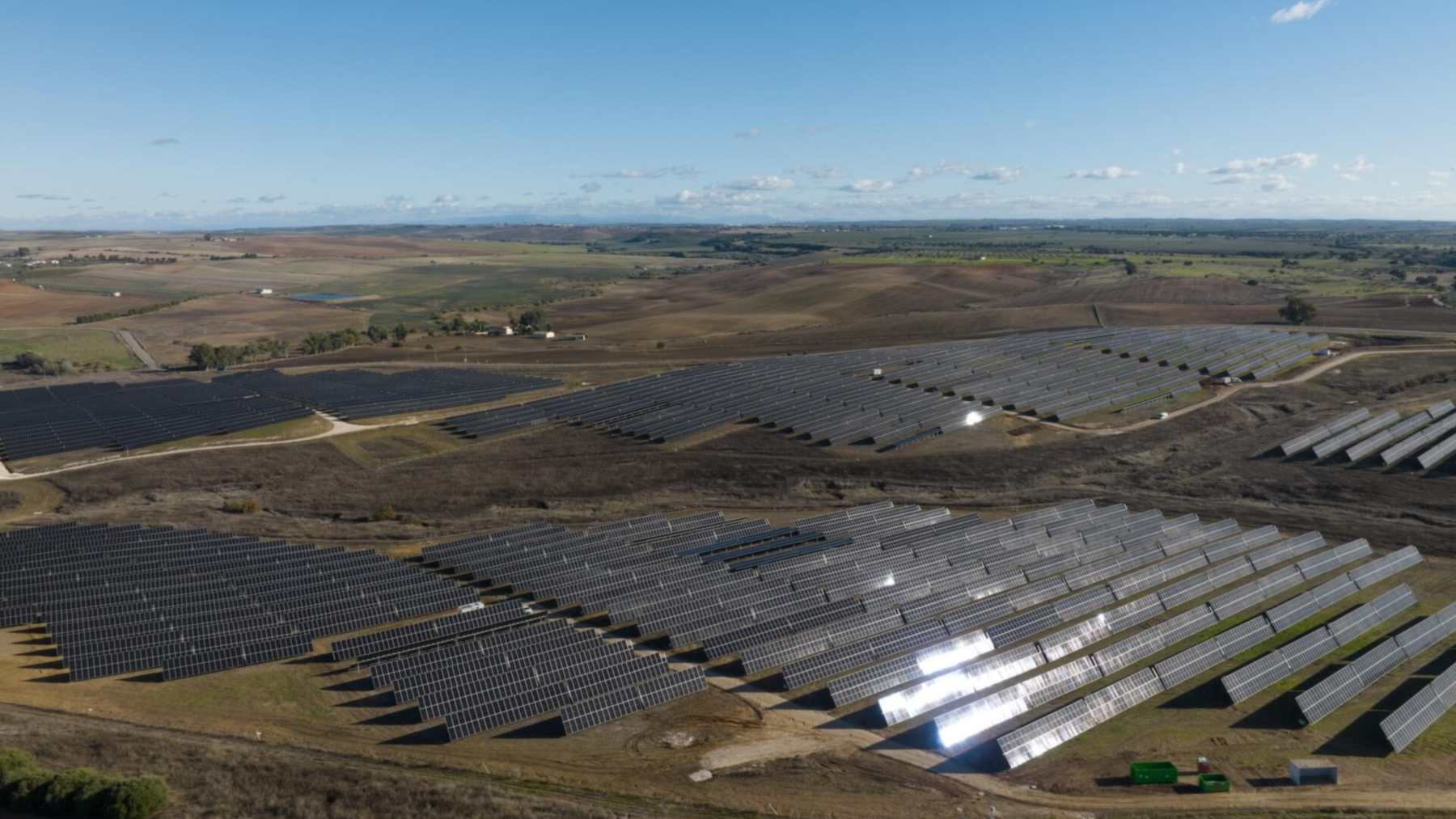
On December 3, 2025, a Nexwell Power drone flew over the Silverio photovoltaic plant in Guadalcázar, Córdoba, as workers finished assembling its rows of panels. Fifteen days later, the Andalusian regional government granted it final operating authorization, and in July 2026 it granted permission for it to become a hybrid solar plant.
The permit adds a lithium battery storage system that will be able to store 110.33 megawatt-hours (MWh) of gross energy, according to the resolution published in the Córdoba Provincial Official Gazette on August 25, 2026.
Nexwell Power, the plant’s owner company, asserts that it will be the first photovoltaic installation in the province authorized to hybridize with batteries. The company plans to connect the new storage module to the grid in the first half of 2027.
What the Junta Has Authorized in Guadalcázar
The resolution was signed on July 17, 2026 by Agustín López Ortiz, the Junta’s territorial representative in Córdoba, at the proposal of José María Pérez Gil, head of the Energy Service. It grants the preliminary administrative authorization and construction permit to Silver RIC Energy SL, the company listed as owner, for the project “HIB SILVERIO I.”
Hybridizing, in the language of the electricity sector, means adding to an operating plant another technology that shares its same connection point to the grid. Here it concerns a battery storage system that the file terms “BESS SILVERIO 1,” by its acronym in English.
The solar park is listed in the bulletin with 21.527 MW of installed capacity, 19 inverters, and 29.937 MWp in the panel field, totaling 35,100 modules of 678.5 Wp and another 9,099 of 672.8. Megawatt-peak measures what the panels deliver under standard laboratory conditions; the installed capacity is that of the 19 inverters, each rated at 1,133 kW, and that is why it is lower. Nexwell has presented it as a 26 MW plant.
Más de 110 MWh repartidos en 22 contenedores
According to the resolution, the storage system will have a nominal power of 23.63 MW and a “total gross storable energy” of 110.33 MWh, distributed across 22 containers and with five transformation centers. With the batteries included, the total installed capacity of the hybrid plant rises to 47.32 MW.
One megawatt-hour is the energy delivered by one megawatt of power for one hour. With the gross figures in the file, the batteries could discharge at full power for a little over four and a half hours.
The bulletin also notes a limit. Red Eléctrica de España updated on January 5, 2026 the access and connection permissions for the installation at the Almodóvar del Río substation, at 220 kilovolts, and granted it a capacity of 20 MW. That is the power the plant can inject into the grid at any given moment, even though the total installed capacity reaches 47.32 MW, so the batteries serve to spread production over more hours without requesting additional access.
Storing midday energy for the night
The idea, according to Nexwell Power in its press release, is that the cheap daytime solar electricity will cover part of nighttime demand, when otherwise more expensive fossil-fuel plants would be needed. The company adds that the batteries also provide the flexibility that the electrical system requires to stay stable.
The company says that the combination of renewable generation, storage, and asset management will allow it to expand its energy marketing capability “around the clock,” with offerings tailored to each customer’s consumption profile.
“This is a new step in our objective of offering customers renewable energy that is not only sustainable but also adapted to their consumption profile and reliability requirements,” explained Jorge Lara, Nexwell Power’s chief executive, when announcing the permit in September.
Nexwell bought Silverio from Q Energy in June 2025, along with six other solar plants in Andalusia and Aragon, totaling more than 248 MWp in all, and was already talking then about hybridizing. “It strengthens our commitment to net-zero emission goals through cutting-edge photovoltaic solar technology and high-capacity hybrid systems,” said Miguel Muñoz, the company’s chief operating officer, at the time.
A file with objections from the town hall and the Road Authority
Silver RIC Energy filed the request on November 24, 2025. In February it added another request: not to undergo a new environmental impact assessment, as permitted for almost a year by Royal Decree 997/2025, on urgent measures to reinforce the electricity system. The solar plant had passed that filter in January 2023.
Along the way there were objections. The Guadalcázar Town Hall requested in February that the planned occupancy be placed “as far as possible from the A-3051 road, for visual-impact reasons.” In March, the Road Authority opposed the planned access road on safety grounds.
The promoter redesigned the project in April and, by June, favorable reports arrived, including one from Red Eléctrica. The town hall did not respond, and in that case the rule presumes agreement.
The first step of a 1 GWh plan
Nexwell Power describes Silverio as the first in a series of storage projects that it will roll out across its portfolio, with a combined capacity close to 1 gigawatt hour (GWh), about 1,000 MWh, in this initial phase. The company has not disclosed in its note the investment or the battery manufacturer.
The move aligns with what the photovoltaic sector has been signaling for months, with an increasing number of projects adding batteries to solar plants already built or under construction.
There are other cases underway outside Córdoba, such as the Talayuela (Cáceres) hybrid solar plant with batteries authorized by MITECO, the hybridization of solar plants in La Roca de la Sierra (Badajoz), or Naturgy’s first battery projects in its Gran Canaria and Almería photovoltaic parks.
What the authorization still does not guarantee
A construction authorization allows the installation to be erected, but not put into operation. When the works finish, the company will have to request the exploitation authorization, and the resolution recalls that the permit would be void if the access and connection rights expired. It also requires licenses from other bodies, including municipal ones.
The date of 2027 is the company’s forecast.
There is also no public register that would allow independent verification that Silverio is the province’s first solar plant authorized to hybridize with batteries, as Nexwell claims. And the 110.33 MWh in the bulletin are gross energy, so the amount that reaches the grid in each cycle will be somewhat lower.
The full resolution has been published in the Córdoba Provincial Official Gazette on August 25, 2026 (BOP-A-2026-2908).
An appeal by an administrative review (recurso de alzada) to the Department of Industry, Energy and Mines could be filed within one month from notification. If the works proceed as Nexwell expects, the 22 battery containers will begin charging with Guadalcázar’s sun next year.
Foto: Nexwell Power
