
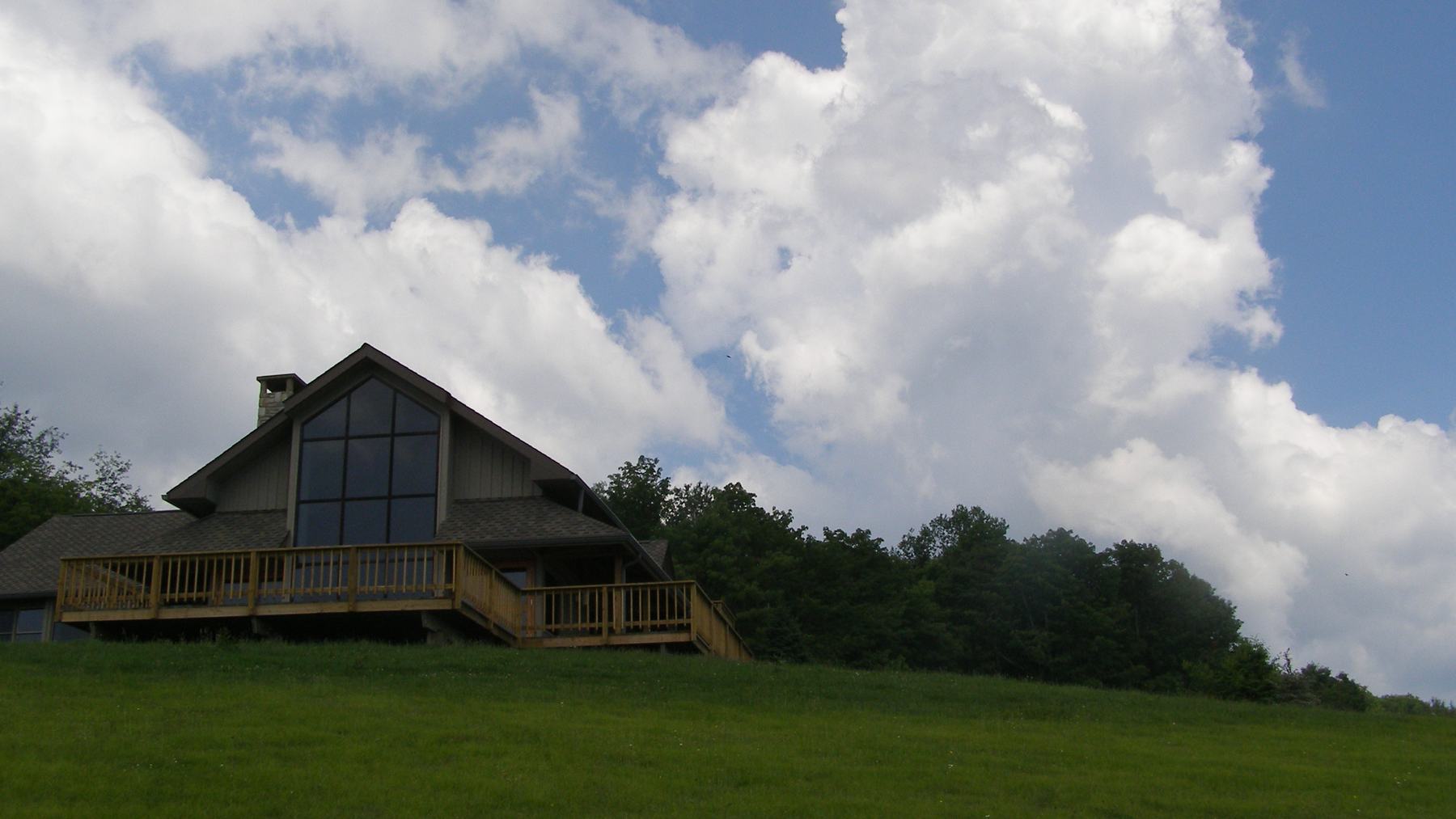
In 1964, Kathryn McNeil and her then-husband, Voit Gilmore, bought a tract of mountain land in Haywood County, North Carolina, and built a house there to spend summers with their five children. In 2000 they donated the entire estate, about 216 hectares, to Great Smoky Mountains National Park, and the United States National Park Service (NPS) regards it as the park’s largest land donation since its creation.
The former summer house is today the Appalachian Highlands Science Learning Center, through which around 5,000 scientists, students, and teachers pass each year, according to the park’s official fact sheet.
A Love-at-First-Sight Purchase
The property has long been known as The Purchase, and within it sits Purchase Knob, a peak at 1550 meters above sea level.
McNeil, a third-generation San Franciscan and a Vassar graduate, had married in 1945 to Gilmore, then a Navy officer, and after the war the couple settled in North Carolina, where he would become mayor of Southern Pines before serving as the first director of the United States Travel Service, under Kennedy and Johnson. “It was one of those love-at-first-sight purchases,” she wrote in her book Purchase Knob: Essays from a Mountain Notebook, published in 1999.
In the opening lines of the book she talks about the mountain. “They are ancient mountains, among the oldest on Earth,” she wrote, and she added that owning a house atop one of them “is the closest you can get to heaven.”
The house was built atop Limby Birch Mountain, at about 1490 meters, with windows roughly six meters high and a chimney made from stones from the Ferguson family’s old barn—the family that had tilled these lands until 1902. Their log cabin, built in 1874 and rebuilt around 1974 with materials from the original, is the highest cabin in the entire park.
The Largest Land Donation Since the Park’s Creation
Over the years the children grew up and the marriage dissolved, but McNeil kept spending summers on the mountain. In 2000, she and Gilmore donated the land and the buildings to the park, which the property already adjoined.
The NPS puts it in writing in its center factsheet: “This represents the largest land donation since the park’s existence.”
There are more recent cases of families protecting land next to a park, such as the two brothers who chose not to build near Zion National Park in Utah, although the property remains in the family there.
A Laboratory in the Old Summer House
In 2001, the estate became home to one of the five early learning centers the Congress created to support research in national parks and to share its findings with the public. According to The Mountaineer, this happened at McNeil’s explicit request, who wanted the place to serve science and education.
The house was renovated and today comprises two buildings with offices, a laboratory, a classroom for 50 people, and lodging for up to eight researchers.
Paul Super, the park’s science coordinator based at The Purchase, told The Mountaineer in 2020 that at the summit, “aside from the stumps of chestnut trees that died,” there are mostly northern red oaks. “Three young hybrid chestnut trees were planted on the peak around the park’s 75th anniversary, as the first symbolic effort to return chestnuts to the park,” he explained.
Ozone, Lichens, and Salamanders to Measure the Air
Much of what is taught at Purchase Knob relates to air pollution. Ground-level ozone crosses borders and forms when nitrogen oxides from cars, power plants, and factories react with other compounds on warm, sunny days.
According to the center’s educational programs, students visit a garden planted with ozone-sensitive plants and estimate how much damage is present on their leaves. In another activity they note the type and amount of sulfur-sensitive lichens that grow on particular trees, because lichens rely on the air and are good indicators of its quality.
The North Carolina Department of Environmental Quality has an ozone monitor next to that garden. In 2022 it explained that twenty years of data on leaf stippling, the tiny spots ozone leaves on leaves, crossed with the device’s measurements “show a spectacular improvement in air quality over the last two decades.”
Other groups descend to a stream to measure water quality and track salamanders using the mark-and-recapture method, which involves tagging specimens to recognize them if they are recaptured. Salamanders breathe through their skin and are especially sensitive to air quality, at a time when amphibians are disappearing even in protected forests.
The Endowment McNeil Left to Fund a Educator
McNeil was a founding member of Friends of the Smokies (FOTS), the association that supports the park, and shortly before her death in 2016 she established with it a fund to pay for a permanent education specialist position at Purchase Knob. In 2019, the association announced $68,000 to set it up.
“Kathryn McNeil, a founding member of FOTS, realized the value of having a permanent person responsible for the educational programs,” Paul Super said then. According to him, she “spoke several times about the joy of being able to contribute to Purchase Knob’s educational programming with this fund.”
Super also explained why it was needed. “You can’t have a school program if there’s no one to teach it,” he said. “We have managed to hire temporary rangers with grants, many of them through FOTS, but with the education specialist position we can have a steady and reliable presence here, year after year.”
Susan Sachs, head of the park’s education section, gave the measure of the demand. “Purchase Knob hosts about 5,000 students in its short season, making it our most popular site for educational programs in the Smokies,” she told the association.
Super met McNeil in 2000 at a science camp, when the house had not yet passed to the park. “She came down to see how we were doing and to make sure we had cotton candy for the campfire,” he said. “Kathy loved the Smokies, and especially Purchase Knob. She could talk to anyone, young or old, who shared that love.” And he added: “Offering cotton candy didn’t hurt.”
Sachs remembered the high school groups that climbed up in the summer of 2000, when McNeil was still using the house. “She would go out to greet the groups and bring us iced tea and cookies. She was always incredibly welcoming and kind,” she said.
The Numbers Don’t Quite Add Up
Sources don’t all align. The NPS and The Mountaineer cite 535 acres, about 216 hectares, but Friends of the Smokies wrote in 2019 that the couple bought “nearly 600 acres,” about 243 hectares. The dates are inconsistent as well, because another NPS page lists 2001 and The Mountaineer splits the transfer between 2000 and 2001.
The claim of “the largest donation” is made by the NPS itself, and its fact sheet does not explain what other transfers it is compared with. To visit the center, reservations are required, and a local guide warns that driving access up Hemphill Road is closed since 2021, although it is possible to reach it on foot via the Cataloochee Divide Trail.
The data come from the National Park Service’s fact sheet on the center, updated July 12, 2024, and from The Mountaineer’s report published September 12, 2020.
In that same fact sheet, the park also includes a note of gratitude. “Every day, the staff and participants in the programs thank the family for their generous gift.”
Image: NPS