
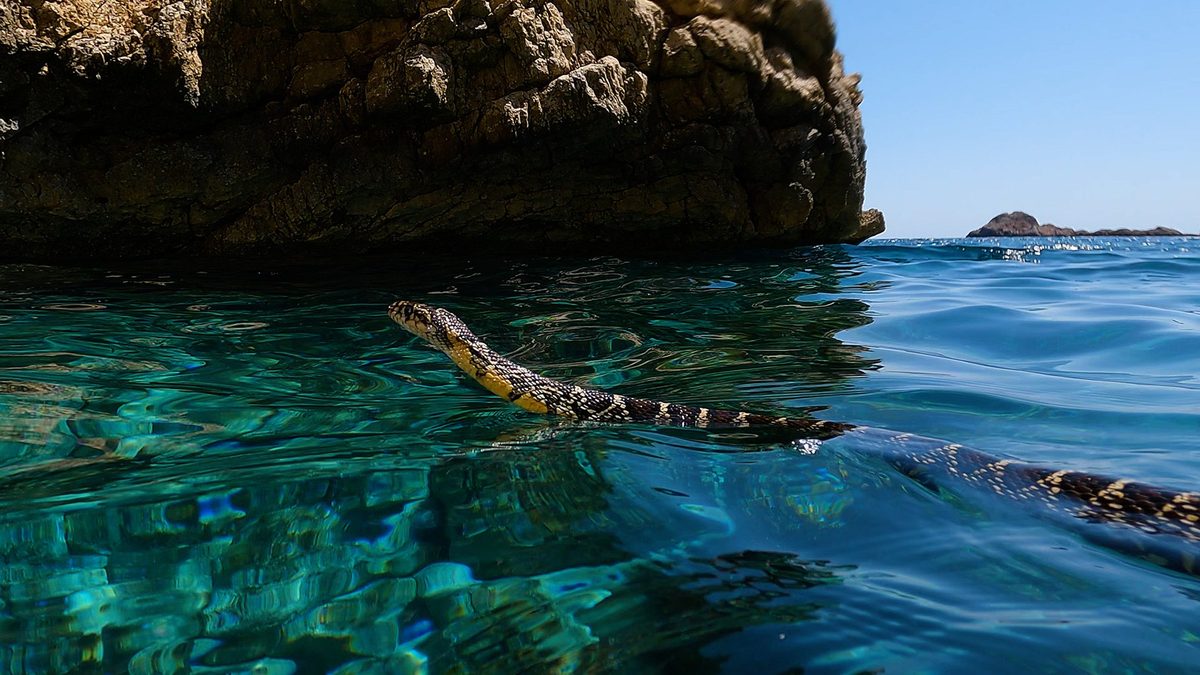
A European project, LIFE Reptiles, aims to establish 22 sanctuaries to save five reptile species that exist only in the Balearic and Canary Islands. One of them is the Pitiusan lizard, Ibiza’s emblematic reptile, which has plummeted over the last two decades. The culprit is the horseshoe snake, which now occupies more than 90% of the island and even swims to nearby islets.
Oriol Lapiedra, a CREAF researcher, has spent six years tracking this invasion with his team, who participate in the project, as the center explained on November 10, 2026. “Losing these evolutionarily unique populations means we will never again see individuals that are the same,” he warned in CREAF’s note dated May 15, 2026.
Snakes that swim to new territories
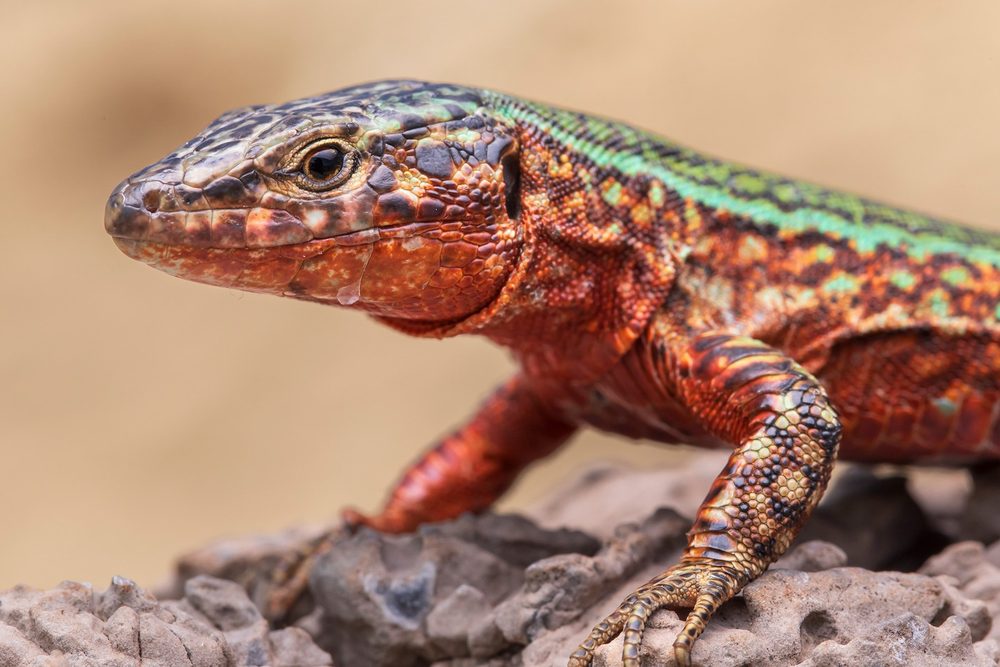
The Pitiusan lizard (Podarcis pityusensis) lives in Ibiza, Formentera and almost forty nearby islets, long believed to be safe from the horseshoe snake (Hemorrhois hippocrepis). The snake reportedly arrived concealed in olive trees carried from the Peninsula. The first individuals found on the islets seemed to have arrived by accident, perhaps on ships.
The team changed its view after assembling recordings and observations from fishermen and residents. “As we collected videos, photographs and testimonies of snakes swimming in open sea, we understood that they were capable of reaching these places on their own,” explains Lapiedra.
The study was published in 2026 in Ecology. According to the team, it had been almost unprecedented worldwide for a snake to colonize other territories by swimming.
From 72 lizards to none
The islet of Santa Eulària encapsulates what is happening. In 2016 there were 72 lizards counted there. In 2023 only three appeared, and in 2025, none.
The team installed 12 traps on the islet and captured up to 58 snakes between 2023 and 2025. The lizard has already become extinct on 10 islets, including Santa Eulària and s’Ora.
On such tiny islets, a few snakes are enough to wipe out everything within a few months. To save what remains, specimens are being brought to the Barcelona Zoo to be bred in captivity, in collaboration with the Balearic Government.
Spreads like wildfire
In 2010 the snake occupied less than 5% of Ibiza. By 2016 it hovered around 40%, and by 2025 it had surpassed 90%.
According to Lapiedra, when the horseshoe snake conquers a new zone, it can finish off the local lizards in less than three years. “The invasion moves like a wildfire, with a front advancing as the food runs out,” he explains.
With no competitors and plenty of prey, they have captured individuals up to 2 meters long. They are “200% larger than those on the mainland,” the researcher notes. They also feed on mice, bats, birds and shrews.
Why the lizard matters
The Pitiusan lizard pollinates most of the island’s flowers. It also eats insects that can become pests and disperses seeds. If it disappears, all of that ceases, and other predators are left without food.
Moreover, it is one of the world’s species with the widest color variations. There are green, brown, gray, blue and black populations. They are the product of thousands of years of adaptation to different habitats and isolation on the islets, and that is precisely what is lost with every extinction.
Twenty-two sanctuaries for five reptiles
In LIFE Reptiles, Lapiedra’s team will study the genetics, morphology and behavior of the different lizard populations. In Gran Canaria the threat is another snake, the California kingsnake.
The 22 sanctuaries will be refuges where snakes cannot enter. To detect them, drones, artificial intelligence and environmental DNA will be used. Lapiedra notes that the snake can swim to the islets, “which is why this initiative is especially necessary,” he adds.
It is coordinated by Gesplan and includes, among others, the CSIC, CREAF and the Spanish Herpetological Association. Also involved is the Balearic Fauna Recovery Consortium (COFIB). Their roles will be taken on by BIONA, the new Balearic fauna foundation, which will also monitor invasive species.
In October, the Balearic Parliament asked to include the horseshoe snake in the catalog of invasive species. CREAF’s study provides figures for that debate, with extinctions already confirmed.
What cannot be fixed
Eradicating invasive snakes entirely is not feasible today, the project itself acknowledges. Therefore the aim is to preserve at least 50% of the genetic diversity and trait variation of these species. With the post-project plan, they hope to reach 75%.
What is lost on the islets cannot be recovered, because those populations do not exist elsewhere. And the problem has already reached Formentera, where snakes have been observed. According to CREAF, a population explosion could wipe out the lizards there in a few years.
The study also includes the Environment Agents Service and the University of Granada, among others. The full statements have been published on CREAF’s website.
Image: Rubén Casas / CREAF
