
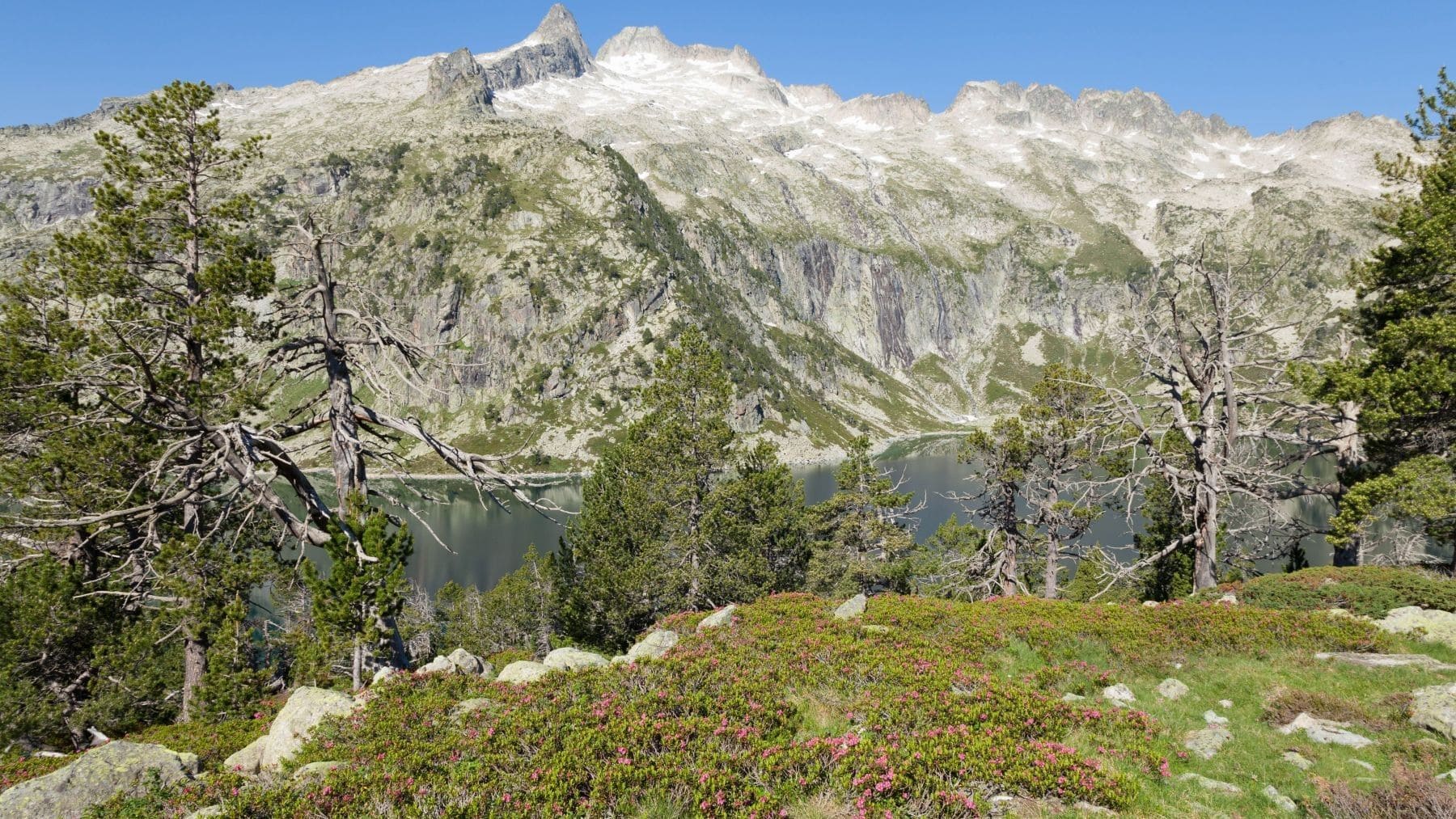
The Pyrenees flora will have a new open scientific platform capable of gathering data from Spain, Andorra and France to study the impact of climate change: this is an advance that requires turning knowledge into effective protection.
CSIC and 31 entities will protect the Pyrenean flora
The Pyrenean flora will have a common scientific tool for the three countries to overcome a contradiction: plants share the mountain range, but their information remains distributed across multiple sources and different criteria. Thirty-one entities from Spain, France and Andorra are now joining forces to correct this situation.
The Pyrenean Institute of Ecology, part of CSIC, is the one leading the project PHYLOFLORA-PYR, which has been presented in Boltaña. For three years it will gather all botanical information about the Pyrenees flora into an open digital platform, including genomic data, distribution data, descriptions and images that will facilitate species identification and the study of climate change effects.
This is a valuable bet on shared knowledge. Its importance also reaches administrations: having better tools should translate into conservation decisions, because digitizing information by itself does not stop environmental deterioration. Conservation requires continuity, political support and resources.
Administrative borders cannot limit nature
The project coordinator and curator of the JACA Herbarium, Pablo Tejero, identifies the basic problem: there is high-quality botanical information, but it is highly dispersed. Moreover, classification criteria vary by territory, which makes it difficult to work with a common reference for the entire range.
Unifying information about the Pyrenean flora will improve the querying and comparison of plants. The goal goes beyond merely producing a catalog: a coherent database can help managers and researchers interpret data without the differences between national systems obstructing analysis.
Tejero recalls that plants are the backbone of ecosystems and form a pillar of the primary sector. That role deserves political attention: preserving biodiversity also means caring for the natural bases of activities that depend on the territory. Scientific cooperation provides tools that allow addressing that responsibility with greater coherence.
The value of PHYLOFLORA-PYR lies precisely in its aim to share criteria and knowledge. In the face of fragmentation, the project proposes a joint response among three nations. It is a positive direction that should continue with proper environmental management, where coordination is as necessary as in laboratories.
Open science is needed in the face of a crisis that demands responses
The forthcoming platform will integrate genomic information and general distribution data of the Pyrenean flora. That combination will serve as a basis for developing indicators that allow studying the effects of climate change on the local flora, with results to be built and evaluated during the project.
It will also include reference images and their descriptions in four languages. Facilitating plant identification expands the scope of inquiry and reduces barriers to access knowledge. The usefulness will depend on offering content that is rigorous, comprehensible and organized for those who need to use it.
The initiative turns information about the Pyrenean flora into a freely accessible shared resource. That openness deserves emphasis: environmental knowledge gains reach when it can be consulted and cross-checked, rather than being confined to scattered or hard-to-connect sources.
It is worth keeping clear what its function is. The indicators will help study changes; they will not automatically prove that any observed variation has a single cause. Scientific rigor requires interpreting the data, recognizing uncertainties and distinguishing between the tools available and the conclusions that can be drawn.
More than 20,000 specimens: conservation requires going beyond announcements
The 11 partner entities and 20 associated entities will share more than 20,000 herbarium specimens during the project. This exchange began with the Boltaña presentation during the handover of the first sheets, a concrete example of the collaboration that supports the work.
The Pyrenean flora will also be the focus of the first PHYLOFLORA symposium, with 3 days dedicated to the technical development of the initiative. The project receives 65% European co-financing through the POCTEFA 2021-2027 system. This public backing requires accessible results and a utility that endures beyond the project’s launch.
The urgency is reflected in numbers: the Pyrenean Climate Change Observatory reports an increase in the average annual temperature by 1.9 °C since 1959 and a decrease in precipitation by 12% between 1959 and 2023.
The Pyrenean flora needs not only better data but also governments that act on that knowledge. Funding research while environmental decisions that should be taken are postponed would waste precisely the science that this initiative aims to promote.
