
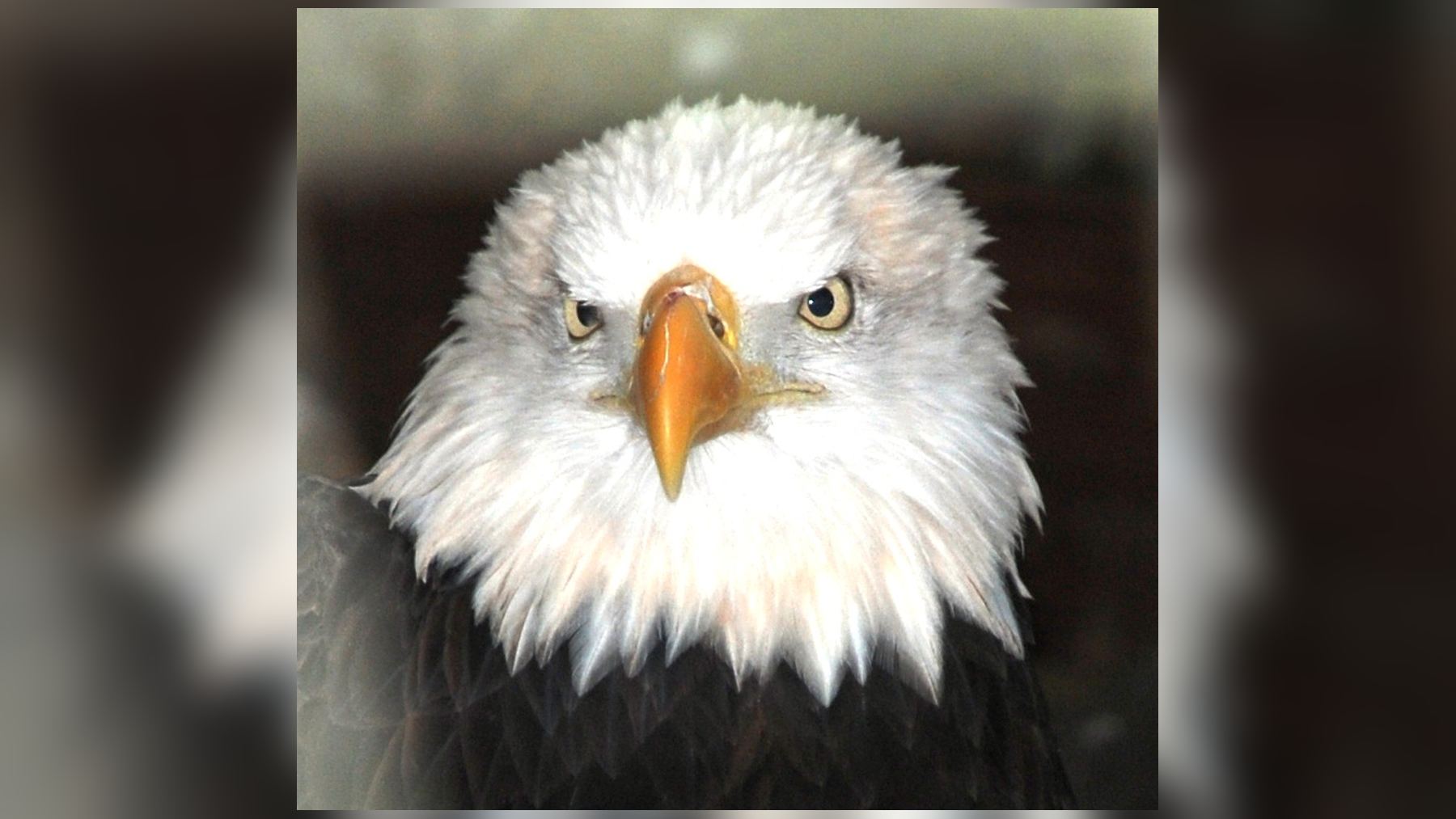
On the night of April 18–19, a storm uprooted a tree next to Eagle Mountain Sanctuary, Dollywood’s aviary in Pigeon Forge, Tennessee, and the netting covering the bald eagles ripped open. Three birds bolted through the opening, and another 26 were moved to the American Eagle Foundation headquarters in Kodak.
On August 21, the foundation and Dollywood Parks & Resorts announced that the urgent relocation would be permanent and that the sanctuary’s eagles would stay forever on the organization’s Kodak campus, which the joint statement described as a 50-acre, about 20-hectare property dedicated to education and conservation.
A Fallen Tree and a Torn Net
According to Crystal Slusher, the foundation’s spokesperson, at least 26 eagles were secured and transported to Kodak, where the avian care team detected that one of them was distressed and required medical attention.
Corrie Arnold, a bird-care specialist with the American Eagle Foundation, told WATE what they did on arrival. «As you can imagine, a tree falling is a little frightening. So first we gathered them together and then did a quick medical check to ensure they weren’t missing feathers or anything like that,» she said.
The birds were kept in two outdoor aviaries, separated by sex. Arnold added that the eagle distressed by the tree fall had recovered and that all were doing well, while the park closed the area and suspended the Wings of America raptor show to repair the net.
Three Eagles Escaped from the Sanctuary
The three escapees were named Wesley, Caesar, and Rockland, and each wore an identification band on its leg. The foundation asked neighbors to report any sightings.
Lori Moore, the executive director of the American Eagle Foundation, explained in early May in an interview with WVLT that the remaining two at large had injuries to the wing or shoulder. «That doesn’t mean they can’t fly at all, but it certainly limits their ability to survive in the wild,» she said.
Moore urged especially that no one should try to feed them. «They are very accustomed to receiving a balanced diet, so if the public tries to give them food they aren’t used to, that will make it very difficult for us to recover them,» she warned.
Caesar was recovered on May 2 in a cow pasture, and a foundation specialist identified him by his orange band with the letters «SE.» Rockland arrived days later in Knox County, probably taking advantage of thermals—rising columns of warm air that allow birds to cover long distances with little wing-flapping.
On June 2, Slusher was still without good news. «Rockland has been sighted several times in the area, but as with many sightings, the eagle often moves before our team can arrive,» she said, noting that they had not received any confirmed sighting of a bird with Wesley’s black band.
The August Announcement
The August 21 release explains that the change enables more intensive care, conservation, and education work to be concentrated on the Kodak campus, opened in 2023 and located about 24 kilometers from Dollywood.
«Eagle Mountain Sanctuary has played an extraordinary role in our story and in helping generations of people understand and appreciate these magnificent birds,» Moore said in the release. According to the director, the Kodak campus gives them the opportunity to «offer an exceptional permanent home to the bald eagles we care for.»
Eugene Naughton, president of Dollywood Parks & Resorts, recalled that for 35 years the collaboration «has allowed millions of Dollywood visitors to meet and appreciate the bald eagle and other birds of prey.» The park will continue the Birds of Prey program at the Wings of America theater.
The announcement came four days before Dolly Parton’s death, who passed away on August 25 in Nashville at the age of 80, according to a statement from her representatives.
Why These Birds Cannot Return to the Wild
All the sanctuary’s eagles have some permanent disability that would prevent them from surviving on their own, according to the foundation. Their resident records show wing injuries, some from gunshots, eye injuries, amputated toes, inability to hunt, and human imprinting.
Imprinting is the bond formed when a bird raised by humans associates them with food. This is the case of Challenger, the foundation’s best-known bald eagle, who fell from a Louisiana nest in 1989, was raised by hand, and after release could not survive on her own.
Mark Armstrong, who has spent 22 years watching birds in Sevier County, summed it up simply for WVLT: «They aren’t used to finding their own food,» he said about the escapees. Clare Dattilo, a guided interpreter at Seven Islands State Birding Park, went further: «I hope they are enjoying their time in freedom, but I also hope they are found healthy and safe, because I don’t think they will be able to survive long-term.»
A Sanctuary Opened in 1991
Work on Eagle Mountain Sanctuary and the Wings of America theater began in mid-January 1991, inside Dollywood. In April of that year, Dolly Parton, the co-founder Al Cecere, and comedian Bob Hope released a bald eagle into the enclosure during the opening.
The foundation described it as the largest non-releasable bald eagle exhibit in the United States, about 11,300 cubic meters of aviary perched on a wooded hillside.
Between 1992 and 2020, the organization released 182 bald eagle chicks from a release tower beside Douglas Lake, and more than half came from pairs cared for by the foundation, many of them within the sanctuary itself. It is the same breeding-and-release technique used by a 26-year-old biologist to rear bald eagle chicks in an artificial nest in 1976. In total, the American Eagle Foundation says it has returned more than 400 bald eagles to the wild.
The Recovery of the Bald Eagle
In 1963, only 417 bald eagle nesting pairs were known, according to the U.S. Fish and Wildlife Service. The pesticide DDT, which thinned eggshells, was one of the major culprits, and even today pesticides banned half a century ago appear in bird eggs.
The Environmental Protection Agency banned DDT in 1972, and on June 28, 2007 the species was removed from the federal list of threatened and endangered species. The most recent estimate from the service, for 2018–2019, counts about 316,700 individuals and 71,467 breeding pairs across the 48 contiguous states.
Captive breeding was one of the tools of that recovery, just as with the California condor, which had almost been reduced to no wild individuals.
What the Announcement Leaves Unclear
The release does not mention the eagles that escaped, and the latest public information we found, from June 2, placed Rockland and Wesley still at large. It also doesn’t say how many birds are now at Kodak, and in April figures of 26 and 21 were cited.
The note mentions 50 acres, although the foundation’s website describes its headquarters as 57 acres, about 23 hectares. And in 2022 the organization asserted that the eagles would remain in the park. «Our birds will stay at the park, so Dollywood will remain our biggest corporate sponsor,» said then WVLT to Robyn Miller, the foundation’s education content specialist.
The American Eagle Foundation itself acknowledges on its website that it is not equipped to operate a full veterinary rehabilitation hospital on its grounds. To ensure medical care for injured birds, it works with partners such as the University of Tennessee College of Veterinary Medicine—a support network similar to that used by other raptor-recovery centers.
The full release was published on August 21, 2026, on the American Eagle Foundation’s website.
Anyone wishing to see the eagles of the former sanctuary will now have to go to Kodak, where the foundation offers guided tours with at least 24 hours’ advance reservation and self-guided tours without an appointment.
Image: jjjj56cp / Wikimedia Commons (CC BY 2.0)
