
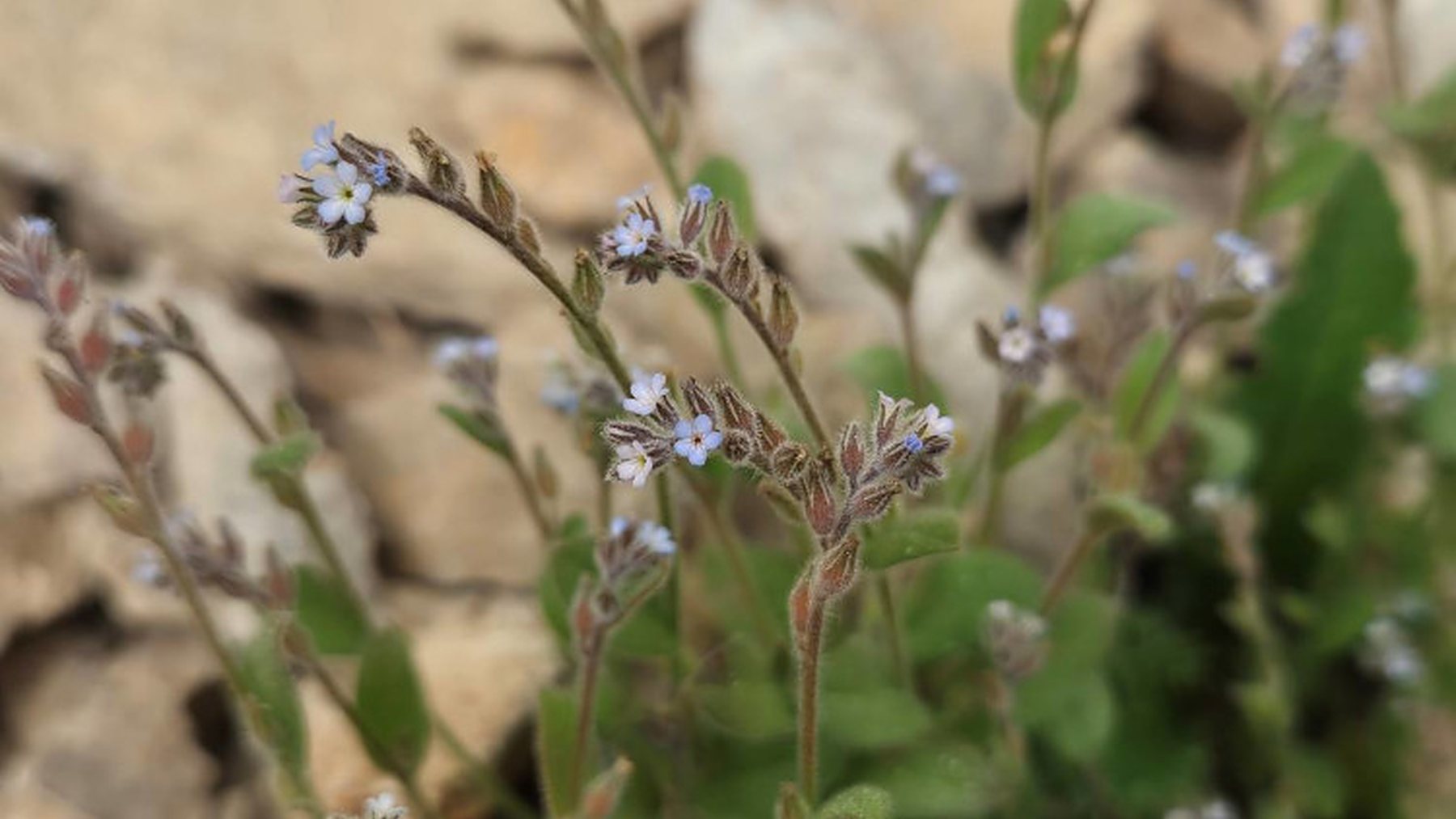
Cadí-Moixeró Natural Park counted this year 310 specimens of Myosotis minutiflora, an annual herb barely 7.5 centimetres tall. It is the only known population of this species in the entire Pyrenees. The census took place in June, with the plant in full bloom.
It is the third census since it was discovered there in 2014, and the park draws a reassuring conclusion: the population remains stable and in good conservation status. How does such a rare plant endure in such a small corner of the mountain?
From 131 to 310 specimens
In the initial census, 131 individuals were counted. In 2021 it jumped abruptly to 425, according to the park’s note of 29 October 2026. This year’s count has fallen to 310.
It may seem like a setback, but the technicians do not interpret it that way. For annual plants, it is normal for the number to vary greatly from year to year, because each generation depends on how the season unfolds. One year there are many individuals and the next year fewer, without signaling a problem.
According to the park, the population remains above 250 reproductive individuals, the threshold that separates the categories “Endangered” and “Critically Endangered.” Moreover, no threats have been detected that could jeopardize its survival.
A miniature forget-me-not
This species belongs to the forget-me-not genus, within the Boraginaceae family. Its stems grow erect or slightly inclined and are covered with hairs. On the upper leaves, those hairs are straight on the blade and hooked on the underside.
The flowers are tiny, pale blue, with five lobes. They cluster at the tips of the stems and, when they mature, they produce four very small fruits called nutlets. You really have to bend down to see it, to be honest.
It lives in rocky and calcareous soils, at the foot of cliffs or rock shelters—those rock alcoves that provide natural cover. It is a very specific habitat. And in Cadí-Moixeró it occupies a minuscule surface.
It fits in four square metres
A review of the park’s flora monitoring, published in 2023 in the Bulletin of the Catalan Institution of Natural History, provides the exact measurement. In the first assessment, the 131 specimens occupied 2 square metres. In 2021 they occupied more than double that amount, about 4 square metres.
In other words, the entire Pyrenean population could fit on the floor of a small bathroom. The same study explains that no other nucleus was found in nearby places with a similar habitat. For that reason, experts consider it highly vulnerable, even though it is currently stable.
The article describes it as a mountain plant of southern origin, more typical of southern mountain ranges. Its appearance in the Pyrenees gives it enormous biogeographic value. With such a small area, any disturbance of the site would affect the entire nucleus at once.
At the highest risk level
Catalonia’s Threatened Flora Catalog lists it as an “Endangered” species. Under the criteria of the International Union for Conservation of Nature (IUCN), in Catalonia it reaches the highest category, “Critically Endangered.”
It is not alone in facing problems among Catalonia’s plant treasures, as shown by the list of threatened flora in Catalonia. But few depend on a single corner like this one. And that weighs heavily.
In high mountains, the context does not help, because heat pushes many species upward. Several studies warn that the Pyrenean high-mountain flora may lose a substantial part of its diversity due to climate change.
Fifty plants under monitoring
Monitoring is part of the Cadí-Moixeró Plan for tracking threatened or of-interest flora. The park defines it as an essential tool to understand its most fragile species and decide how to protect them. According to the 2023 article, the park has 50 taxa of special interest and monitors 13 of them on a regular basis.
Although it is a slow and modest task, without it there would be no way to know whether a population is collapsing or holding steady. Thanks to that kind of monitoring, other rare relatives have reappeared as well, such as the forget-me-not rediscovered in Pontevedra.
No further populations in sight
The park’s note does not detail how much surface the 310 specimens occupy this year. It also does not clarify when the next count will take place, although there have already been three in a little over a decade.
Are there more hidden populations in other balmas of the Pyrenees? So far no one has found them, so the species, in Catalonia, remains dependent on just a few square metres of calcareous rock.
The official communiqué has been published on the website of Catalonia’s Natural Parks.
Photo: Cadí-Moixeró Natural Park / Government of Catalonia
