
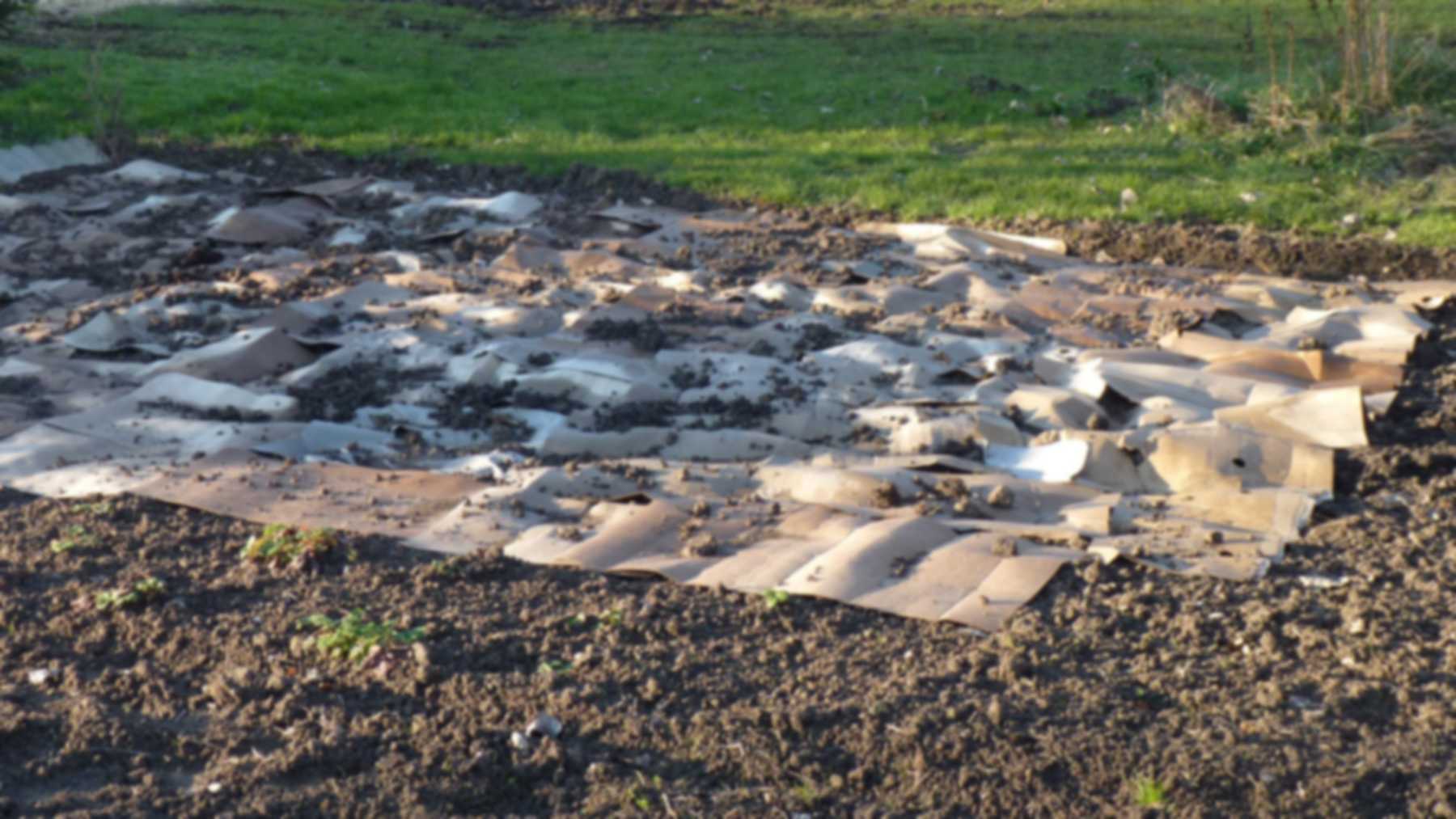
In the spring of 2022, at Sweet Hollow Farm, an Idaho horticultural property, four beds measuring about 30 meters were covered with cardboard and compost, while four others were tilled using the same cardboard-on-garden technique that many hobby gardeners employ each autumn. After the second season, weed cover reached about 15% of the soil under the cardboard and 45% in the tilled beds, according to the project’s final report.
The trial was funded by the Western SARE program of the U.S. Department of Agriculture, with the University of Wyoming as a partner, and its aim was to cultivate without tillage, the same idea that led an Ohio farmer to alter his farming method. “If this works well, the system could be important for small producers,” farmer Jonah Sloven told Western SARE in 2022. In the neighboring state, a Washington State University experiment has measured how much the cardboard slows the passage of gases between soil and air.
Cardboard cuts weeds off from light
The technique is called sheet mulching: covering the soil with cardboard or thick paper and layering organic residues on top. Oregon State University’s guide, signed by Shannon Rauter and Len Sherp and updated in July 2025, explains that this barrier suffocates weeds and weed seeds in the soil “by depriving them of the sunlight they need for photosynthesis and growth,” the process by which plants produce their food using light.
At Clemson, the explanation is nearly identical. “Cardboard works because it blocks the light that the unwanted plant needs for photosynthesis,” writes Jackie Jordan, urban horticulture agent with Clemson Extension, adding that most weed seeds need to touch soil to germinate.
With perennials, the story changes. Oregon’s guide recommends pulling up bramble, creeping grasses or bermuda grass early because lasagna or layered composting “may not suffocate these weeds,” and it suggests overlapping the edges by at least 20 centimeters, because “weeds will find any gap, wherever it is, no matter how small.”
Autumn provides months of lead time before planting
Iowa State University estimates that several months are needed to completely kill the plants left underneath, so starting in autumn to plant in spring seems a “good calendar” to them. Oregon follows the same logic: “Autumn is an excellent time because the material breaks down slowly over the winter and is ready for spring planting.” Clemson notes that the cardboard’s decomposition itself takes four to six months, and Oregon estimates about six months for a bed built in layers to be ready, depending on climate.
Kathleen Hallal, vice president of FireHawk Bioherbicide, explained it to Martha Stewart magazine in September 2026: “Autumn is ideal because many weeds are producing or dispersing seeds, while others are establishing themselves for the next spring.”
Stephanie Sutherland, horticulturist at Frederik Meijer Gardens in Michigan, told the same article that by the time it’s time to plant, late spring or early summer, the cardboard will have decomposed and helped improve soil structure.
Idaho farm halved its weeding hours
Sweet Hollow Farm’s problem was creeping bit, a vine that spreads by seed and horizontal roots. “Even tilling in spring, we spent huge amounts of time weeding by hand all season to control creeping weed,” Sloven said, and that’s why he did the math: “Reducing weed pressure saves hours of work, cuts costs, and improves farmers’ quality of life.”
In the second year, two people spent an average of 55 minutes weeding the cardboard-mulched beds and two hours on the tilled plots. The farmers noted in the report that “weeding the cardboard beds was much more pleasant, and the weeds came out with far less effort,” and creeping weed appeared only in the holes they had opened for sampling.
Crops yielded mixed results. In 2022, kabocha squash produced 28% more on the tilled beds, and spaghetti squash 40% more with cardboard, although five delicate gourds failed to push through the mulch. In 2023, four varieties of onions and shallots yielded more on cardboard, ranging from 3% to 97% higher.
A Washington experiment measured how much gas passes through cardboard
The most serious concern emerged in 2019 from Washington State University. “There was no prior research using cardboard as mulch until we did this and published it in 2019,” recalled horticulturist Linda Chalker-Scott, one of the authors, in a talk to the International Society of Arboriculture in 2023. Khurram Shahzad and Markus Flury’s team filled greenhouse test vessels with soil and compost, covered them with wood chips, cardboard, weed cloth or plastic, and left other setups as bare soil for comparison.
Over 16 days they measured carbon dioxide and oxygen at depths of 6.5 and 13.5 centimeters, because, as Chalker-Scott explained, soil hosts organisms “from microbes to earthworms, moles and roots” that use that oxygen, and “anything that disrupts that exchange will be detrimental to soil health and life.” The diffusion coefficient of carbon dioxide—the ease with which that gas moves through a material—was about 0.001 square centimeters per second in wood chips, 0.0001 in cardboard, 0.00001 in weed cloth, and 0.000001 in plastic.
“A single sheet of cardboard was ten times worse than ten centimeters of wood chips,” she summarized in the talk. The authors note that these differences “could negatively affect a diverse soil, such as those in biologically rich garden beds with higher oxygen demand,” and they conclude that wood chips are the preferred option “in terms of gas permeability.”
The thin layer and smooth cardboard perform best
Iowa recommends one or two layers of cardboard, no more. “Thicker is not better, because newspaper and cardboard can hinder the movement of water and air into the soil, especially when piled too high,” their guide warns, while still noting that, “when done properly, this method is one of the most environmentally friendly options.”
Oregon calls for brown corrugated cardboard, without shine or printing, and for removing tape and staples and pre-wetting it well before covering. Clemson warns that colored inks can contain heavy metals and tapes and labels contain plastic, and Oregon’s weed-control program suggests topping with 7.5 to 10 centimeters of leaves or compost.
Jordan also notes that “cardboard boxes are hydrophobic to some extent and, if allowed to dry, they can prevent water from reaching the roots,” meaning they can repel water and that can be “critical” while established trees and shrubs are taking root. Chalker-Scott puts it differently: when cardboard is wet, it is “very, very wet,” and when it dries, it is “very, very dry.”
When the vegetation underneath has died, Iowa advises removing or breaking the cardboard so it does not hinder new plants, because if it remains, “soil health can also be compromised.” There are other paths, each with its pros and cons, such as mulching in farming or home remedies of vinegar and salt against weeds.
What still isn’t known about cardboard
The Washington experiment lasted 16 days in a greenhouse, and the concentrations of carbon dioxide and oxygen beneath the cardboard were not significantly different from those in bare soil; only the plastic made a difference. The Idaho trial had four beds per treatment and likewise did not show significant increases in organic matter or soil aggregate stability.
“We were surprised not to see much difference in the biological counts,” wrote the Sweet Hollow farmers, noting that the study period may have been too short. Jordan also concedes from Clemson: “I don’t know if there has been enough research into cardboard’s effects on different soil types or its long-term impacts.”
Chalker-Scott, the harshest critic, adds that “termites love cardboard” and that “they actively seek it out to eat,” and regarding layer recipes of 30 to 45 centimeters she is blunt: “There is absolutely no science behind this.” Jordan is equally clear: “If you want to improve soil fertility, add organic matter.” There are long-term studies showing that compost and manure trap more carbon in soil than synthetic fertilizers.
The full study was published in Soil and Tillage Research, and the recommendations appear in Oregon State University’s guide, in Clemson’s sheet-mulching fact sheet, and in Western SARE’s final report.
For Jordan, cardboard is, in the end, “one more tool in the gardener’s box.” With what we know today, the guides call for smooth, not overly thick cardboard, well-wetted, covered with leaves or compost, and removed or broken when the vegetation beneath dies, as Iowa recommends.
Image: Natureln / Wikimedia Commons (CC BY-SA 4.0)
