
Naidiri, a Fiji village on the Coral Coast, closed a 1,200-square-meter patch of reef to fishing in 2009. By 2024 its marine park covered 28,800 square meters, nearly 24 times larger, according to the United Nations Development Programme (UNDP).
In 2023 the park planted 18,000 corals. The heatwave from February to April 2026 wiped out most of Naidiri’s corals, according to the NGO Corals for Conservation. Now the village and its scientific partners rely on corals that tolerate warmer water.
A Plate with No Fish in 2009
The story begins with a dinner. After a rugby match, Manoa Duwai sat down to eat and the table held only rice and tea. When he went down to the reef, he found small fish barely surviving.
Duwai spoke with the village leaders. That same year they created a tabu, a zone where fishing is prohibited. He summarizes it on the UNDP website: before the park, «there were no fish due to overfishing.»
Naidiri is beside the bay of the same name, near Sigatoka, on Fiji’s southwest coast of Viti Levu. Its waters form part of a qoliqoli, the traditional fishing grounds shared by three villages.
Other coastal communities have asked for the same to recover fish stocks. This is the case, for example, with the marine reserve that is gaining support in Calp.
From 1,200 to 28,800 Square Meters
The village gradually expanded the protected area. Along the way it joined Fiji’s Ridge to Reef project and the UNDP. It enjoys support from the Global Environment Facility (GEF).
In 2022 the Government recognized the area as Naidiri Marine Biodiversity Park. According to the park, then Environment Minister Mahendra Reddy went to the village to inaugurate it.
The village chief, Aisea Vereverelagi, describes the change in few words. Since the tabu has been applied, he says, “there has been an abundance of fish.”
The park also boasts staghorn coral. This branching form provides shelter for many fish. It is scarce on the Coral Coast, but abundant inside the reserve.
Young People Cultivating Coral
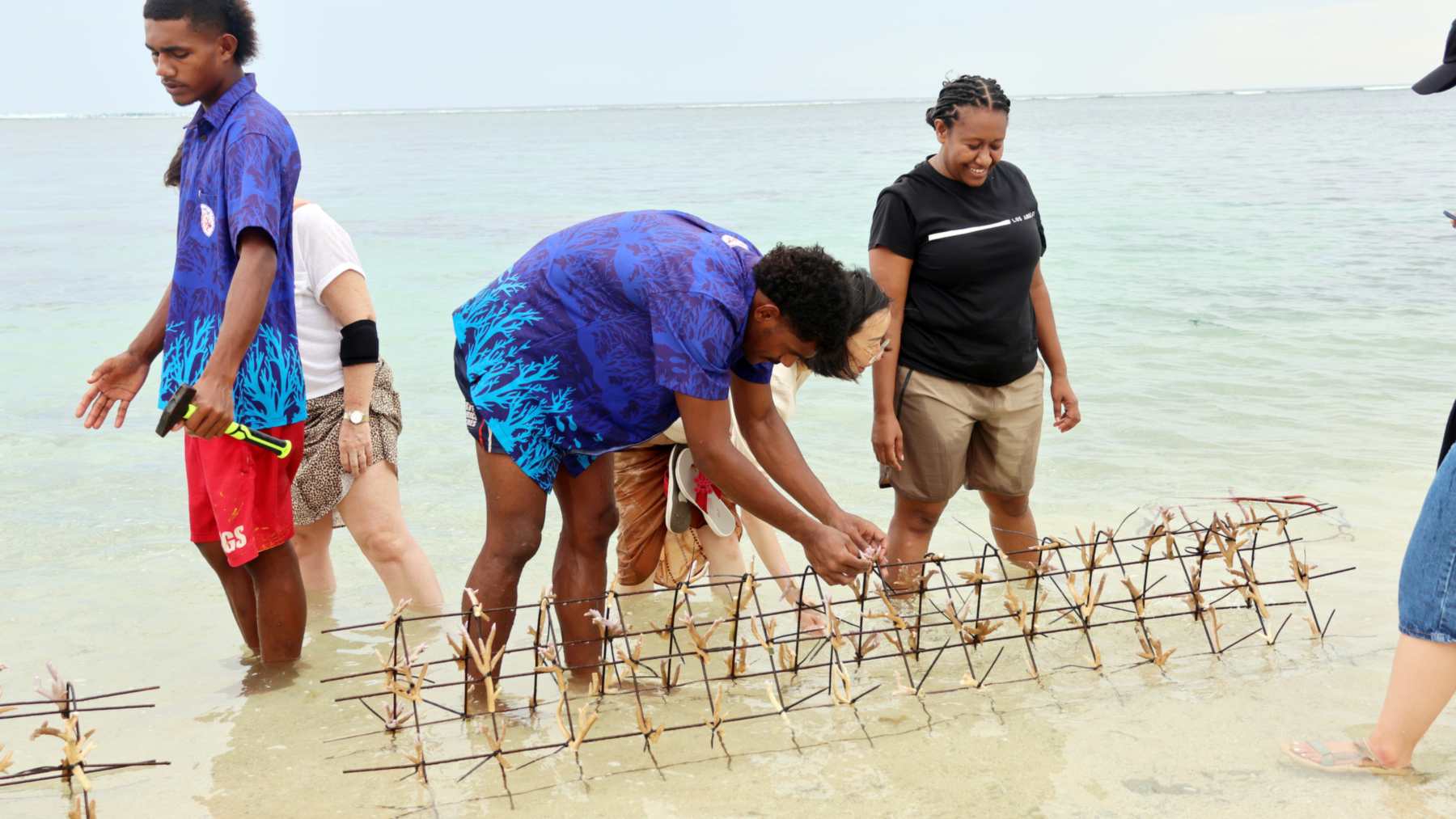
A village youth club has become the park’s engine. Its members monitor the reef, plant coral, and guide visitors from nearby hotels.
The park has trained its own coral gardeners. They use mesh frames, rope nurseries, and disc nurseries. There they rear fragments before placing them on the reef.
Each week they review the corals, the fish, and the nurseries. They also remove crown-of-thorns starfish, which eat coral polyps. Each one can devastate up to 10 square meters per year.
In the reserve live three species of giant clam: Tridacna gigas, Tridacna squamosa, and Tridacna maxima. The park tracks them closely because they indicate a healthy reef.
The system echoes other community nurseries. One of them grew out of a school project that filled Florida with coral trees.
Tourism and Livelihoods for the Community
The park also provides jobs. Young people accompany snorkelers. Women from the Naidiri Women’s Club prepare meals for visitors and researchers.
Its coordinator, Elenoa Vea, tells the UNDP that these duties bring money into the village. According to Duwai, the community hopes to open a guesthouse to provide more employment for the youth.
In February 2026, delegates from a regional GEF workshop planted coral with the youths. Fred Boltz, head of programming for the fund, said the village reflects how they want to work going forward.
The 2026 Heat Wave
That same month the problem began. Between February and April, a mass bleaching event affected all the sites where Corals for Conservation works in Fiji. This is reported in their July 9, 2026 report.
The project lead, scientist Austin Bowden-Kerby, writes that “Naidiri lost most of its corals.” The site’s temperature loggers recorded more than 36°C on several occasions.
Bleaching occurs when water gets too hot. According to NOAA, coral expels the algae from its tissues and becomes white. They do not die right away, but they may perish if the stress continues.
Fiji is not an isolated case. Mass bleaching is again threatening reefs worldwide. Moreover, 44% of reef-building corals are threatened.
Heat-Tolerant Corals Selected to Withstand Heat
Naidiri also works with heat-resistant corals. The park calls them “super corals” and plants them with Corals for Conservation. It does so within Reefs of Hope, a UNESCO-backed initiative of the Ocean Decade.
The NGO takes fragments from corals that have already survived several heat waves. Then they rear them in nurseries to obtain generations more tolerant to temperature.
The 2026 crisis helped identify corals that did not bleach. In March, Bowden-Kerby reported that Naidiri’s shallow nursery was suffering. The NGO’s BULA genetic bank, located in deeper and cooler waters, remained safe.
In July he admitted a setback. They had not found in time a cooler-water site to store a copy of every Naidiri variety. In other seas, trials of super corals are underway, such as in the Galápagos.
What Is Still Unknown
Official sources do not provide year-to-year fish tallies. Fish abundance is based on what the chief and neighbors report, with no published censuses.
There is also no exact tally of surviving corals in 2026. Enduring one heat wave does not guarantee surviving the next. The NGO’s thermal-resistance experiments were set up in June at Malolo, another Fiji site.
The UNDP published the park’s story on March 16, 2026 on its Pacific web page. The bleaching data come from Corals for Conservation’s July report.
In July, the NGO replanted with the cool-season. In March it organized the first exchange between Naidiri and the village of Nangumagua, in Serua. And Duwai is invited by other islands to share his experience.
Photo: UNDP Pacific
