
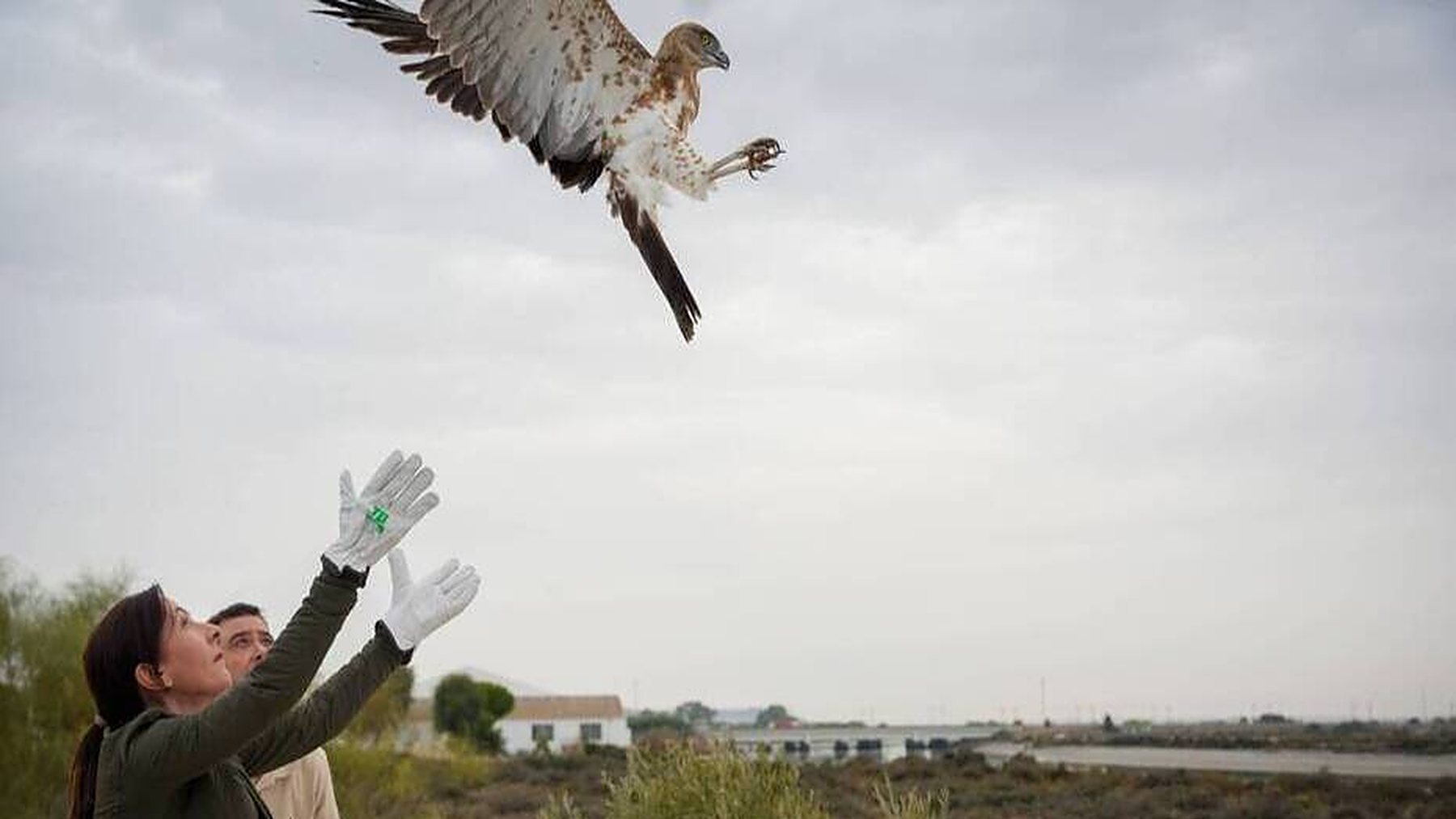
Five raptors that had been rehabilitated at the Andalusian wildlife centers took to the skies again on October 27 in El Puerto de Santa María (Cádiz). Four were released from CREA Dunas de San Antón, in the town itself. The fifth arrived from CREA Marismas del Odiel, in Huelva, and the release was attended by the Councillor for Sustainability and the Environment, Fina Martínez.
All are equipped with scientific bands to identify them if someone finds them again. One of them, a buzzard with damaged vision, also carries a GPS transmitter. Thanks to it the technicians will know where it moves and whether it fends for itself in the wild.
A broken wing in Jerez
The most delicate case was that of a short-toed snake eagle (Circaetus gallicus) found in Jerez de la Frontera. It arrived with an open fracture in the metacarpals of the left wing, the bones at the tip of the wing. For a bird that hunts on the wing, such an injury is almost a death sentence.
At the center they operated to repair the bone. Afterwards came a period of recovery and muscle strengthening in specialized facilities. According to the Junta, the eagle reached “the optimal conditions to be released back into the wild.”
Hunger in Trebujena and San Roque
Two of the birds arrived malnourished. A booted eagle (Aquila pennata) found in Trebujena was brought to the CREA in such a malnourished state that its life was in danger. It required several weeks of care, specific food, and checks on its physical condition.
Something similar happened to a common kestrel (Falco tinnunculus) picked up in San Roque, which also arrived malnourished and received treatment until it was back in good shape. And why does a raptor go hungry? The official note does not explain it in these two cases, so best not to guess.
A kestrel too trusting
The second kestrel had a very different problem. It was a juvenile picked up in El Puerto de Santa María showing signs of imprinting, that is, being overly accustomed to people. All indications, according to the Junta, point to it having spent some time in captivity.
A bird like this can approach people it should not or may not know how to find its own food. Therefore, the technicians paired it with other kestrels so that it would depend less on humans and adapt better to the natural environment.
It is a good reminder that a bird that lives in close proximity to people has a harder time returning to the wild.
The common buzzard from Hinojos carries GPS
The fifth bird is a common buzzard (Buteo buteo) that appeared in Hinojos (Huelva) with a serious infection in its mouth and in its left eye. At CREA Marismas del Odiel it underwent surgery and two months of care. It has recovered, though it sees worse with that eye.
That is where the transmitter comes into play. The GPS will show how it moves and behaves with an affected eye. If it adapts well, it will be good news for the buzzard and for the work of the technicians as well.
Nearly 8,000 animals in 2024
These five releases are a small sample of the work of the Andalusian Network of Centers for the Rehabilitation of Threatened Species. There are eight centers, one per province, and Cádiz’s center is a reference for seabirds and vultures. According to the Andalusian Government Council, in 2024 the network attended 7,917 protected specimens.
Of the total, 7,243 animals arrived alive at one of the centers. Birds accounted for 87.74% of admissions, mainly due to nest falls and collisions. Cadiz, Seville and Malaga each surpassed one thousand cases, with the peak in June and July.
The Junta plans to invest around 13 million euros until 2027, with European funds, to improve these centers. At Dunas de San Antón there will be new reception buildings, quarantines, and aviaries—the large cages where the birds gain strength. It is not by chance in a province where Jerez already hosted an international meeting on the conservation of large raptors.
Caring is not only about healing
During the release, Fina Martínez recalled that care at the CREAs blends veterinary work, rehabilitation, and follow-up. Many animals arrive with problems that sometimes relate to human activity. And it is not enough to close the wound, because before releasing a bird you must ensure that it can fly and knows how to hunt.
The same happens in other places, such as in the rescue of Félix, an imperial eagle that fell from the nest due to heat in Badajoz. The councillor also urged people to know what to do when confronted with a wounded wild animal, and in Cádiz the CREA Dunas de San Antón attends at 670 946 198. It’s worth noting, because raptors also hunt in unexpected places, such as the six species that hunt among the panels of a solar plant in Seville.
The official note about the release has been published on the Andalusian government portal.
Photo: Government of Andalusia
