
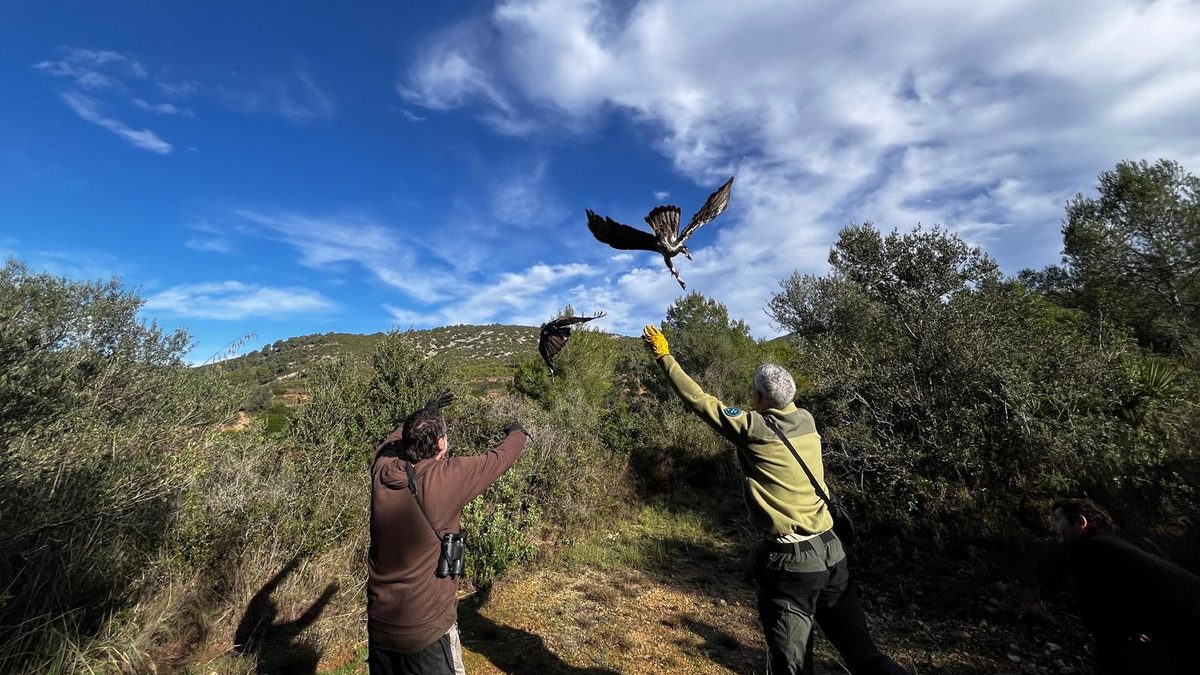
The male and female of the lesser spotted eagle pair at Parc del Foix, in Barcelona province, are already fitted with GPS transmitters on their backs. They were placed on November 10, according to the Diputació de Barcelona, which announced the news on November 26.
The aim is to learn where these two birds move and to detect possible threats in their territory. The species, Aquila fasciata, is listed as endangered in Catalonia.
A Transmitter Mounted on a Harness
The two devices worn by the eagles are GPS-GSM transmitters. They periodically record the bird’s position and send the data through the mobile network, much like the GPS carried by one of the rodent-hunting raptors released in El Puerto de Santa María.
Each device is strapped to the back with a teflon harness, custom-made and fitted for each individual. It is a system widely used in the scientific tracking of large raptors. According to the Diputació, it holds the transmitter securely without obstructing flight or the bird’s usual behavior.
Additionally, the two eagles wear rings that can be read from a distance. This allows technicians to identify each individual during field monitoring through telescope or binocular observations.
Where they hunt, rest, and sleep
With the position data, the team will reconstruct the movements of each bird. They will determine which areas they routinely use for hunting, resting, breeding, or spending the night.
They will also be able to delineate their home range—the area each eagle regularly uses for those activities.
One question is whether the two birds move mainly within the park or venture to other natural spaces in the surrounding area. Another is where the dangers may lie.
The Diputació speaks of detecting “possible threats” in the territory. It cites risk points related to infrastructures and other factors that could compromise the survival of the two eagles.
A Historic Breeding Territory
Parc del Foix lies in the surroundings of the Foix reservoir, which the park’s website describes as one of the few wetlands in the Penedès. The park also houses Penyafort and Castellet castles, of great strategic importance in the Middle Ages, according to the same site. And, according to the Diputació, it hosts a historic breeding area for this eagle.
The note does not provide chick figures, but it does mention a low reproductive productivity of the pair in recent years. In other words, their breeding success has been low.
The same text mentions several episodes of individuals being substituted within the pair. It does not specify how many or when.
According to the Diputació, little was known about this territory until now, and the monitoring will yield new information. The data will be a technical tool to plan conservation measures and locate potential sensitive zones. It is also aimed at improving survival and breeding success for the species.
Threatened in Catalonia
The lesser spotted eagle is one of the most emblematic raptors of Mediterranean ecosystems, according to the Diputació. In Catalan it is called àguila cuabarrada.
In Catalonia it is listed as “endangered” in the threatened fauna catalog of Decree 172/2022. This appears in the Generalitat’s open data on protected species.
Across Spain as a whole, its status is lower. The Spanish Catalogue of Threatened Species lists it as “vulnerable,” under its former scientific name Hieraaetus fasciatus.
Law 42/2007 of Natural Heritage defines what it means to be vulnerable. It is a species at risk of moving to the “endangered” category in the near future, should the adverse factors acting on it not be addressed.
Power Lines and the Law
The note does not detail which infrastructures are of concern in Foix. As general context, Spanish regulation does recognize the danger posed by power lines to birds.
Royal Decree 1432/2008 establishes measures to protect avifauna against collision and electrocution on high-tension lines.
The Two Eagles, Now Free
One of the photos released by the Diputació shows the two eagles taking to the air after tagging. According to the note, the transmitters periodically record their position.
The Diputació frames the tagging within two United Nations Sustainable Development Goals, numbers 11 and 15. They correspond to Sustainable Cities and Communities and Life on Land.
The note does not specify how long the monitoring will last or when the first results will be known.
Image: Diputació de Barcelona