
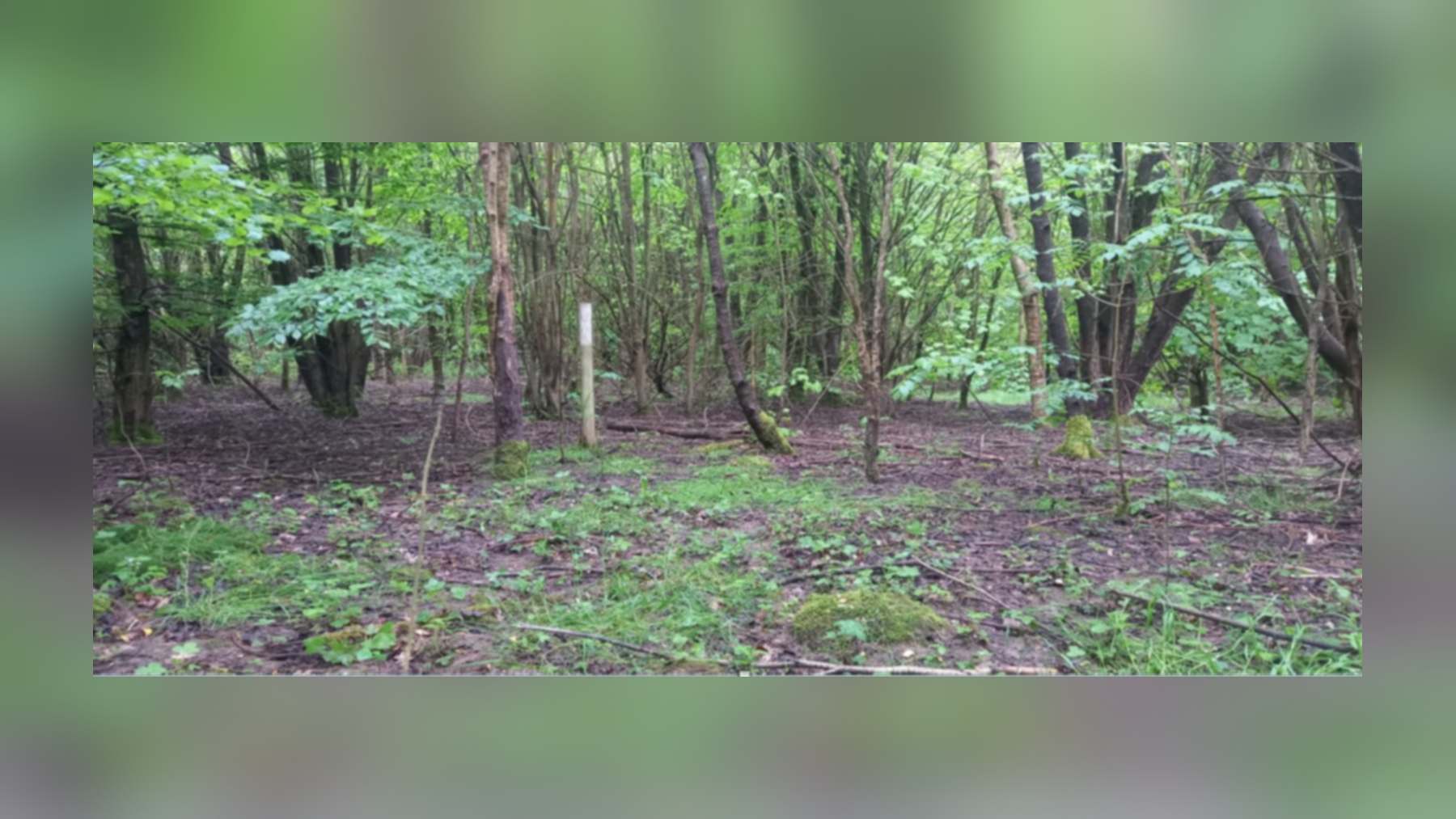
In 1999, nearly 12 hectares of oaks, ashes, hornbeams and limes were planted over an old flax field at Hucking Estate, in Kent, southeast England. Right next to it stood an ancient woodland that has been continuously wooded since at least the year 1600.
A quarter of a century later, a team from the University of Reading, the conservation charity Woodland Trust, and Forest Research, the UK’s forestry research body, have found that the soil, the ground flora, and the fungi in the plantation remained clearly distinct from those in the neighboring woodland as of 2024.
The study’s lead author is Julija Fediajevaite, a PhD student in Ecology at the University of Reading, with senior authors Brian J. Pickles of the same university and Nadia Barsoum, senior forest ecologist at Forest Research.
An experiment that began in a flax field
The plot had been cultivated continuously since at least 1786 and had been limed and fertilized for years, so the soil contained no seed bank of woodland plants. The adjacent ancient woodland, by contrast, appears on England’s official register of ancient woodlands.
For the plantation, the same species that dominate that neighboring forest were chosen: common oak (45%), ash (30%), hornbeam (10%), small-leaved lime (10%), and 5% hazel and hawthorn, with trees spaced 2.1 meters apart.
The researchers installed 47 fixed plots measuring 8 by 12.5 meters in the planted zone and another 22 within the ancient woodland. Botanists catalogued the vegetation in different years between 2001 and 2024, and the soil was analyzed in 2002, 2012 and 2024.
“It is a long-term, repeated-observation study of afforestation on cultivated land that is valuable and uncommon, taking into account the combined responses of plants, fungi and soil properties,” Barsoum explained in Forest Research’s May 2026 press release.
The soil still carries lime and fertilizer
The first difference is in the soil. Soil pH measures how acidic it is, and the lower the number, the more acidic. In the plantation, pH shifted from an average of 7.4 in 2002 to 6.39 in 2024, while the 2024 average in the ancient woodland was 4.57.
The authors believe that the lime applied during the agricultural phase may have kept that pH elevated. The former cropland also had more phosphorus and potassium available, though the gap with the ancient woodland narrowed over the years, and according to the paper the excess phosphorus is probably due to past fertilization.
In total carbon and nitrogen, the opposite occurred, with higher values in the ancient woodland. The carbon-to-nitrogen ratio was the soil variable most closely associated with changes in plant diversity.
The forest’s specialist plants did not appear
In the early years of the plantation, non-forest plants dominated. Their numbers declined over time and by the 2024 inventory none were recorded, so the understory was left to generalist species capable of living in many habitats.
Forest specialists are another story. “Forest specialist plants did not appear in the plots on the former arable land over the 25 years,” the authors write. In the ancient woodland, the analysis identified indicator species such as bluebell, wood anemone, and yellow dead-nettle.
The presence of ancient-woodland specialist plants was associated with more light and proximity to the edge. The communities in the ancient woodland were also associated with heavier seeds, and the team notes that woodland specialists tend to disperse only short distances.
Total plant diversity was higher in the plantation throughout the monitoring, though the gap narrowed over time. Three invasive exotic plants were also found there—the buddleja, cherry laurel, and a cotoneaster—not appearing in the ancient woodland.
Underground, other fungi live
In 2024 the team also collected soil samples to identify fungi by DNA. They focused mainly on ectomycorrhizal fungi, which form associations with the roots of many trees and help them obtain nutrients.
The planted plots averaged 7.63 more species of these fungi than the ancient woodland plots, but the communities were different. In the plantation, genera considered early colonizers by other studies appeared, such as Hebeloma, Laccaria or Paxillus, while in the ancient woodland Russula and Lactarius stood out, typically categorized as late-stage taxa.
Among the environmental factors studied, only pH influenced the number of fungal species, and tree diversity had a weak positive effect. Forest Research studies this fungus–restoration relationship in its Fungi4Restor project.
“This study rests on an exceptional experimental design established by Woodland Trust, and we were delighted to be part of this unique long-term observational research,” said Fediajevaite. “What we have learned can help improve projections of forest development, especially when the management objective is to accelerate the shift toward ancient-forest conditions.”
Planting new forests takes more than a few decades
The United Kingdom has pledged to create about 200,000 hectares of forest on low-quality agricultural land by 2050 as part of its net-zero strategy, and in England there are plans to plant up to 500,000 trees to counter heat and flood risks.
“With large-scale tree planting underway across Great Britain, we still have a lot to understand about the conditions needed for forest communities to establish themselves,” Barsoum cautioned.
The authors also look at England’s environmental offsets, which typically give developers around 30 years for a created habitat to reach a certain state. In their view, the characteristic forest flora and indicator plants of ancient woodland “take more than a few decades to establish in newly created forests.”
“We know that ancient forests are irreplaceable habitats, taking many centuries to develop their ecological complexity,” said John Crawford, senior conservation-evidence lead at Woodland Trust. “But it is also vital that we understand the ecological trajectory of newly created forests, especially on former cropland where trees have been missing for many decades or centuries.”
Other restoration projects are measured in years of work as well, from the Brazilian family that returned the Atlantic Forest to its grasslands and saw tapirs return, to the Queensland farm where more than 119,000 trees planted now form a tropical forest. Planting does not cure everything, as shown by eucalyptus planted on a saline farm in Australia.
One forest and several open questions
The team itself acknowledges that they studied only one forest, so their conclusions mainly guide forest creation in southeastern England, though the underlying ecological processes may occur in other regions.
Fungi were only sampled once, in 2024, so there are no data on how they changed over time. Moreover, soil carbon and nitrogen also rose in the ancient woodland, something the authors did not expect and cannot fully explain, even though the laboratory and methodology were kept consistent.
The results do not signal failure, because pH, phosphorus, potassium, and plant diversity gradually approached those of the ancient woodland. What the study does not allow is to date that convergence, and other studies cited by the authors estimate that the arrival of forest specialist plants could take centuries.
“A better understanding of these processes can help us manage and design forest-creation projects more effectively, so that nature thrives at all stages of a forest’s establishment,” Crawford added.
The full study has been published in Forest Ecology and Management.
The research was funded by the UK Government’s Nature for Climate Fund, together with Forest Research and Woodland Trust.
Foto: Forest Research
