
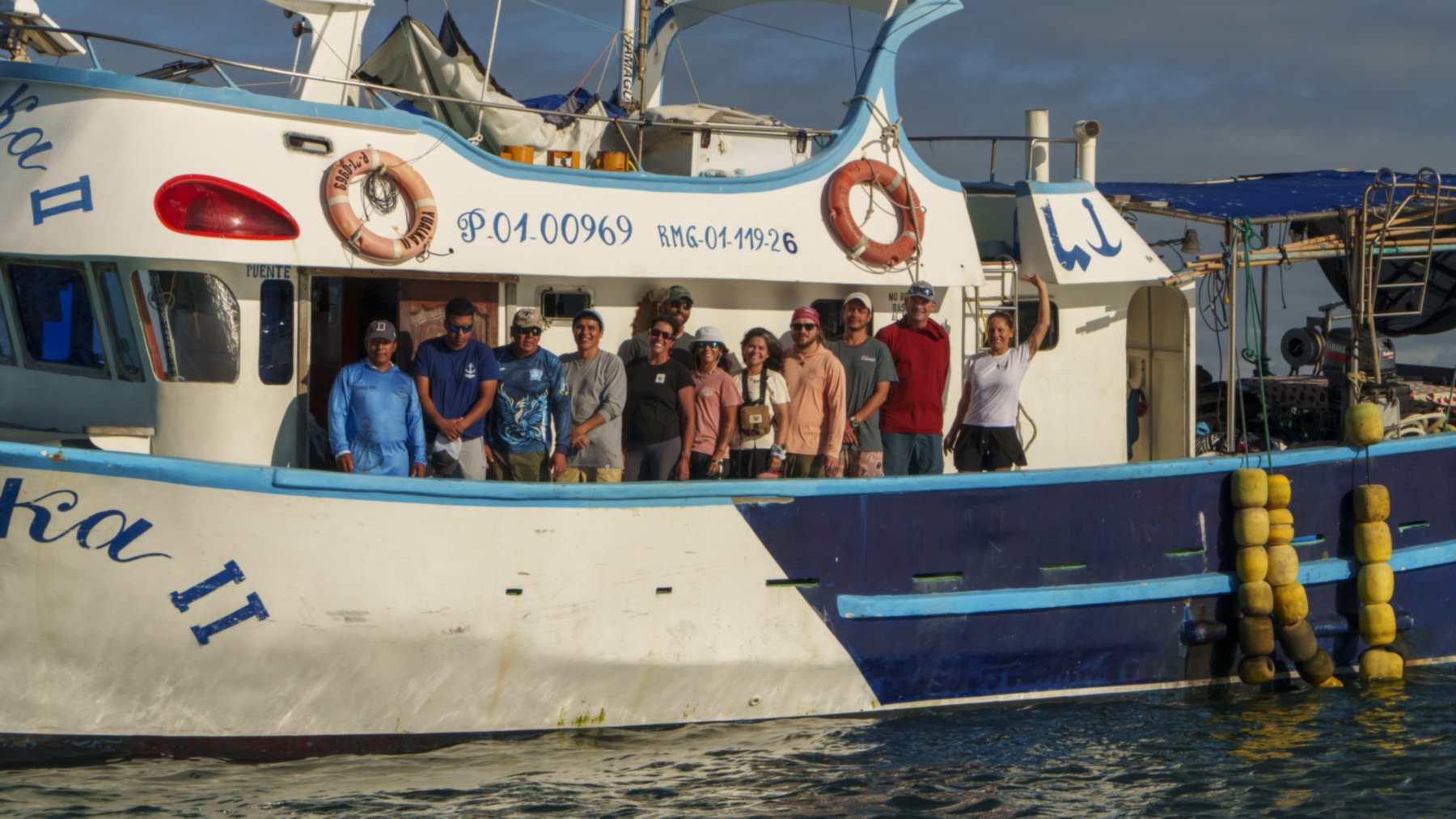
A team of scientists searched for blue whales in the waters around Galápagos between October 2025 and July 2026 and found no specimens. Instead, they measured surface sea temperatures as high as 27.56 °C. The Galápagos Science Center (GSC) regards these values as high for the season.
The team aimed to attach satellite transmitters to several whales to track their routes, but they did not succeed. By September, with the search finished, a guide spotted an adult blue whale with its calf off San Cristóbal.
Four Islands and the Bolivar Channel
The search covered waters around San Cristóbal, Isabela, Fernandina, and Santiago, with a focus on the Bolivar Channel, between Isabela and Fernandina, a region with many historical records of blue whales.
The project was led by Daniela Alarcón and Juan Pablo Muñoz, from the San Francisco University of Quito (USFQ) and the GSC, as part of the Galápagos National Park Directorate’s work, with participation from WWF Ecuador, Oregon State University, and the University of Wisconsin.
With no whales in sight, the group measured water temperature and collected plankton samples, the tiny organisms that drift in the sea and sustain the food chain.
Sea of up to 27.56 °C
On the surface, the water ranged from 25.52 to 27.56 °C, and at 100 meters depth the instruments recorded between 19.11 and 19.67 °C.
The GSC compares these figures with the cool season, from June to November, when surface temperatures typically range from 19 to 24 °C in the center and east of the archipelago and from 16 to 22 °C in the Bolivar and Fernandina channels to the west.
The 20 °C isotherm, which indicates the depth at which the water reaches that temperature, is usually found within the islands between 20 and 45 meters. This time it appeared between 78 and 96 meters, about 55 meters deeper than the midpoints would suggest.
By late August, Ecuador declared a nationwide Red Alert due to El Niño, and some coastal and island stations recorded sea levels up to about 40 centimeters above normal. In September, NOAA projected a 75% probability that this El Niño would surpass all those recorded since 1950.
Krill, in Another Layer
Blue whales feed mainly on krill, tiny crustaceans that they filter with their baleen, and according to NOAA the largest individuals can swallow about 5.4 tons per day.
During the expedition, the band of temperatures where these whales feed stayed close to 60 meters, while their prey was in a higher layer. According to the press release, “the food was concentrated at one depth, and the temperature ideal for the whales at another.”
In a 2024 study in the journal Animals, Héctor Guzmán, from the Smithsonian Tropical Research Institute, and two coauthors tagged 16 blue whales in the Galápagos between 2021 and 2023 and found that, for feeding, they preferred cooler waters with more chlorophyll. The same work links the 2023 El Niño to changes in sea temperature and primary production, which the authors say likely affected the available prey.
Mother and Calf at Punta Pitt
In early September, the Cetácean Galápagos citizen science network reported an sighting at Punta Pitt, on San Cristóbal, where naturalist Isis Lara and captain Edwin Buenaño observed an adult blue whale with its calf.
For the GSC, that record “reinforces the need to study variations in arrival times” and the zones used by the whales within the archipelago. In 2025, a standardized monthly protocol logged 45 sightings, and August accounted for most of the season.
A 2023 study in the Journal of Cetacean Research and Management, by Judith Denkinger, Alarcón and four other authors, reviewed sightings from 2001 to 2018. Eighty-two percent occurred during the austral winter, and calves appeared between June and September, but since they also observed whales in summer, the authors speak of indications of “a non-migratory blue whale population.”
From Isabela to Peru
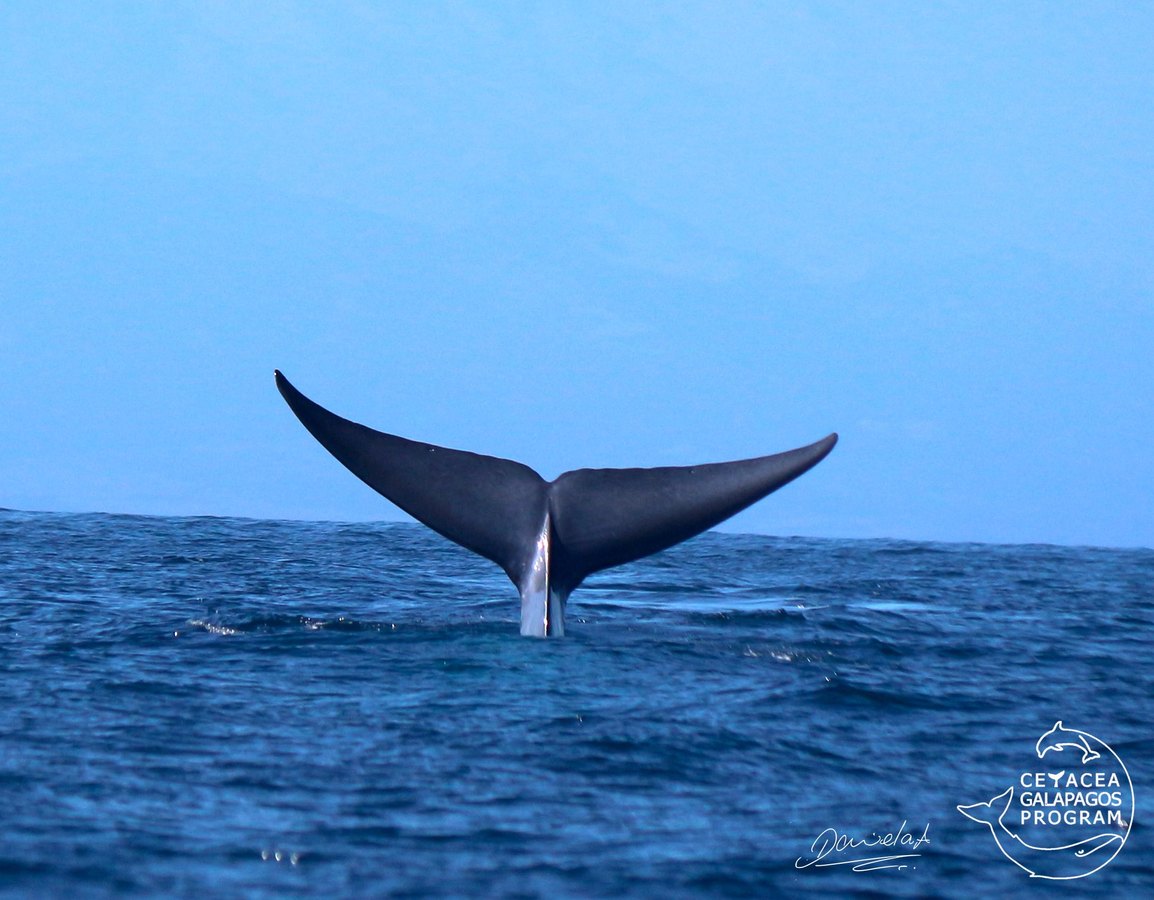
In the 2024 study, most tagged whales stayed near the islands, especially around Isabela, an area seeing increasing tourist boats and where the authors warn about collision risks. Some ventured into Ecuador’s exclusive economic zone, and one migrated south to Peru.
According to the GSC, some blue whales feeding in Chilean waters migrate to Peru and Ecuador, and a large portion of that journey remains unknown. Chile is already working to protect its whale corridor against ship strikes.
The expedition is part of the Eastern Pacific Blue Corridor, an initiative of WWF. Its head, Yacqueline Montecinos, explains it in the WWF Ecuador note: to conserve the planet’s largest animal, “it’s not enough to protect the places where we manage to see them.”
NOAA cites ship strikes and entanglement in fishing nets as the main threats, and one possible measure is to reduce ships’ speeds to protect cetaceans.
El Niño, no proven culpability
Scientists cannot attribute the absence of whales to El Niño, nor claim that migration has permanently changed, and the current season has not yet ended.
Alarcón emphasizes: “Not finding whales during an intensive search does not mean they have stopped arriving to Galápagos.” She proposes cross-referencing sightings with ocean data.
The 45 records from 2025 are sightings, not distinct animals, and on their own they do not indicate whether the population has declined. The GSC released the statement on September 23, 2026, and WWF Ecuador on September 29.
Photo: Galápagos Science Center
