
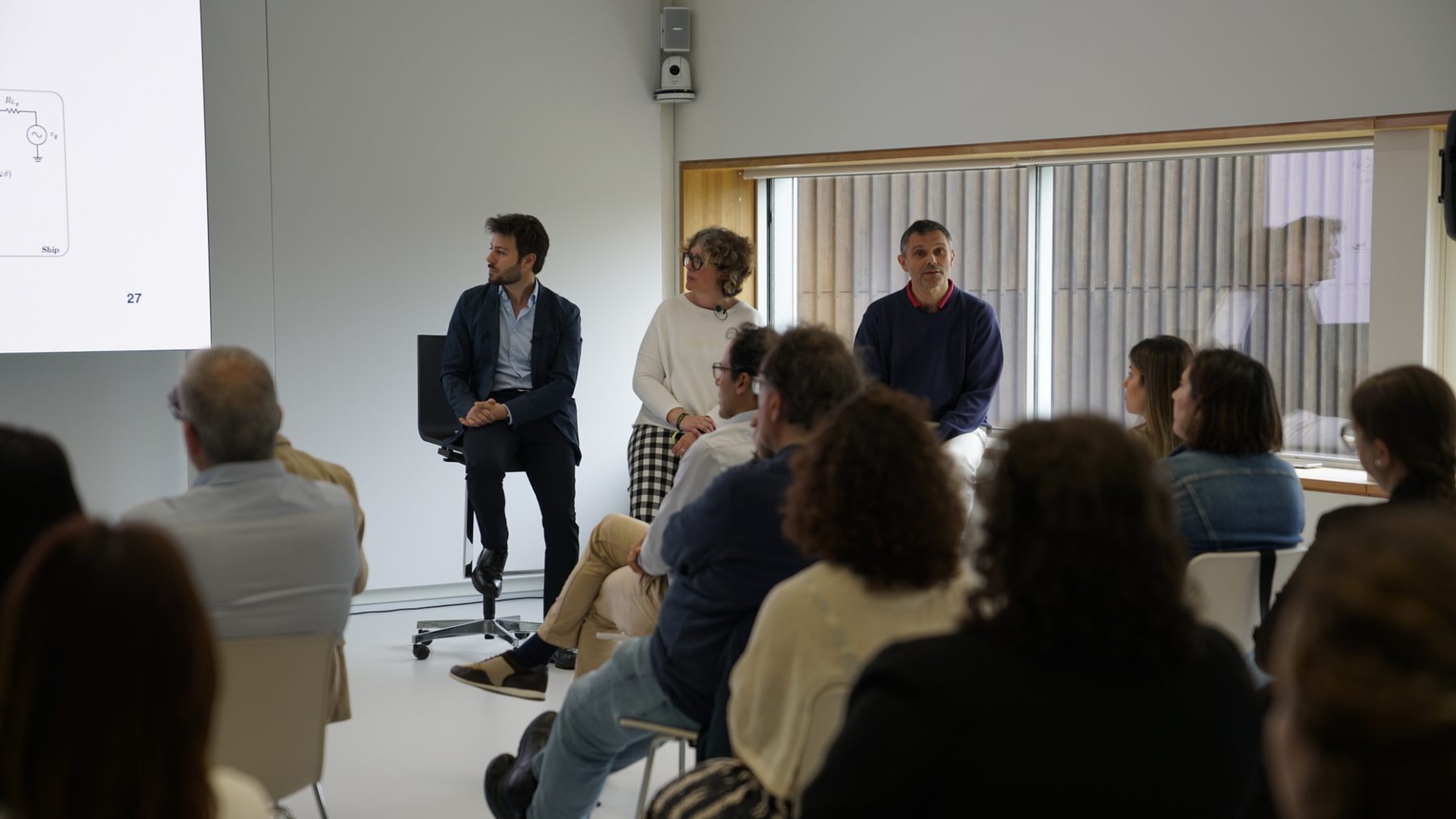
Three Galician teams are building a converter for ships. Their mission is for berthed vessels to draw power from the port’s electric grid instead of burning fuel. The project is called FISTERRA, it started in 2024 and, according to the second annual report, at the end of 2025, they had already begun manufacturing their first prototype.
Behind it are Norvento Enerxía, the Centro Tecnolóxico de Automoción de Galicia (CTAG), and a group from the Universidade de Vigo, with a budget of 2,659,287.76 euros from the Xunta and FEDER funds. And what would the air in the ports gain? According to their calculations, with 32 European ports, more than 583,000 kilograms of sulfur dioxide would be avoided annually.
Un enchufe para buques atracados
Anyone living near a dock knows that constant hum and the smell of smoke well. FISTERRA aims, in the company’s words, to “drastically reduce fossil fuel consumption on ships.” And that includes arrival, berthing, and departure.
The key component is a multi-megawatt power-electronics converter. In practice, it acts as a bridge between the onshore grid and the ship’s electrical system. And they do not always speak the same language.
Norvento recalls that 80% of goods travel by sea. That movement accounts for 15% of annual NOx emissions and 13% of SOx emissions. For years, the European Union has been pressuring to cut emissions from maritime transport.
583,000 kilos menos de azufre
Attention, because those 583,000 kilograms come from the company’s own calculation. Brussels considers 319 maritime ports essential, out of more than 1,200 commercial ports in Europe. If the converter reached only 10% of them, about 32 ports, the savings would exceed 583,000 kilograms of SO2 per year.
Norvento compares it to what would be released in a year by more than 47.8 million cars. Impressive, of course. But for now it’s a paper calculation and the project itself acknowledges that it will be adjusted.
Hybrid cooling and dual response
What makes this device special? Norvento, which calls it the nGM series, promises, thanks to its cooling, roughly twice the dynamic response of today’s offerings. When they unveiled it in June 2025, they spoke of hybrid cooling (liquid plus air conditioning) and packing more power into less space.
It also carries its own control software, which should react sooner. And it does more things, such as integrating renewables, compensating reactive power, or stabilizing both sides of the plug. It’s not just a cable on steroids.
Its creators also see uses beyond the sea, such as producing green hydrogen. They also mention leveraging catenaries for ultra-fast charging of electric vehicles, in line with fast charging using recycled batteries at Vigo port.
Tablets, QR codes and digital twin
In the second year of work, Norvento completed the first version of the design and started refining it. With the University of Vigo, they tested on computer the most delicate control components. In parallel, they prepared the test facility and began assembling a prototype that will not be sold.
Meanwhile, at CTAG they have been refining a digital twin of the future factory, a virtual model to calculate people and machines. They also have a ready augmented reality app that operators will carry on a tablet for the final inspections. Each inspection generates its own QR code, linking it to its station.
And in Vigo? There they simulated several “grid-forming” converters (GFM) operating at the same time to see if the port-to-ship connection can withstand the load. It may sound like jargon, but that is what it takes to ensure the ship does not go dark.
Seven jobs and more automation
The project foresees seven technical hires, in research and manufacturing. And it gives preference to women with prior experience. The idea is to move from semi-industrial, low-volume production to a more industrial and highly automated process.
This is not the first time the Galician company has ventured in this field. Norvento already launched an energy-storage system at CIUDEN, in Cubillos del Sil (León). They are no strangers to testing.
No power and no test port yet
Open questions remain, because the data sheets do not say how many megawatts the final converter will deliver. They also do not specify at which port it will be tested with real ships. And there are still no published tests.
The end-of-2025 report placed prototype validation “in the coming months,” and since then there have been no published results. Until they exist, the 583,000 kilograms remain a projection. Promising, yes, but still a projection after all.
Norvento has published the full information on the official FISTERRA page and in its second-year report.
Photo: Norvento
