
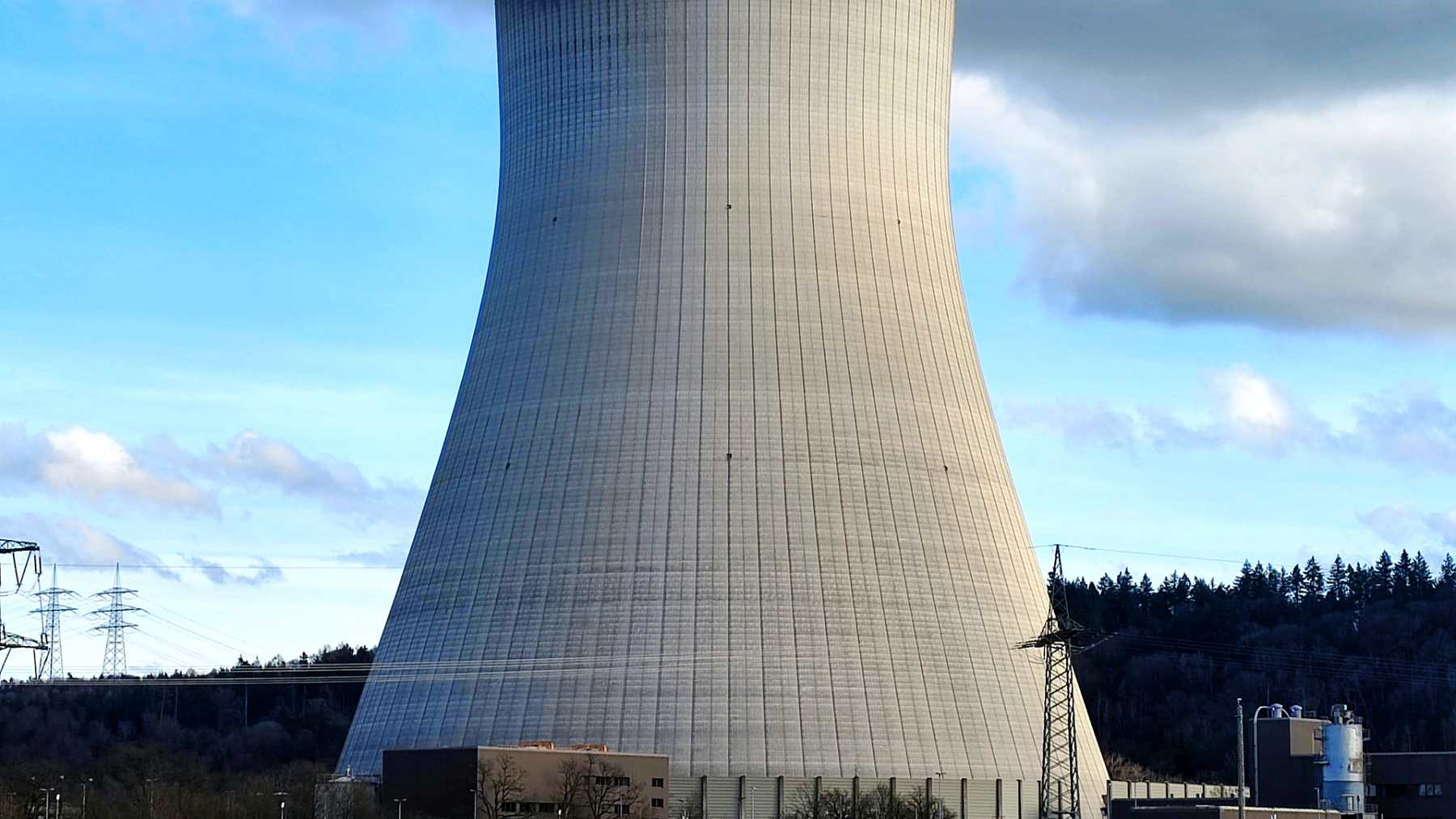
The surroundings of the former Isar II nuclear power plant, in Bavaria, could usher in a new era tied to renewable energy. The firm Advisum proposes to build in Niederaichbach a 900 MW battery storage facility, accompanied by a 100 MW data center for artificial intelligence.
Storage makes it possible to store electricity for use when needed, which is especially useful with variable sources like sun and wind. In this case, the initiative has the backing of the Bavarian government, but it remains just a project.
What remains after the shutdown
Isar II stopped producing electricity on April 15, 2023, when Germany shut down its three last nuclear plants. According to a response from the federal government released by the Bundestag in August 2026, the three facilities are still in the process of dismantling and are removing components that are no longer needed.
Shutting down a plant does not equate to emptying it overnight. The federal government notes that, although the reactor cores have been unloaded, the facilities still contain nuclear fuel. That dismantling work remains open-ended.
Storing the noonday sun
Bavaria has reasons to seek more storage. In 2025 alone, it added a net 4,675 MW of solar photovoltaic capacity, according to the balance published by its government in May 2026, a growth that allows more electricity to be produced when the light conditions are favorable.
The problem arises when that production coincides with low demand or with transmission lines unable to carry all the electricity. The ministry itself explains in its information on grid connections that this happens increasingly around midday in summer and may force a reduction in solar generation.
What changes with a battery? It can store part of that energy and release it later, when the sun goes down and we are still cooking, turning on lights, or using appliances. As the U.S. Department of Energy explains, storage allows separating the time of production from the time of consumption, although some energy is always lost in the process.
What the 900 MW means
The announced figure describes the capacity of the installation, that is, the rate at which it can deliver electricity. To know how long it can do so, one must also know its energy capacity, expressed in megawatt-hours (MWh), a distinction explained by the U.S. Energy Information Administration.
Let’s consider a simple example, unrelated to this project. A battery with 900 MWh of usable energy could theoretically deliver 900 MW for one hour, while it would require 1,800 MWh of usable energy to maintain that power for two hours. These are different quantities, even though both capacities could share the same maximum power.
The Advisum press release does not specify the capacity in MWh. Without that data, it is not possible to calculate the autonomy or to claim how many households could be supplied for an entire night.
A link to the North
Isar is also the southern end of SuedOstLink, an infrastructure designed to move electricity from northeastern Germany to Bavaria. According to operator 50Hertz, the corridor between Wolmirstedt and Isar is about 540 kilometers long and envisions two connections of 2,000 MW each.
Its function is to bring renewable generation, especially wind from the north, closer to homes and industries in the south. This helps explain the site’s appeal for storage, although building transmission lines and developing batteries are separate projects, with their own work and schedules.
AI also consumes
Advisum places the battery and the data center on a planned five-hectare site. This second installation would increase electric demand, because data centers need to power both their computing equipment and their cooling systems, as described by the International Energy Agency (IEA).
The energy footprint of these facilities is growing rapidly. The IEA calculates that global electricity consumption by data centers rose by 17% in 2025 and warns of the need to coordinate their expansion with grids and supply. Therefore, co-locating storage and computing in a single place requires planning for both uses together.
What remains to be decided
The announcement does not set a commissioning date nor quantify savings for consumers. The IEA notes that the impact of new data centers on prices depends on electricity supply, the investments required, and how their costs are distributed.
With the information available, it would be premature to translate this project into a concrete reduction of the electricity bill.
The official announcement of the initiative was published on September 9, 2026, by the Bavarian Ministry of Economy, Regional Development and Energy.
Image: Helmlechner / Wikimedia Commons (CC0)