
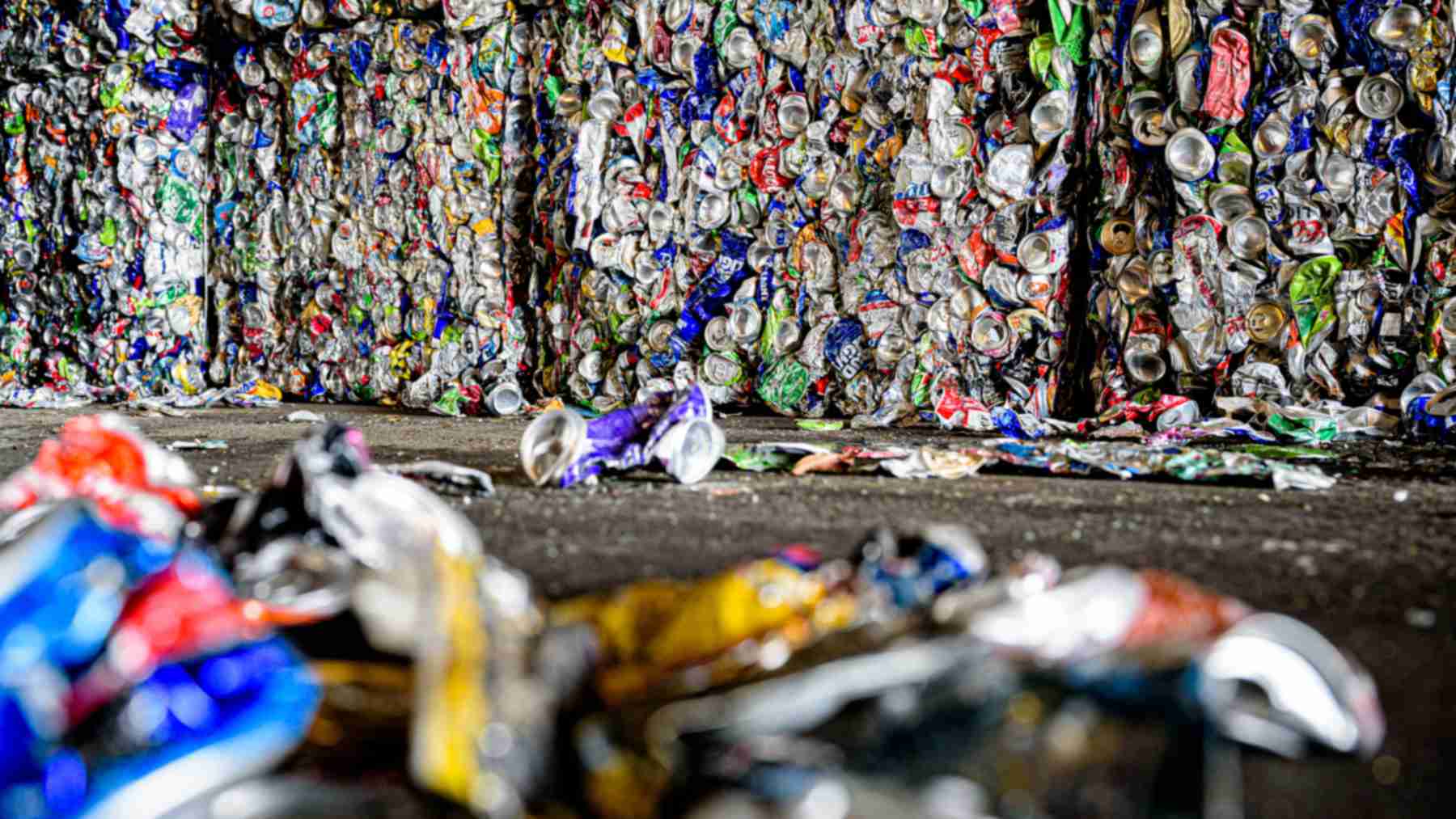
Of every 100 aluminum cans sold worldwide, 77 are collected for recycling and 76 end up re-melted into metal. These are the figures from the 2026 edition of the Global Beverage Container Recycling Dataset, which places the can ahead of PET bottles (54%) and glass bottles (51%).
The data were presented on September 22 in New York by the Global Beverage Can Circularity Alliance (GBCCA), an alliance of aluminum producers, can manufacturers, and recyclers. The calculation was carried out by Eunomia Research and Consulting at the request of the alliance.
“Aluminum beverage cans are collected and recycled at a higher rate than any other major beverage packaging format worldwide,” summarizes the note from the International Aluminium Institute (IAI), which coordinates the alliance.
Three Containers Measured by the Same Standard
The study compares three formats: aluminum cans, PET bottles, and glass bottles. PET is the transparent plastic used to manufacture nearly all water and soft drink bottles.
For each format, two figures are provided. The collection rate measures what share of sold containers reach a container, machine, or recycling center. The recycling rate measures what share leaves the process as material ready to manufacture something new.
For cans, the collection rate is 77% and the recycling rate 76%. For PET, collection is 69% and recycling 54%. For glass, 56% and 51%, respectively.
The gap between the two figures represents the material collected but lost along the way, in sorting or smelting. For cans, it stays at one point, and for PET bottles it is 15 points.
The results are based on markets that together account for at least 84% of global sales for each format. The data sheet published by the IAI includes 35 entries, with Europe counted as a single market.
From Brazil and Japan to the United States
The global average hides enormous regional differences. According to that data sheet, Brazil recycles 97.1% of its cans, Japan 94.7%, and China 98%. Europe, counted as a single market, stands at 76.3%, and the United States at 43%.
Regionally, East Asia and the Pacific reach 94.2% and Latin America and the Caribbean 94.1%. North America sits at 45.3%.
Ramon Arratia, sustainability director at Ball Corporation, one of the major can manufacturers, explained the Brazilian case when the first edition of the study was published in November 2025. “In Brazil, the average recycling rate of aluminum beverage cans has been 98% over the last 15 years,” he said.
Arratia attributed that result to the value of aluminum, “but also to the work of more than 800,000 recyclers who collect cans across the country for recycling.” He added that these workers “play an important role in recycling in the Global South.”
Almost One Point Higher Than in the First Edition
The 2026 edition is the second in a three-year series, with reports in 2025, 2026, and 2027. The first, presented at the COP30 climate summit in Belém (Brazil), placed can recycling at 74.8%, based on 2023 data.
Then Marlen Bertram, director of Scenarios and Forecasts at the IAI, spoke. “This milestone shows real progress in keeping aluminum in circulation and out of landfills,” she said during the presentation of the first report.
Bertram also pointed to a fundamental problem. “Too many regions still lack precise recycling data, a gap we must close through closer cooperation between governments and industry,” she stated.
Andy Grant, chief technical officer of Eunomia, the consultancy that performs the calculations, pressed the same point at that 2025 presentation. “With better data we can set more effective targets, track progress, and ultimately close the global recycling gaps,” he said.
This year the study adds analyses of five rapidly growing markets where recycling systems are still developing: Indonesia, Nigeria, Saudi Arabia, Turkey, and India.
The 80% Target for 2030 Remains Far Off
The sector has set itself the goal of recycling 80% of used cans by 2030 and approaching 100% by 2050. With 76% in the 2026 report, four percentage points remain and four years to go.
The alliance itself concedes that the results “also show that more remains to be done.” Closing that gap, it notes, “will require sustained investment in collection and sorting worldwide.”
In Spain, Aluminum Lags Behind
In Spain, the figures Ecoembes reports to the Ministry for Ecological Transition refer to aluminum packaging as a whole, a broader group than beverage cans. In the domestic packaging covered by Ecoembes, that group was recycled at 57% in 2025.
Rosa Trigo, CEO of Ecoembes, explained this at the shareholders’ meeting of June 17, 2026. According to her figures, in 2025 97% of steel packaging, 89% of paper and cardboard, and 62% of plastic packaging were recycled, with an overall rate of 74.6% included in Ecoembes’ 2025 recycling results.
In separate collection, aluminum was the only material that did not meet its target. “We are less than two points away from reaching the target, which we will achieve in 2026,” Trigo said, according to the transcript of her speech.
Two years ago, in 2024, it was already noted that only half of aluminum packaging was recycled in Spain. The debate on how to recover more cans now blends with the planned deposit system for returning bottles and cans, and with the European requirement to use more recycled plastic in beverage bottles.
What the Report Does Not Clarify
The study is commissioned by the aluminum and can industry itself, which has an interest in ensuring its packaging fares well against plastic and glass. The calculations are carried out by an external consultancy aiming to present a coherent and comparable image over the three years.
PET and glass rise considerably more than cans compared with the first edition, which gave them 47% and 42%. Neither the press release nor the summarized data sheet explains what accounts for this jump.
The global average does not apply equally across markets. In Europe, the data sheet assigns glass a 76.2% rate, essentially the same as cans, while in the United States only 23% of glass and 18% of PET are recycled.
Moreover, the Spanish figures from Ecoembes and the global GBCCA figures are calculated differently and should not be compared one-to-one.
The International Aluminium Institute has published a summary of the 2026 data in an Excel sheet; the complete methodological report remains that of the first edition.
Already at the presentation of the first edition, in 2025, Grant warned: “This study reinforces the need to continually improve recycling infrastructures and policies.”
Photo: City of Greenville, NC (public domain)
