
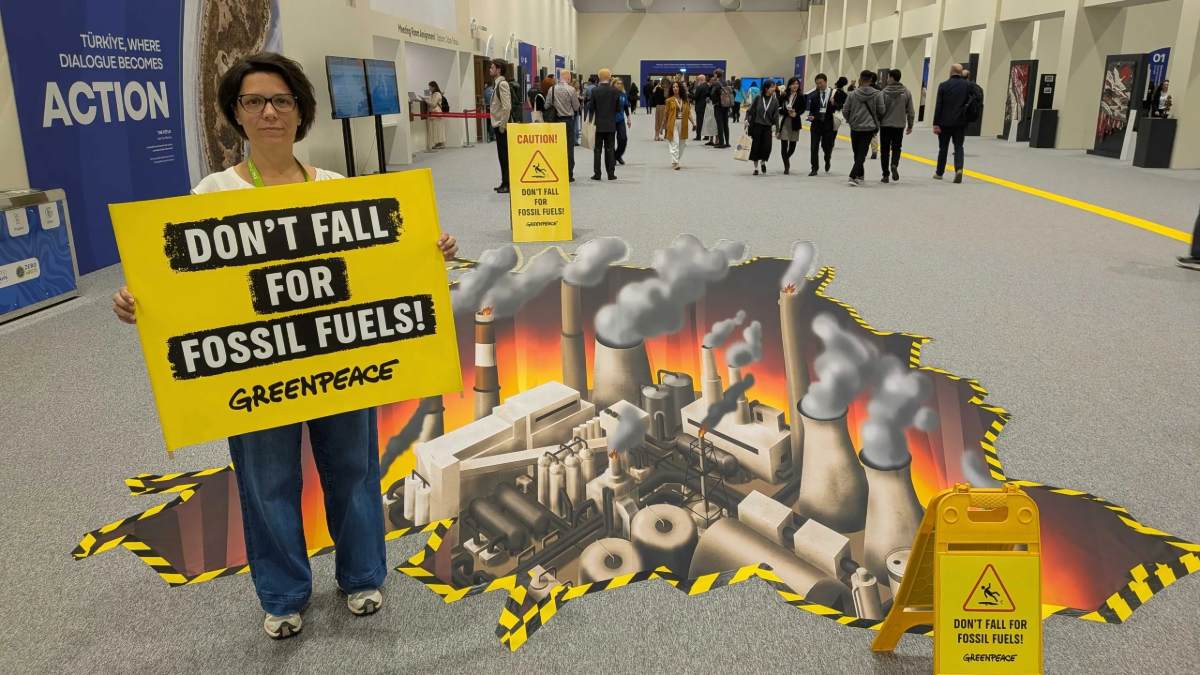
Greenpeace warns that the COP31 ends without an agreement to accelerate the phase-out of coal, oil and gas, months after the UN announced that the 1.5 °C safety threshold will be exceeded.
Spain pledges to abandon fossil fuels before 2040, while Greenpeace demands taxes on oil companies and denounces a just transition without funding
Eva Saldaña, executive director of Greenpeace Spain and Portugal, has stated: “The outcome of this COP31 is a chilling paralysis when action is most needed and it is tremendously humiliating for those who are already suffering the climate crisis. Blocking the abandonment of coal, oil and gas and letting climate finance be hijacked by the Global North gives a lifeline to oil companies while condemning the population to more heat waves, fires, floods and avoidable deaths. In addition to being reckless, it is unforgivable to keep wasting so much valuable time when we are already hovering near the 1.5 °C limit.”
The Government of Spain has taken a step forward by proposing a plan to abandon fossil fuels and arguing that the agreement should reflect this and avoid false solutions. However, it has not had enough clout to stop the Global North — and especially the European Union, despite its historic responsibility — from dodging the international financing demanded for adaptation and a just transition. Climate change knows no borders, and without global action or solidarity, we will keep patching things up while lamenting preventable tragedies. For pure social justice, it is essential that the fossil fuel industry pays new taxes to fund the disaster it is causing.
We value that Spain has promised a fossil-fuel phase-out plan, which is a starting point but still lacks adequate financing, concrete strategies, and 2040 as an non-negotiable deadline. Whatever government takes office after the next elections, the interests of the Spanish people require us to cut fossil dependence at its roots and to arrive at COP32 with ambitious financing commitments, not with propaganda.
We need brave leaders who place life above the fossil-fuel business, advance firmly along parallel multilateral avenues such as the Santa Marta process, and open decisions to greater civil society participation. Let no one mistake this outrage for resignation: hope will not fall from the offices, it is earned by an organized citizenry that does not give up and will fight with even greater strength in the streets, in institutions, and at the ballot box until bending the arm of those who sabotage our future.
Jasper Inventor, head of Greenpeace’s delegation at COP31, has stressed: “We came to COP31 to end fossil fuels, not to promote them and extend their life. It is utterly disappointing to leave without a result that defines steps to end fossil fuels. A flawed agreement favorable to the fossil-fuel industry was blocked, but that represents a defeat for the population that is already suffering the climate impacts. As always, the most vulnerable people are the ones bearing the worst consequences of the climate crisis. We have run out of time to avoid exceeding 1.5 °C, but we can still keep alive the goal of returning to that temperature limit as soon as possible.
This is the fight for our future, and we remain hopeful. We have seen countries striving to move forward, presenting plans to end fossil fuels. But we have also seen oil, gas, and coal producers trying to derail agreements and keep them out of the final outcome. This blockade is unacceptable. We continue to fight for a just transition to a renewable future both within COPs and beyond these spaces. But if the COPs do not advance climate action, perhaps it is time to rethink the process.
The European Union, flagged by Greenpeace: calls for ending fossil fuels, but dodges climate financing
The European Union has also contributed to undermining confidence in achieving an ambitious agreement, by declaring even before COP31 began that progress on climate finance was “doomed to fail” in Antalya. The blockage on fossil fuels is no excuse for the EU’s stance from the outset. Global North countries must look in the mirror, meet their climate-financing obligations, hold oil and gas companies accountable, and make them pay for the climate damages they cause.
This summit started badly from the outset, with Global North countries arriving in Antalya with nothing to offer on climate finance and trying to shift their financing obligations onto the Global South, which has blocked negotiations. There has been only minimal progress on the vague objective of tripling adaptation financing agreed at COP30, which still lacks a concrete figure. Negotiations on a Just Transition Mechanism have not concluded after the Global North refused to turn it into a constituted body, breaking their COP30 promise.
Greenpeace denounces COP31 failure: blocking the phase-out of oil, gas and coal sparks ecological outrage
Emel Türker Alpay, Climate and Energy Campaign Lead for Greenpeace Turkey, stated: “The longest COP in history has ended in an utterly disappointing fashion. We have witnessed how countries with the greatest historical responsibility refused to provide funding, while clinging to fossil fuels, in the face of millions of people paying the price of the climate crisis.
The Turkish presidency promised a COP of dialogue, consensus and action, but that promise has not been fulfilled. The leadership needed to place the world on a path toward real fossil-fuel abandonment has not materialized; on the contrary, fossil-fuel interests have undermined the agreement.
A year ago in Belem, Global North countries pledged to create a mechanism for a just transition. In Antalya, they have reversed course. Without an institution and without funds, the just transition is merely a slogan, and workers and local communities will pay the price. The EU cannot defend the end of fossil fuels if it does not commit to funding the just transition that would make it possible. Together with fossil-fuel producing countries, the EU has left local communities and workers empty-handed after COP31.
Shiva Gounden, Pacific lead for Greenpeace Australia Pacific, has noted: “They called this a COP of “implementation,” but implementation means nothing when the foundations are broken. The communities bearing the brunt of climate change demand urgent and definitive action in the face of the stark reality of surpassing 1.5 °C. Instead, Global North countries have turned away from their historical responsibilities, hijacked climate financing, and used their debt as a mere bargaining chip.
Billions of people around the world strive to defend their lives, homes, cultures, and livelihoods with all their might, and we came here with their voices demanding real action. By refusing to provide financing and by pointing to the root cause of this collapse, polluting countries have made a calculated decision to protect their own interests above our shared future. The Pacific will increasingly pursue parallel avenues, such as the International Court of Justice’s Advisory Opinion and the Santa Marta and Tuvalu processes, to keep finding solutions, because that is what our people need.”
