
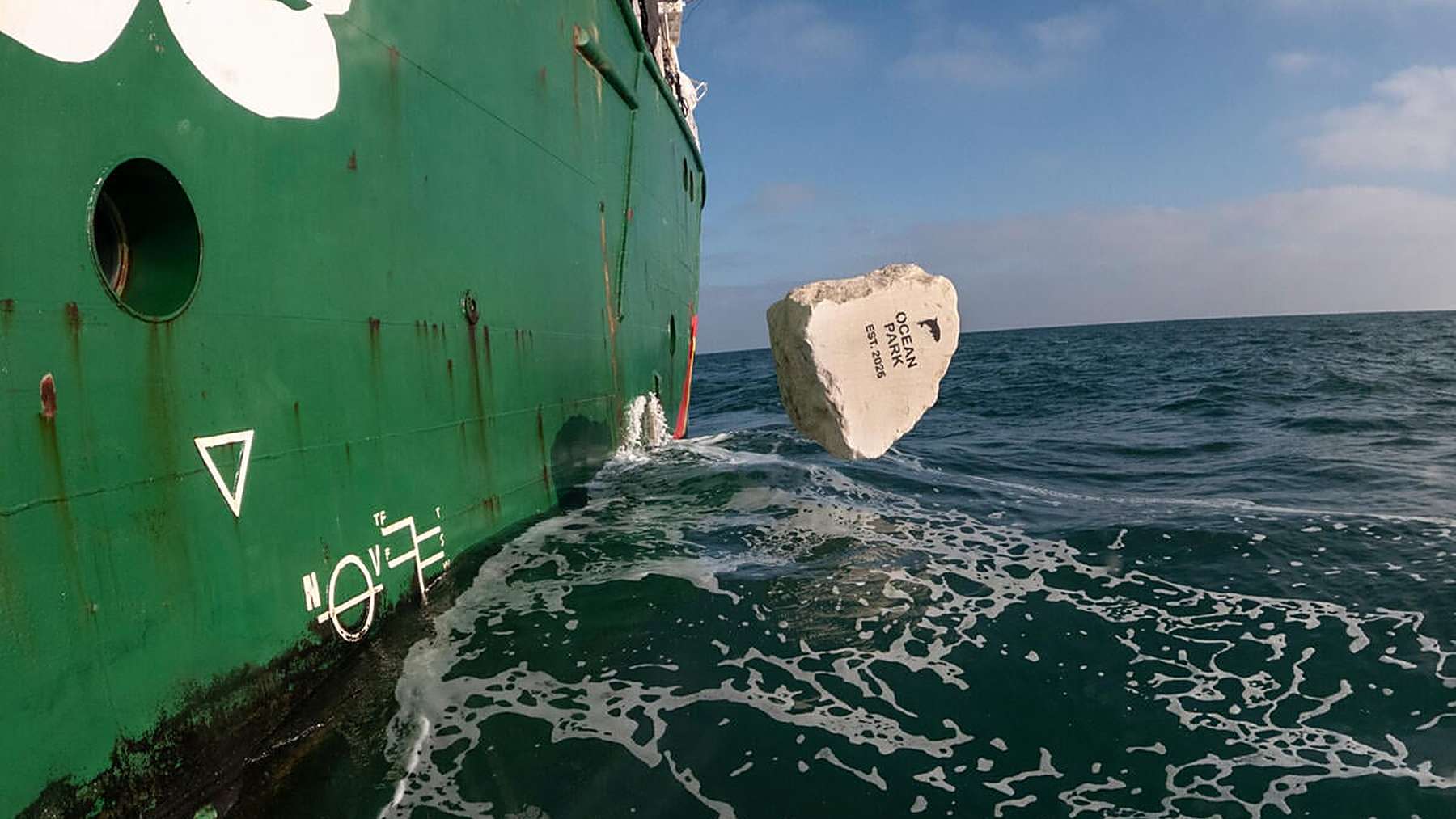
Greenpeace has placed rocks weighing up to two tons on the seabed of the North Sea to curb bottom trawling in 116 square kilometres of a marine protected area off the east coast of England. The announcement came on November 2. They spent the weekend releasing them from their vessel, the Arctic Sunrise.
That same Monday, the English marine regulator published the coordinates to warn fishermen and mariners. Nature protection or a danger in the middle of the fishing grounds? It depends a lot on who you ask.
A harbor porpoise sanctuary
The site chosen, Southern North Sea, was established in February 2019 to protect the harbor porpoise, a small and shy cetacean. According to the scientific body advising the British government, it covers 36,951 square kilometres, from the northern edge of Dogger Bank to Dover. When it was created, no other area of this kind was so large in Europe.
There lives about 17.5 % of the harbor porpoises in Britain’s North Sea, though Greenpeace rounds up to nearly 20 %. In summer, the northern part matters most to them, and in winter they concentrate mainly in the south. The rules require that they are not disturbed too much and that they have enough to eat.
But almost all of that sea remains open to the fleet. The trawling bans affect only the portions that also touch two other protected areas, Dogger Bank and Haisborough, Hammond and Winterton. Greenpeace compares it to letting excavators into a national park.
37,200 hours of trawling
Behind the protest lies Greenpeace’s own analysis using data from Global Fishing Watch. In 2025, vessels spent at least 37,200 hours trawling gear here. No other offshore British area reached such a total, though the method is only disclosed to those who request it.
With all those figures combined, the NGO arrives at 115,000 hours and 55,600 square kilometres swept in a year. Watch that last number. It counts every pass, so the same patch of seabed can add up two, three, or more times.
Sound familiar? Bottom-trawling in protected areas is also contentious in Europe. And what is allowed in Natura 2000 networks remains unresolved.
Nine points on the chart
According to the NGO, its team called the authorities every time they dropped a rock. The Marine Management Organisation (MMO) has published nine coordinates in the southern North Sea. It notes, however, that it has not verified all the positions, which Greenpeace handed over to the coastguards.
Those 116 square kilometres account for around 0.3% of the protected area, so the barrier is mainly a show of force. Some rocks bear the signatures of Benedict Cumberbatch, Simon Pegg, and several MPs. And the Arctic Sunrise will continue patrolling the area in the days ahead.
“We’re doing what the Government isn’t doing,” summed up Will McCallum, co-director of Greenpeace UK. The action coincided with the premiere of Blue Planet III on the BBC, something the NGO highlights in its note.
The license that ended up in court
In February 2021 the organization carried out two actions at sea that, according to the MMO, required a marine license and did not have one, and the regulator took the case to court. In January 2022, the Newcastle Crown Court confirmed that the MMO had jurisdiction. A month later, the MMO dropped the accusation, among other reasons because Greenpeace had not reoffended.
Now the rocks have returned to the water, and neither Greenpeace’s note nor the MMO’s press release of November 2 mention licenses. In its blog, the NGO defends that it is a “safe and peaceful” protest and a last resort.
The veto still has no date
The United Kingdom has committed to protecting 30% of the sea by 2030. According to the NGO, only 43 of its 378 marine areas ban bottom trawling outright, and the consultation to ban it in part in another 42 has been dragging on for more than a year without result. Nor is this an isolated case, because many marine areas still lack effective protection.
Southern North Sea awaits its turn in a later phase, still without a schedule. The official record, by the way, still lists the harbor porpoise as being in a favorable state in its most recent update, from March 2023. And no one has yet measured whether the rocks will make a difference.
The statement has been issued by Greenpeace UK.
Photo: Andrew McConnell / Greenpeace
