
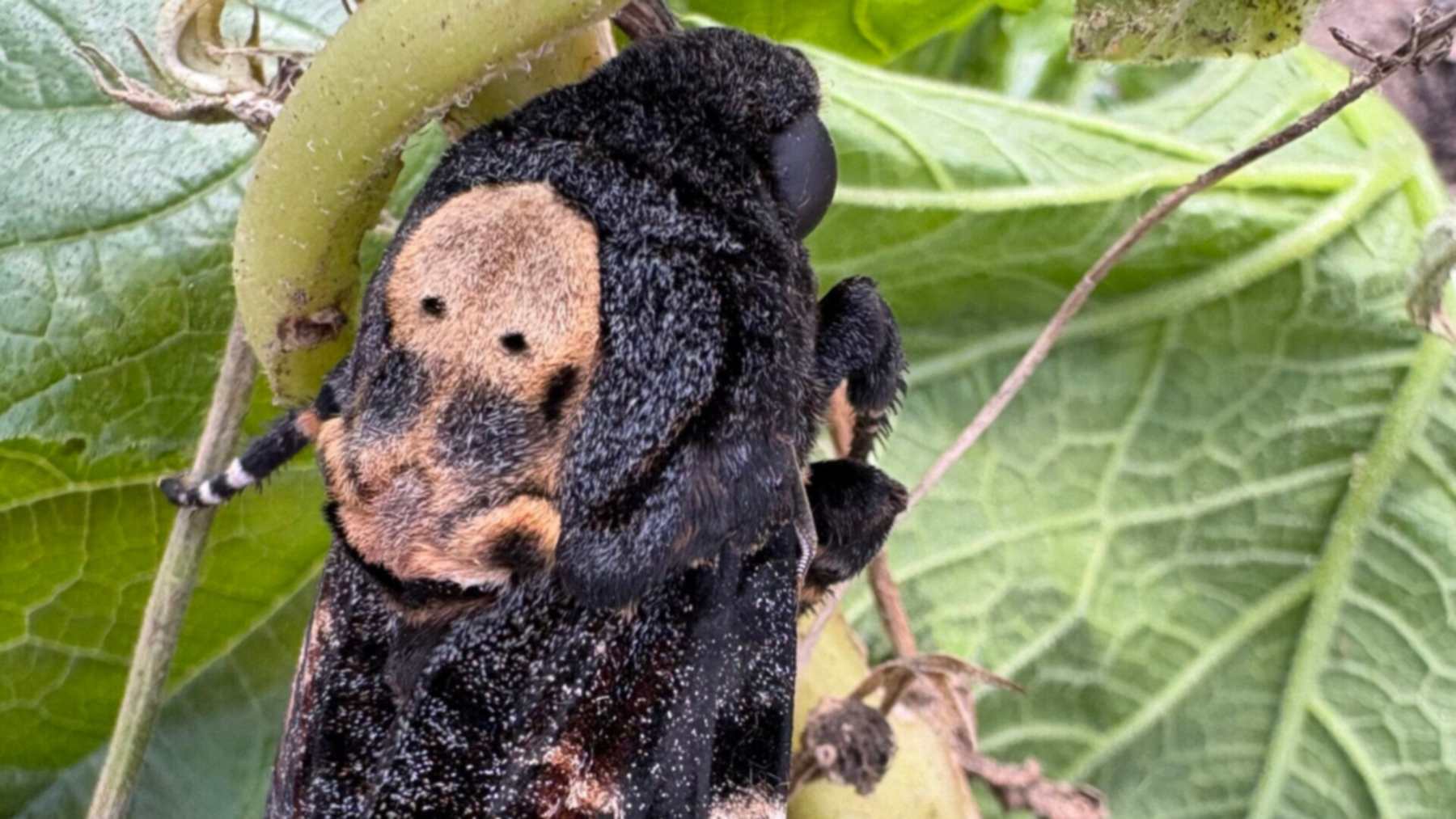
One rainy September morning, Louise Moreton, the horticulturist at Wicor Primary School in Portchester, in the English county of Hampshire, was pulling potato plant debris from the compost when she heard a piercing squeal. She thought it was a mouse, but it turned out to be a Death’s-head hawkmoth (Acherontia atropos), the moth that appears on the poster for The Silence of the Lambs.
The species migrates to the United Kingdom from southern Europe and Africa in small numbers each year. The discovery was reported by the BBC on 9 September 2026, and the students were able to see it before it was released.
A Squeal from the Compost Bin
«It was so loud and so large that I thought, “Oh my goodness, we have another mouse,” but no, it was the gorgeous moth,» Moreton told the BBC.
The local Portsmouth newspaper The News offered more details. «I wheeled a wheelbarrow full of weeds to the compost container and took a good scoop. I heard a very sharp noise and thought it could be a mouse,» she explained. She added: «My first reaction was to run inside with my wellington boots on to fetch the headteacher.»
In the piece she later sent to the National Garden Scheme, the UK network of gardens open to the public in which the school’s allotment participates, she summarised it like this: «What, by the size and colour of its body and its sharp squeal, looked like a mouse, clearly was not as it moved through the compost.»
Why This Moth Screams
According to Butterfly Conservation, the UK charity dedicated to butterflies and moths, adults scream when alarmed, expelling air through the proboscis, the long feeding tube they use to feed.
«The Death’s-head hawkmoth is one of the coolest insects around: it is the largest hawkmoth in Europe; some come flying in from Africa, which gives it an exotic touch; it raids beehives to steal honey and, if someone tries to trap it, it screeches», wrote Pete Hughes, Butterfly Conservation’s senior communications officer, in 2024.
The Skull-Thorax and the 1991 Poster
The name derives from yellow hairs on the thorax, right behind the head, that form something resembling a skull. It has black blotched forewings and hindwings of bright yellow, and Butterfly Conservation assigns it a wingspan of 8 to 12 centimeters, from tip to tip when the wings are spread.
In the 1991 Oscar-winning film, the killer Buffalo Bill leaves pupae of this moth in the mouths of his victims, and the posters show it with its wings spread, covering Jodie Foster’s mouth.
In Europe it was long considered a death omen if it appeared by candlelight, recalls David Britton on the Australian Museum blog in Sydney. «Despite this dark fame, adult moths are completely harmless to people,» he writes.
A Migrant That Cannot Withstand the English Winter
In the United Kingdom it is seen mainly from August to October, almost always in the south and east of England, though it has reached the Shetlands and the west of Ireland. It is nocturnal, and many records come from adults drawn to light traps, much like countless other insects that fly toward artificial light.
Professor Richard Fox, head of science at Butterfly Conservation, explained it in comments to The News. «The Death’s-head hawkmoth is always an exciting species to see in the UK,» he said.
«It is one of the largest moths you can find here: the caterpillar is about the size of a grown person’s finger, and the moth’s wingspan reaches almost 14 cm,» he added. «As a relatively uncommon visitor to the warmer parts of Europe, it isn’t the everyday garden moth, but it can breed here in the summer, with caterpillars often found on potato plants, although those caterpillars cannot survive our winters.»
The school also kept careful records. «Investigating a bit, staff and children observed that only a few reach the UK each year, which makes this sighting rare and very exciting,» Moreton wrote.
The Hampshire and Isle of Wight Lepidoptera Atlas describes it as a rare migrant, much less common there than the convolvulus hawk-moth, though its caterpillars are found more frequently than those of that other species.
The journey can be long. In a 2022 study, a team from the Max Planck Institute for Behavioural Biology and the universities of Konstanz and Exeter tracked 14 of these moths from a helicopter for up to 80 kilometers, finding that they maintained their course by adjusting to wind currents. According to Exeter’s release, the species travels up to 4,000 kilometers between Europe and Africa each year.
«We demonstrated that insects can be large navigators, on par with birds,» said then-Myles Menz, the study’s lead author, published in Science.
Potatoes, Nightshades, and Underground Caterpillars
The caterpillars mainly feed on the leaves of nightshades, including the potato family. When ready, they bury themselves and form a chrysalis, the pupal stage in which they transform into adults, spending four to six weeks underground, according to Butterfly Conservation.
The News notes that the Wicor moth probably reached the container attracted by some potatoes that the younger children had been growing and were composting. This is the newspaper’s best guess: Moreton says the compost contained residual potato plants, but neither she nor the headteacher say that drew the moth.
The caterpillars are not dangerous either. «The caterpillar of this fascinating moth can grow quite large, and its pointed tail may look intimidating, but they are completely harmless to people and animals,» said Sue Smith, chair of the Butterfly Conservation Gloucestershire branch, in 2015.
The Students Met Chianti Before Releasing Her
At the school, they gave it a name, Chianti, according to Moreton’s piece for the National Garden Scheme. Meanwhile, they kept it in a special habitat frame inside the bin to show the students, according to the BBC. «We want the children to share this; it’s a once-in-a-lifetime opportunity,» Moreton said. «They will understand that this is about caring for the wildlife they have brought into their habitat.»
«The children could hardly believe what they were seeing,» she told The News. In her National Garden Scheme article she added that seeing it «has sparked many conversations and a deeper learning about our natural world».
The headteacher, Mark Wildman, felt the same way. «Seeing a rare creature is something very special, and you have to savor and appreciate it,» he said.
At Wicor, all students regularly participate in gardening and learn about soil health, composting, and natural fertilizers, according to the school’s website. A similar practice is followed by more than 4,450 schools with gardens across Spain.
What This Finding Does Not Tell Us
It is a single specimen. Neither the BBC, The News, nor the National Garden Scheme state where it came from or whether it was raised in the school’s own garden, and this record does not yet appear on the county atlas website.
With regard to measurements, the figures vary as well. Fox mentions nearly 14 centimeters, Butterfly Conservation’s data sheet lists 8 to 12, and the Hampshire atlas records 10.2 to 13.5.
The organization asks that if anyone spots a migrant moth, they should report it. «As our climate changes, our scientists are keen to know which species could reproduce successfully in the United Kingdom, survive our winters, and stay as permanent residents,» it writes in its 2026 guide. A recent study estimates that even Europe’s most ambitious conservation policies would not prevent declines in birds and butterflies.
And for anyone with a home composter, the Hampshire and Isle of Wight Wildlife Trust urges caution when turning or overturning the compost, especially in winter, because animals may be hidden or hibernating inside, from common newts to hedgehogs.
The National Garden Scheme published the account of the sighting on 18 September 2026, along with what Moreton and Wildman wrote.
«For many it will be a once-in-a-lifetime sighting, and I certainly never expected to see one,» Wildman acknowledges.
Imagen: Wicor Primary School / National Garden Scheme