
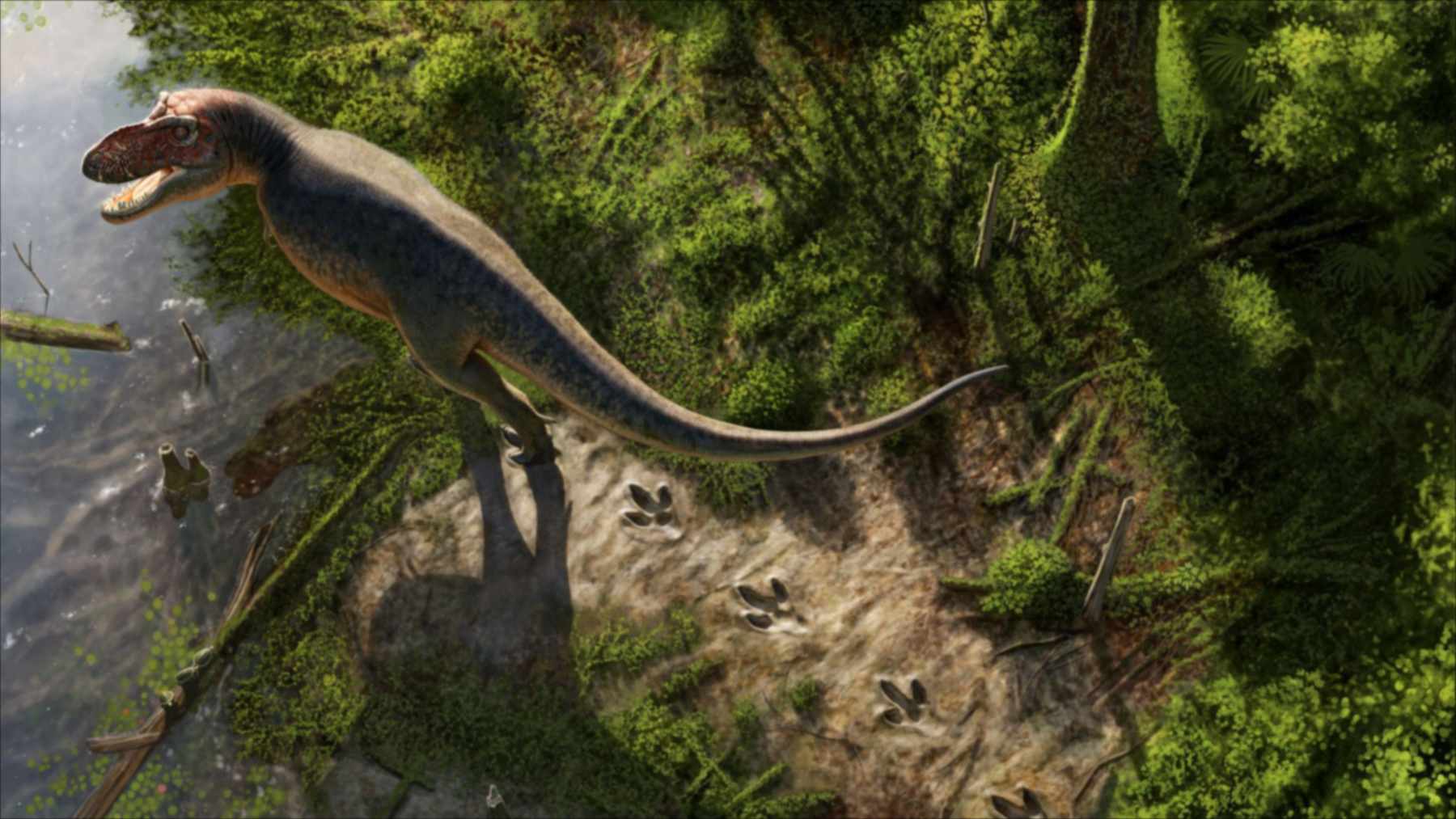
Four footprints, each nearly a meter long, have allowed researchers to reconstruct steps taken about 66.5 million years ago in what is today North Dakota, United States. The scientists present them as the first known trackway of several steps that can be attributed to an adult Tyrannosaurus rex.
The study, carried out by researchers from the Denver Museum of Nature & Science and Liverpool John Moores University, provides clues about how this predator walked. The sequence suggests a movement at a speed comparable to a brisk walking pace, though the wear on the footprints requires careful interpretation.
Four steps that tell a story
The track measures about seven meters in length and preserves two left footprints and two right footprints. It was discovered in 2025 near Marmarth, on federal lands managed by the U.S. Forest Service, within the Hell Creek Formation.
Already isolated footprints attributed to adults of this species were known, but having a sequence adds information about how they moved. It enables measurement of the spacing between each footfall and tracing a short stretch of the animal’s journey.
“The footprints capture a moment of its behavior,” explains Tyler Lyson, vertebrate paleontology curator at the Denver museum. That is where the value of the find lies, bringing us closer to an animal that left signs as it moved across the landscape.
Why it points to T. rex
The identification combines several clues. The exceptional size of the marks, their three slender toes, and the abundance of Tyrannosaurus rex fossils in the surrounding area make an adult of this species the most likely candidate.
That does not constitute a definitive identification, and the study’s own title maintains that caution. For readers, the word “probably” is important because it marks an interpretation supported by evidence rather than a certainty these tracks alone can provide.
Speed comes with caveats
The stride length is about four meters, measured from successive contacts of the same foot. When that distance is combined with the size of the footprints, the study places a rough speed range between 1.5 and 2 meters per second (roughly 5.4 to 7.2 kilometers per hour).
But the authors warn that the animal likely moved more slowly than these values suggest. The uneven preservation and the difference between the size of the foot and the imprint it left introduce uncertainty.
What does this mean in practice? Comparing the track to a brisk walker helps imagine that moment, but these four supports do not allow determining the dinosaur’s maximum speed or how it moved during a chase.
How they withstood the test of time
The footprints were preserved thanks to sand hardened by calcium carbonate around the marks. The authors explain that this material became more resistant than the surrounding rock and ultimately remained exposed as erosion removed the softer sediments.
That resilience did not prevent fractures or the loss of detail. The 66.5 million years is also an estimate, derived from the track’s position between geological layers and its relation to ages from known references.
From the ground to the screen
The discoverer was Kent M. Hups, a professor at Northglenn Institute and coauthor of the research. His find brought together fieldwork in the United States and remote analysis in the United Kingdom, with Peter Falkingham as the study’s lead author.
The team digitized the footprints and the full trackway through high-resolution 3D scanning. Thus, Falkingham could examine them on his computer and in virtual reality without personally visiting the site.
The models allow studying the shapes from different angles and creating three-dimensional physical reproductions. It is a way to share the discovery among specialists and facilitate its study without first moving the original pieces.
A planned trip to Denver
The next step planned is to recover three of the footprints and transport them to the Denver museum for preparation and research. The university tentatively schedules the operation for October 2026 and notes that a helicopter will be required due to the site’s remoteness.
For now, scientific interest lies in those few meters that have survived and in what they allow to measure with caution.
The study has been published in Journal of Vertebrate Paleontology.
Image: Andrey Atuchin / Denver Museum of Nature & Science