
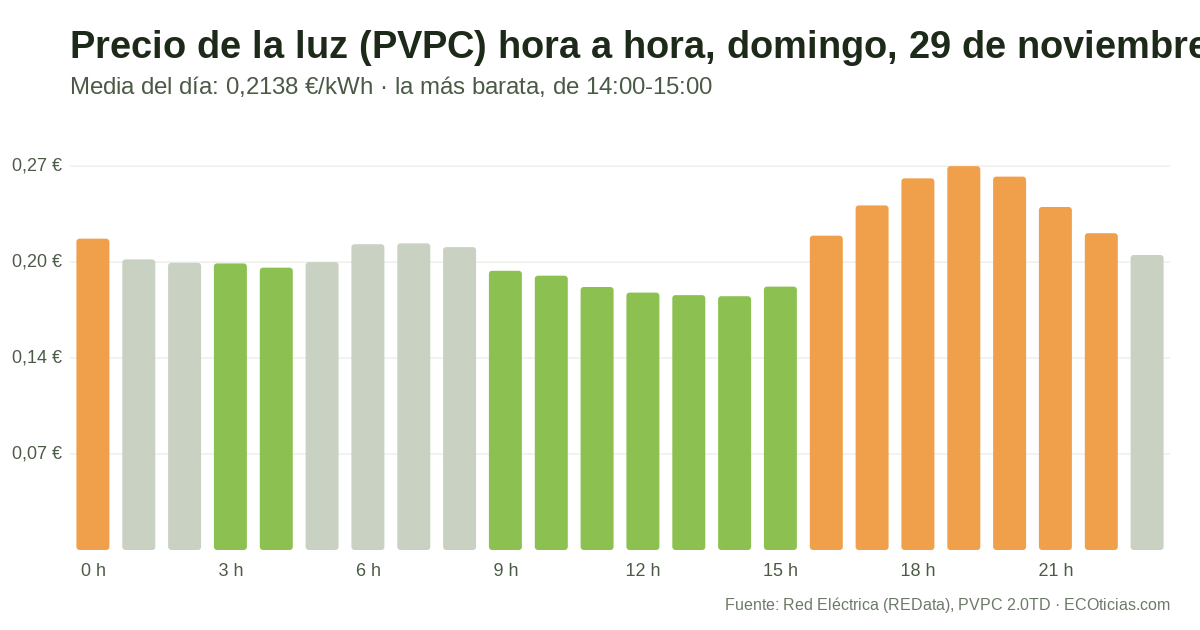
The Saturday average repeats, €0.2138/kWh. The cheapest hour runs from 14:00 to 15:00 (€0.1797/kWh) and the most expensive from 19:00 to 20:00 (€0.2718/kWh).
Being Sunday, in the 2.0TD tariff all 24 hours count as the off-peak period of the tolls, with no flat or peak segments. Not a single hour of the day reaches 28 cents.
The price of electricity today, Sunday, November 29, has an average of €0.2138 per kilowatt-hour in the regulated tariff (PVPC), according to Red Eléctrica. The cheapest hour comes after lunch, from 14:00 to 15:00, at €0.1797. All hours are listed on our hourly electricity price page for today and tomorrow.
The average is exactly the same as on Saturday, the 28th, also €0.2138. Compared with Sunday, November 22, at €0.1479, it is 44.6% more expensive.
What exactly is the price
These are PVPC 2.0TD prices on the peninsula, the regulated tariff for households that have it contracted. They include energy, tolls, and charges, but exclude taxes and the power term. That’s why the final bill may not match this table.
The CNMC Circular 3/2020 sets the toll time periods. According to Article 7, the off-peak hours are “all the hours on Saturdays, Sundays, January 6, and national holidays.” This is stated in the consolidated text in the BOE.
That doesn’t mean the price is flat. The PVPC changes hourly with the market. This Sunday, the most expensive hour costs 51% more than the cheapest.
The cheapest, at midday
The three cheapest hours occur consecutively, from 12:00 to 15:00. From 12:00 to 13:00 the kilowatt-hour costs €0.1822, from 13:00 to 14:00 it drops to €0.1805, and from 14:00 to 15:00 it stays at €0.1797.
The surrounding hours are also favorable. From 11:00 to 12:00 it costs €0.1862 and from 15:00 to 16:00, €0.1864. The morning, from 09:00 to 11:00, stays below €0.198.
The early morning is the other option, though somewhat higher. From 01:00 to 06:00 the price ranges between €0.1998 and €0.2057. The best night hour is 04:00 to 05:00.
The afternoon, the priciest
The costly stretch runs from 17:00 to 22:00. The most expensive is 19:00 to 20:00, at €0.2718. From 18:00 to 19:00 and from 20:00 to 21:00 the kilowatt-hour price rises above €0.26.
The price rise begins in mid-afternoon, around 16:00. From 16:00 to 17:00 it costs €0.2225 and from 17:00 to 18:00 it already reaches €0.2439.
From 22:00 the price drops, and the last hour of the day stays at €0.2088. In the morning there is a small uptick from 06:00 to 09:00, with values between €0.2144 and €0.2171.
How it changes by hour
The gap between the most expensive and the cheapest hour is about 9 cents per kilowatt-hour. That’s less than Saturday’s, which was about 13 cents.
Moving one kilowatt-hour from the afternoon window 18:00–21:00 to the 14:00–15:00 slot saves between €0.083 and €0.092. Shifting it to the early morning, 04:00–05:00, saves between €0.063 and €0.072.
Sunday’s midday is a good time for the washing machine, the dishwasher, or charging an electric car. Many of these devices let you schedule start times to begin in a cheap hour.
The renewables, just context
Red Eléctrica also reports how much electricity came from renewable sources each day. Between November 20 and 26, that share ranged from 51.8% on the 23rd to 66.3% on the 25th.
Those percentages look backward, because no one has yet stated how much renewables will weigh this Sunday. And none of that explains today’s table.
If you don’t have the regulated tariff
With a free-market contract, your agreement governs what you pay, not this table. Many households still use it to gauge whether their fixed price is worthwhile.
The CNMC has a comparator of energy offers to view other tariffs. It’s worth taking a look before calling your supplier to switch.
Where to check the price each day
Above is the graph showing the 24 hours of Sunday, from the cheapest to the most expensive. If you prefer to view it hour by hour, our hourly electricity price page updates automatically each day.
The data come from Red Eléctrica, which every afternoon, around 20:15, posts the prices for the following day.
Image: Asurnipal / Wikimedia Commons, CC BY-SA 4.0