
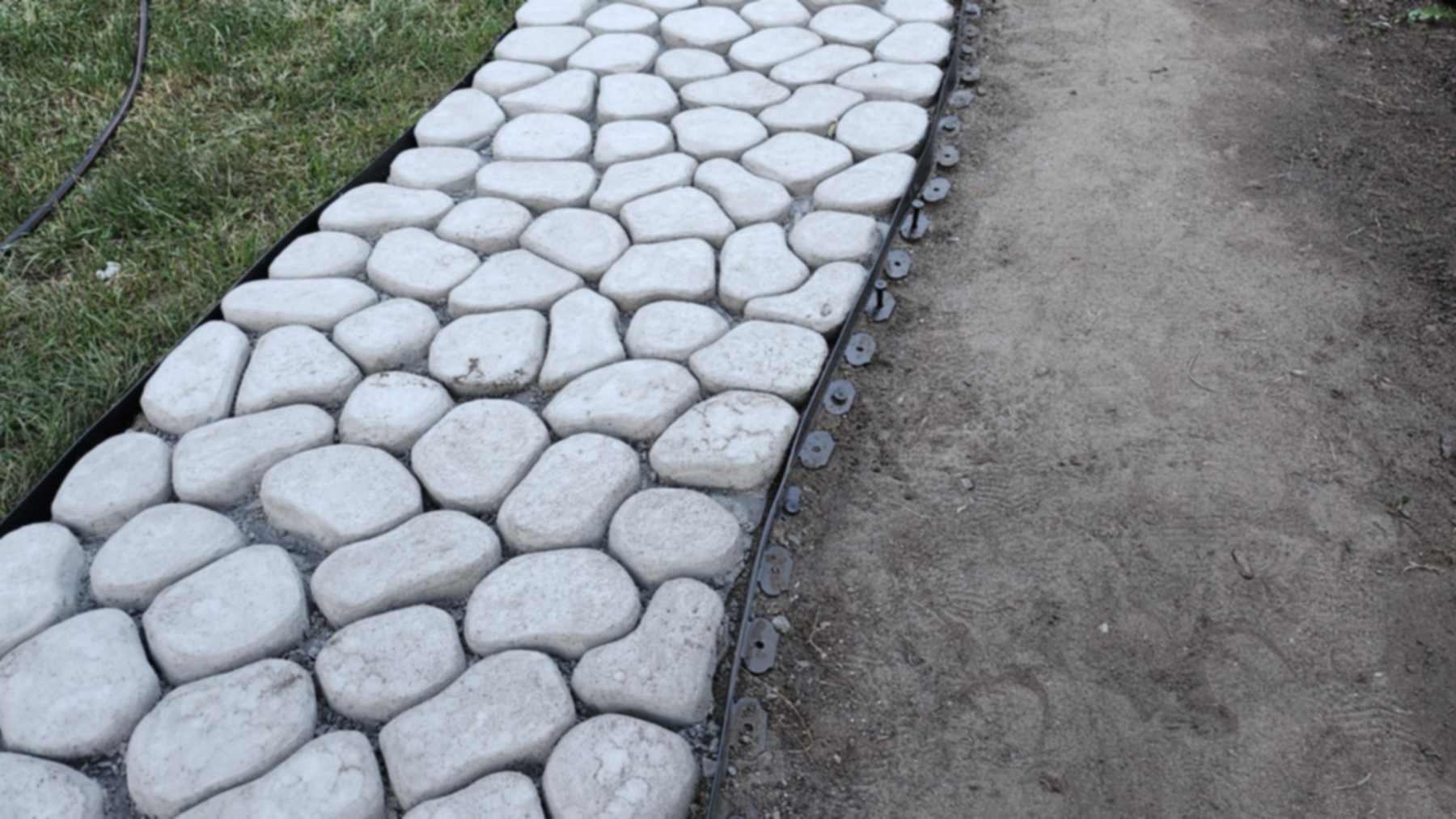
Beside a winding path that cuts through a garden in Michigan, United States, white plastic rings cut from milk jugs pile up. Each one served as a mold for a sand-and-cement piece that its creator later refined by hand until taking on the rounded shape of an old cobblestone.
The owner recounted the process on September 3, 2026, in a Reddit gardening forum, where she signs as u/missmeatbalIs, and the thread amassed over 160 comments. She estimated by eye that she had spent about 60 hours of work and that another 20 or 30 were still ahead.
Plastic bottle rings as molds
In her post she summarized the steps. She removed the lawn, leveled the soil “as best she could,” compacted a paving base and leveling sand, laid down a geotextile fabric, and finally used “horizontally cut plastic milk jugs” as molds.
The mix was three parts of sand to one part Portland cement, the gray cement most commonly used in construction, with water.
When a user asked whether the pieces came out already rounded, she replied in detail. “No, after about an hour or so in the mold, I would remove it and shape it. I would grab a garden staple and scrape the edges. Then I used a small, flat stone and gave many taps to shape it,” she wrote.
The idea came from TikTok
The author of the Michigan path does not claim ownership of the method. “If you’re on TikTok, I got the idea from @krystleconfusesherself. She has videos in which she explains the process,” she replied to someone who wanted to copy it.
That creator presents herself on her profile as the “original creator of the milk-jug mold cobblestone path” and has about 23,100 followers. On April 1, 2026, she posted a video of her path described as a faux stone trail “made with recycled milk jugs, sand and cement,” and the next day another in which she showed how to cut the molds.
The decorating site Hunker picked up her case in May. According to that article, which is based on the creator’s comments, her path of about 8.5 meters cost around $90 for two bags of cement, $11 in sand, and a bucket mixer, and required 331 kilograms of material and four weeks of work.
Many hours for a long path
In the photos, the Michigan path runs through the garden from the house to the back, and that is reflected in the timing. “It has taken me a lot of hours of work, especially for such a long path,” wrote the creator, who admits she did not keep an exact time log.
The photos she shared show finished sections alongside others with the rings still in place and piles of used plastic along the edge of the walkway. A black gardening curb marks the curve between the lawn and the dalia beds.
When a user warned that the plastic edging and its stakes wouldn’t hold, she agreed and explained that it is provisional: “Yes, agreed, I’m only using that edging until I can remove it next spring and put something better.” She also wants to apply a cement stain in light gray and dark gray to give it “more depth.”
The issue with the joints
Her post in the forum asked two questions: what to seal the pieces with and what to fill the gaps with. She planned to use polymeric sand, a sand with additives that hardens when moistened and helps deter weeds popping up through the joints, but she estimated spending at least $200.
In replies she corrected that figure. “Probably $200 is not enough. It could be up to $400,” she wrote, adding: “Just thinking about it makes me sad to spend so much on sand.” Later she put the cost closer to $400 or $500.
Other participants did not reach a consensus. One noted there were “huge gaps between the stones,” another warned that polymeric sand “isn’t the best for gaps this large,” and someone proposed filling first with fine gravel and leaving the polymeric sand only for the top layer.
One of the most upvoted comments framed it with humor. “You’re not going to spend $400 on sand. You’ll spend $400 on better securing the stones, reducing weeds and resisting water erode. It’s not sand, it’s technology,” wrote a user.
Milk jug plastic has a market
Milk jugs in the United States are made from high-density polyethylene, known as HDPE and identified with the number 2 in the bottle-triangle. The United States Environmental Protection Agency (EPA) lists “HDPE bottles for milk and water” among common plastic packaging.
According to EPA data, the recycling rate of natural HDPE bottles, the translucent and colorless plastic used for jugs, was 29.3% in 2018, compared with 8.7% for plastics overall.
Greenpeace USA tempered that optimism in a 2022 report that put the reprocessing rate of HDPE milk and beverage bottles at 10.3%, a metric that only accounts for plastic that is truly reprocessed. “The data are clear: in practice, most plastic simply isn’t recyclable. The real solution is to move toward reuse and refill systems,” said Lisa Ramsden, head of plastics campaigns at the organization, aligning with the view that much of the collected plastic never actually gets recycled.
For recyclers, that plastic is valuable. According to an Argus Media analysis from March 2025, natural HDPE pellets rose from 35 cents per pound in July 2024 to 96 cents in March 2025, i.e., from about $0.77 to $2.12 per kilogram, because brands demand more recycled plastic and fewer jugs are collected.
“No one says the private sector is the problem; it’s the state and local governments,” Argus quoted Scott Saunders, CEO of KW Plastics, a company that makes recycled resin. “Brands want more material and recyclers have expanded production.” The same analysis notes that milk consumption in the United States has been declining for 70 years, meaning fewer jugs to collect.
What the path has yet to prove
In Michigan the jugs serve as a tool rather than part of the pavement. Neither the Reddit thread nor the Hunker article provide a total count of used containers nor measure how much plastic has been saved, and the photos show piles of worn rings along the path with no indication of what will happen to them.
The new material of the path is cement, and the International Energy Agency explains that “reducing emissions from cement production is difficult” due to the dependence on “carbon-containing raw materials” and the need to heat to high temperatures.
Durability remains a question as well, because the pieces are a home-made sand-and-cement mix that has not yet weathered a winter, something the creator keeps in mind. “I live in Michigan, so I know the real test will be how it holds up through Michigan winters,” she wrote.
When another user asked if she would use the method again, she replied: “I’ll tell you next spring.”
A garden to remember two dogs
Behind the hours of work lies a personal reason. To someone who praised her dahlias, she explained that the project is for a garden in memory of her dogs. “Both died this summer and I wanted a nice place to remember them,” she wrote.
The original thread was posted on Reddit on September 3, 2026, in the r/landscaping community.
While she decides what to put in the joints, she still has to place the inner-edge pieces and apply the gray stain.
Image: u/missmeatbalIs / Reddit
