
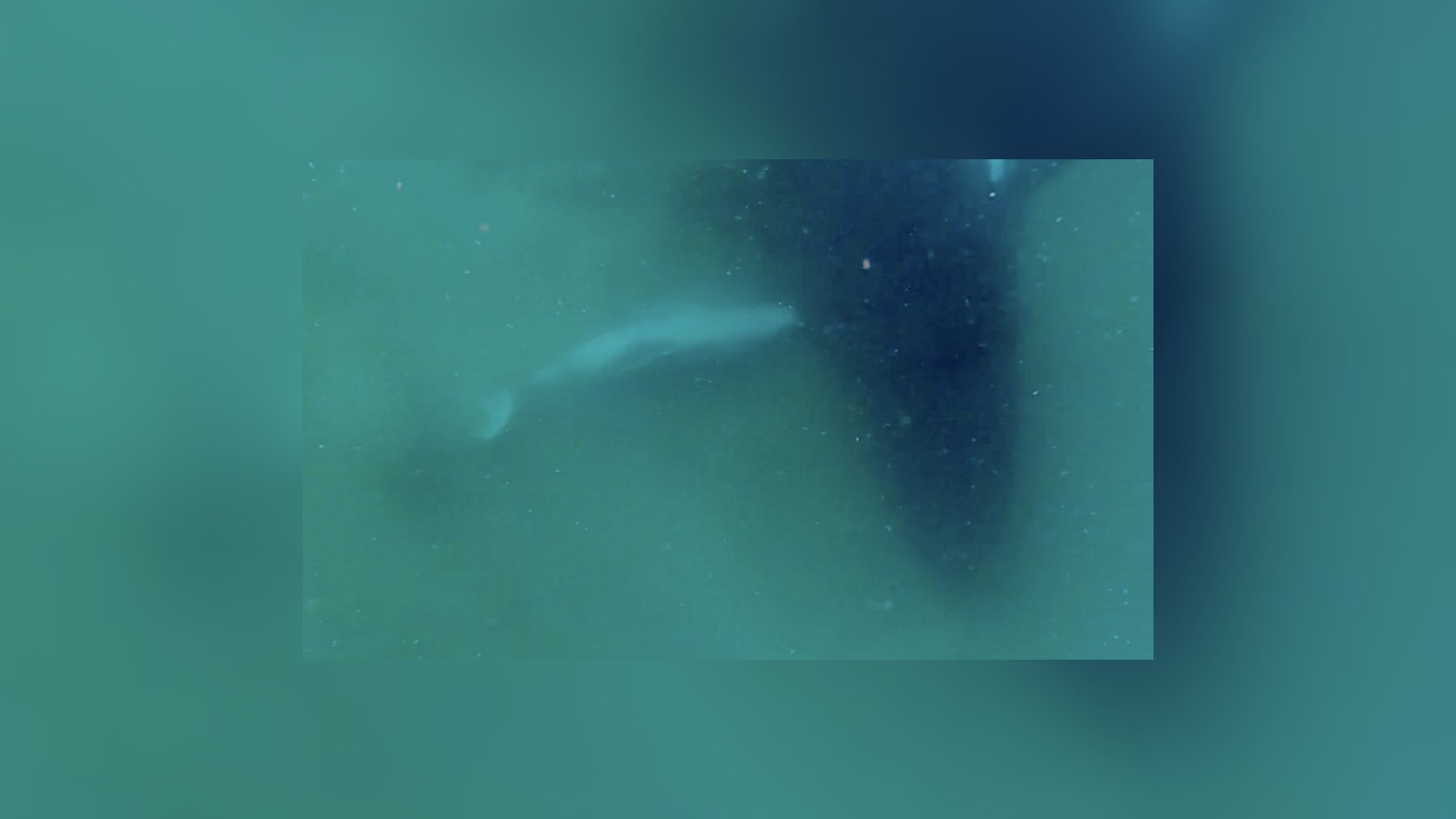
On the morning of July 17, 2025, about one kilometer off the coast of the Australian Gold Coast, a humpback whale gave birth to a calf that was already dead, and she stayed by its side for hours, diving repeatedly to the bottom to touch it with her head and with her pectoral fin.
The researchers who documented it believe it to be the first detailed description of this behavior in the species, and that the mother may have remained there for another two days. In their paper they write that what was observed «could represent a form of grief-related behavior in humpback whales.»
The work is authored by Olaf Meynecke, from the Griffith University Whale and Climate Research Program, and Andrew Mulville, captain of the Sea World Foundation rescue boat, who filmed the scene with a GoPro camera.
A Call on His Day Off, While Fishing
Mulville was fishing with his son on his day off when he was asked to check on two whales that had alerted authorities with unusual behavior, he told the Australian network ABC.
“At first glance I thought they were only two whales resting at the surface, but their behavior was unusual,” he explained in Griffith University’s press release. “When I finally understood what was happening, I was completely astonished.”
He has spent 25 years tending to sick whales, witnessing strandings, and performing rescues, so he knew well how they normally behave. “That was largely what made me think about sticking my head underwater, because it was something I had never seen,” he told ABC.
What the Underwater Camera Recorded
Around eight in the morning, two adult humpbacks, each about 12 to 13 meters long, were slowly circling on the surface over the Palm Beach reef in Queensland. The five-meter boat drifted with its engine off, and the whales eventually rested about 20 meters away from it.
Around 8:30 the amniotic membrane, the inner lining of the sac surrounding the fetus, surfaced, and the researchers estimate that the birth occurred between eight and eight-thirty.
By 8:45 the GoPro showed a small calf lying on the bottom, with no movement or visible breathing. They estimate it measured less than four meters, perhaps shorter than normal, because a newborn of this species typically measures between 3.96 and 4.57 meters.
The mother approached, touched it with her head and with the pectoral fin, and remained beside it, eye to eye, for at least a minute each time. She continued like this until ten o’clock, when the observers left.
On July 18 and 19, observers from the shore and local residents saw two adult whales circling the same area for several hours. “We can’t prove it, but I’m confident they were the same whales,” Meynecke told Science News.
A Mother Who Did Not Try to Bring It to the Surface
Among toothed whales (odontocetes), mothers have often been seen carrying or pushing their dead calves. Dolphins account for more than 90% of such cases, and the orca J35, known as Tahlequah, carried her dead calf for 17 days across more than 1,500 kilometers in 2018.
“Unlike the toothed-whale cases where mothers have been seen lifting their dead calves toward the surface, this humpback mother displayed prolonged post-mortem behavior and attention toward her dead calf beneath the surface,” Meynecke explained in the university release.
In more than half of humpback births, the mother brings the calf to the surface to breathe as soon as it is born. This time she did not, and the authors note that this suggests she “may have been aware that it had died shortly after birth.”
“They were not traveling, they were not socializing; they stayed in the same place, circling the same area,” the researcher told ABC.
Why It Is Rarely Seen in Baleen Whales
Baleen whales, or mysticetes, the ones that filter their food with plates instead of teeth, barely appear in the literature on responses to death.
Part of the explanation is physical. Mysticete calves are born with little fat and sink soon after death, whereas odontocete calves tend to float.
“Of course, something like this has probably happened before, but we simply don’t know,” Meynecke told the Australian news agency AAP. “When it happens, it tends to stay hidden beneath the surface of the ocean.”
According to Live Science, only about 20 humpback births have been observed and described in the scientific literature, and none with a dead-born calf.
Comparisons with Elephants and Primates
The authors draw parallels with elephant and primate responses to death, which also revolve around the mother–infant bond and include touching, vigil, or staying close to the body, as seen in gorillas who watch over deceased kin.
Meynecke repeated that comparison to AFP. “We see it in elephants, in primates, and in cases that are also incredibly heartbreaking,” he said. “But on land we witness it more often, while at sea it is very rare to document something like this.”
“It is very sad,” the researcher summarized to AFP. “It is quite heartbreaking to see this female in continuous contact with the dead calf.”
A Season with Many Dead Calves
The birth occurred in water at 20.5°C, below the 22–28°C of births studied so far, and more than 500 kilometers south of the main calving zones of this population.
In the same July 2025 period, another six newborn calves were found dead, and a young whale was also found dead floating between K’gari Island in Queensland and Ballina in New South Wales. The authors note that the causes of these deaths are yet to be determined and may be related to fluctuations in Antarctic krill that the whales rely on during the summer.
The team uploaded the mother’s tail photo to Happy Whale, a collaborative platform that identifies each animal by the pattern on its tail fluke and that houses more than 15,800 humpbacks along the east coast of Australia. Using the same system, two humpbacks have been tracked across half the globe, but this time there were no matches, which leads researchers to think it could be a young adult female.
What the Study Cannot Prove
This is a single case, described in a brief report based on two hours of observation and 15 minutes of video, 12 of them with the calf, filmed in waters of low visibility. The authors themselves note that interpreting these behaviors as grief “must remain cautious,” because they could also reflect emotional stress, maternal attachment, confusion, or instinctive caregiving responses.
Grief, they add, is hard to prove because wild animals lack physiological and neurological measurements. They also cannot confirm that the two whales seen in the following days were the same individuals, since the animals were not identified.
Vanessa Pirotta, a whale scientist at Macquarie University who did not participate in the work, told ABC that the behavior is “difficult” to interpret. “For a humpback that gives birth to a calf and it is stillborn, I would say there would undoubtedly be at least some reflection on what potentially happened, given that this mother has carried this calf inside her,” she explained.
Pirotta also warned against the temptation to “anthropomorphize” what happened. “What we can do is learn from the observations, and that is exactly what science is about,” she said.
Meynecke shares that caution. “The whale experiences its world in a completely different way,” he told Science News. “They have other ways of understanding their environment.”
The full study has been published in Discover Animals.
“I always think the world would be a better place if we learned from whales,” Meynecke told the AAP.
Image: Andy Mulville / Griffith University