
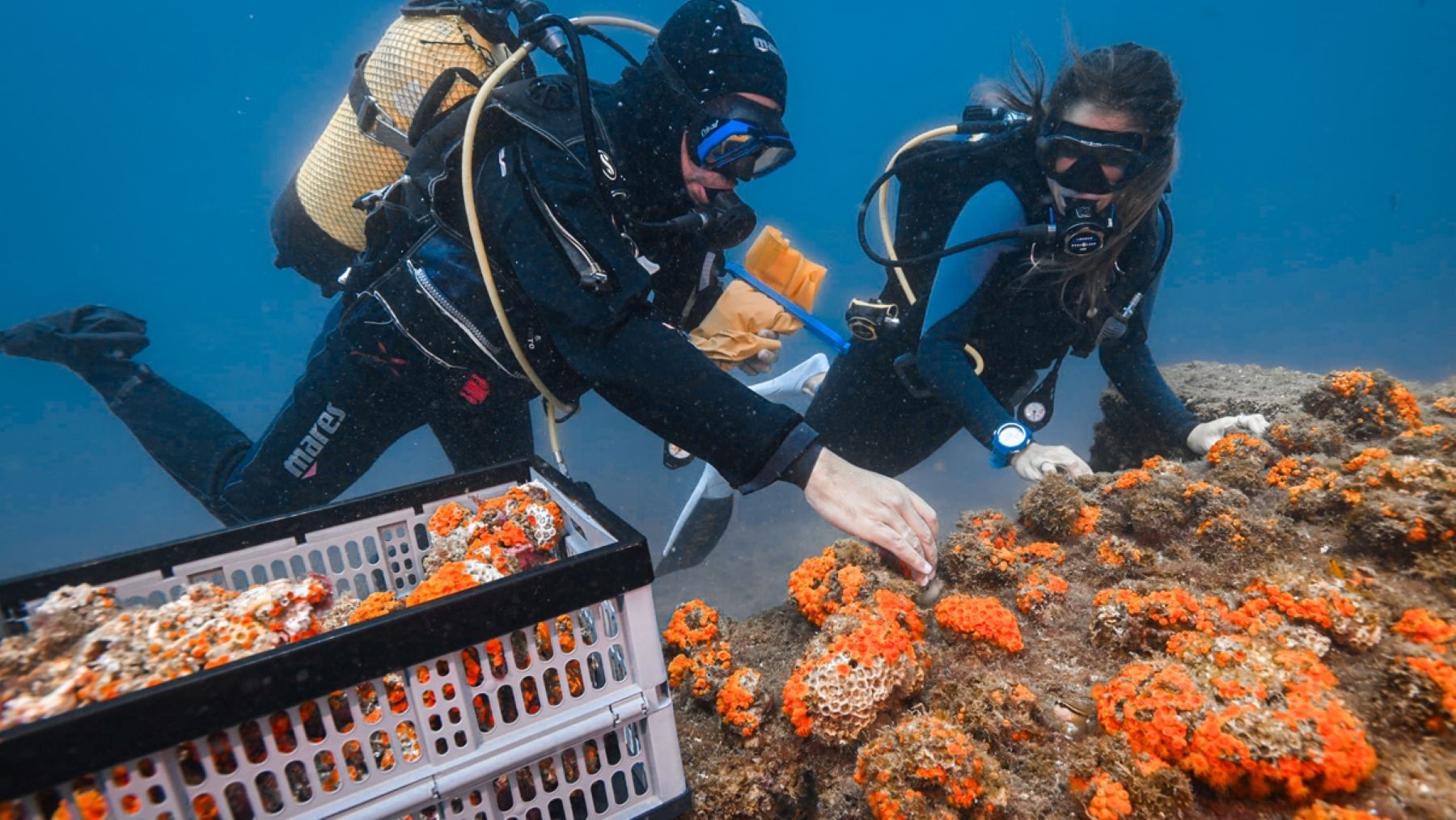
Coral bleaching detected in Almería affects numerous colonies of Cladocora caespitosa. Biologist Alexis Terrón links this phenomenon to temperatures of 24 to 25 degrees Celsius observed at the end of October and warns that, if conditions do not improve, these could be lost.
The coral bleaching in Almería is leaving numerous reef colonies completely affected and others partially harmed. The Association Hombre y Territorio (HyT) documents the phenomenon in the waters north of the Alboran Sea and relates it to an unusual late-October temperature situation: the water remains between 24 and 25 degrees, according to observations by biologist Alexis Terrón.
The affected specimens belong to the species Cladocora caespitosa, a Mediterranean coral capable of forming reefs. Its color loss is a stress signal that is associated with the disappearance of the algae living in symbiosis with them. The coral bleaching in Almería does not necessarily imply death: colonies may recover, but for that to happen the conditions that triggered it must subside.
The concern is how long that stress will last. Terrón warns that, if conditions do not revert, the observed colonies could be lost. Through the MedCoral program, researchers are collecting underwater images to track their evolution and verify whether they manage to recover.
The coral bleaching in Almería worries scientists
The Association Hombre y Territorio (HyT) has alerted to the appearance of numerous bleached coral colonies in the waters of Almería, in the northern part of the Alboran Sea, a phenomenon that it links to rising sea temperatures, which at the end of October reached between 24 and 25 degrees, values unusual for this time of year.
Marine coral specialist, diver, and popular science writer Alexis Terrón explained in a video circulated by the organization on social media that their researchers are documenting this process in specimens of Cladocora caespitosa, a Mediterranean coral species classified as vulnerable and notable for its ability to form reefs.
“We are observing a bleaching of coral in Almería of the species Cladocora caespitosa. We have been seeing many colonies completely bleached and others beginning to bleach or partially bleached,” Terrón noted.
The expert linked this situation to thermal conditions in the Mediterranean and explained that the phenomenon is a response of these organisms to an alteration of their environment. “The coral bleaching in Almería of Cladocora caespitosa occurs as a response by the species to an impact, in this case the constant rise in temperature,” he stated.
October’s temperature values were abnormally high
Terrón drew particular attention to the thermal values observed during the last days of October, when the water maintained temperatures he considers abnormally high for this time of year. “We are at the end of October and we have sea temperatures of 24 or 25 degrees Celsius. For this time of year, this is quite unusual,” he warned.
The researcher clarified that the coral bleaching in Almería does not automatically mean the death of the affected specimens, since there is a possibility that colonies recover if the environmental conditions that triggered it disappear. “This does not mean that the species will die definitively, simply that the algae associated with its tissues has left the polyp,” he explained.
Nevertheless, he warned of the consequences that could arise if these conditions persist for the survival of the observed specimens. “If the conditions revert, the coral can recover. If not, we will lose all these colonies,” he affirmed.
The association is monitoring the affected colonies and collecting underwater images to document their evolution. “Thanks to the DiveVolk housing we are observing and documenting this entire process, which we hope will have a good ending and the colonies can recover,” Terrón added.
The alert is part of the work under the MedCoral program, driven by the HyT association, an environmental organization founded in 2003 that develops research, conservation, and public outreach projects on biodiversity.
HyT’s efforts to save and relocate reef formations
The conservation of these organisms already benefits from several intervention experiences: Hombre y Territorio has reported an 80% survival rate in its transplantation and relocation work on coral colonies in the Mediterranean.
The organization has also evaluated the biological, ecological, and conservation aspects of 59 species of corals and other anthozoans in this sea. These are results from actions different from the monitoring of Almería, but they provide a concrete reference on the tools available to restore damaged populations.
