
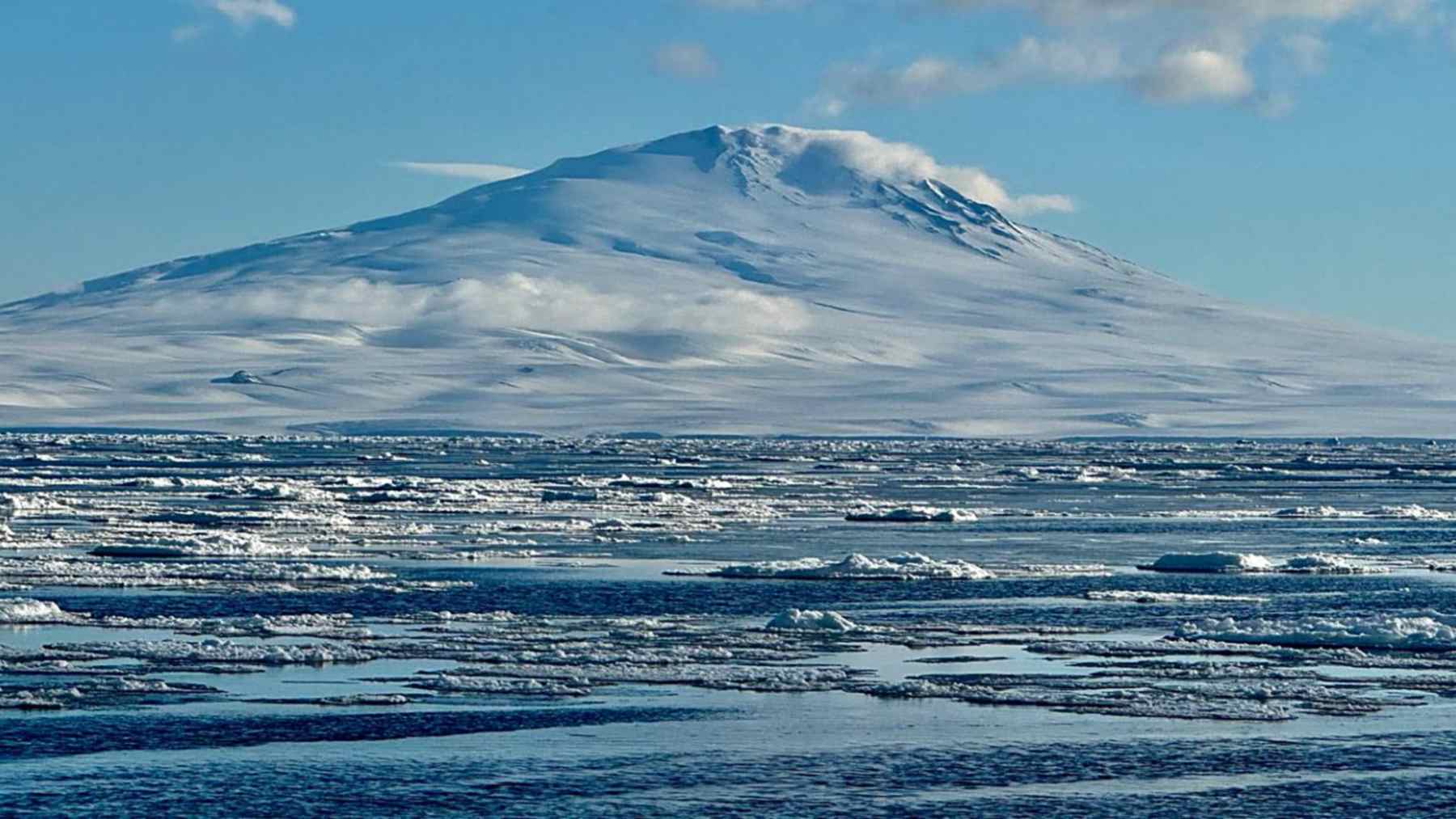
Antarctic Intermediate Water, an immense layer of the ocean that spans a large portion of the Southern Hemisphere, has taken a sharp turn. It had been gradually becoming fresher and lighter for decades. Between 2016 and 2024 it turned saltier, denser, and deeper, according to a study by the University of Southampton and teams from Melbourne and India.
And what has happened to cause it to change in this way? Largely, a lack of sea ice around Antarctica. The authors present this as the first direct evidence of this shift, and the speed is surprising, because, as researcher Bishakhdatta Gayen notes, the last time this layer changed course was about 130,000 years ago.
Less Summer Melting
Each austral summer, ice formed in winter melts and releases freshwater into the Southern Ocean. This freshwater sits above a cold, low-salinity layer near the surface. It then mixes, sinks, and feeds this water mass as it travels northward.
Until 2015 Antarctic sea ice had grown modestly for decades, along with that input. Bishakhdatta Gayen, a researcher at the University of Melbourne and the Indian Institute of Science, compares it to the Amazon. The summer melt was equivalent to three times the river’s annual flow, which is about 6,600 cubic kilometers.
Then came the historic retreat of Antarctic sea ice, and the input fell to around double the Amazon’s flow. The study calculates a net drop of nearly 36 millisverdrups per decade (each millisverdrup equals 1,000 cubic meters per second). Before this, it had been rising by 14 millisverdrups per decade—a striking reversal.
Hundreds of Meters Beneath the Sea
This water originates in the Southern Ocean, travels hundreds of meters below the surface, and distributes across the Atlantic, Indian, and Pacific Oceans. From the shore it is not visible, of course. But it helps organize the ocean’s layered structure and to move heat, freshwater, and carbon around the globe.
That is why what happens to it matters, even thousands of kilometers away. “Changes in this water mass can carry the effects of what happens near Antarctica far beyond the polar region,” summarizes Kaushik Mishra, the lead author who is pursuing a PhD at the Indian Institute of Science.
An Almost Accidental Discovery
In reality, no one on the team was looking for this when it began. At first they were examining how this water enters the Indian Ocean. While reviewing long time series, they found that the salinity at the core had shifted direction around 2016.
Could it be a mere data mirage or something real? The team analyzed measurements from the Argo network, about 4,000 robotic floats that traverse the upper ocean, and cross-checked them with satellite observations and atmospheric data. The salinity increase appears around the Southern Ocean and is stronger in some regions.
Seen from afar, the salinity figure may seem tiny. The core of this layer gains about 0.0048 grams per kilogram of water per decade (with an error margin of 0.0017), and in some regions the change is larger. Additionally, deeper, warmer, and saltier water rises, pushing in the same direction.
Millennia vs Two Decades
What makes the alarms go off is the contrast with the past. According to Gayen, the previous change occurred at the end of the last interglacial period, when there was barely any ice left in Antarctica. “That transition took thousands of years, not two decades,” he notes.
That said, the authors stress that today’s situation does not have to mirror that ancient event. What the comparison shows is something else: a colossal body of water can react very quickly when the forces feeding it change.
The Heat That Descends
This is where the story starts to hit a lot closer to home. The oceans absorb more than 90% of the excess heat, and Mishra notes that a weakened layer could push some of that heat further downward. If so, current models would fall short in projecting deep warming and regional sea-level rise.
A similar thing happens with carbon, as explained by Gayen. If the way surface water sinks to deep layers changes, “it could affect how much carbon the ocean stores, although the magnitude and timing are uncertain.”
Alberto Naveira Garabato, from Southampton, also looks northward. A sustained change could eventually influence, in years or decades, the Atlantic’s thermohaline circulation. Over time, it could also affect Southern Hemisphere storms.
We Still Need to Know How Far It Reaches
Before leaping ahead of the data, it is prudent to read the fine print. The authors themselves acknowledge that the magnitude and timing of these effects are uncertain. That is why they call for close monitoring of the ocean beneath the Antarctic sea ice.
We also do not yet know what the ice will do, as this year it has again fallen short, with the third-poorest maximum since satellites began. As long as it remains so low, Mishra warns, current models could continue to underestimate deep warming.
The study has been published in Nature Climate Change.
Photo: Alberto C. Naveira Garabato
