
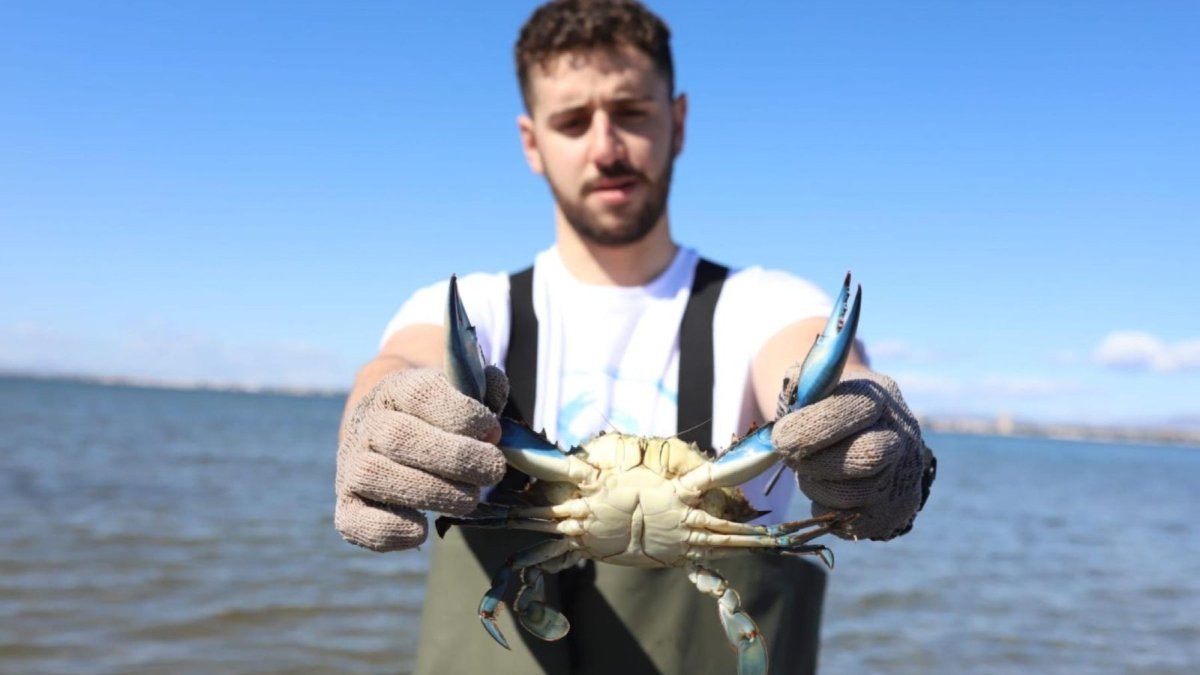
Researchers from the University of Murcia (UMU) and the Miguel Hernández University of Elche (UMH) have analyzed the evolution and establishment of blue crab colonies in the Mar Menor, one of the invasive exotic species that worry the Mediterranean the most, and which has proliferated in shallow waters such as the netted enclosures.
The invasive blue crab in the Mar Menor consolidates its presence in the netted enclosures and reaches abundance highs after oxygen crises
The study, published in the journal Marine Environmental Research, tracks the seven-year progression of this crustacean in the lagoon and concludes that it mainly settles in the areas where the Mar Menor connects with the Mediterranean and where water renewal fluctuates.
Thus, the highest concentrations of young individuals of this species have been found in the netted enclosures, according to data provided by Antonio Andrés Herrero-Reyes, a UMU researcher and the study’s first author, together with other experts from the Miguel Hernández University of Elche.
The netted enclosures become the main refuge for young specimens of an invasive species that worries the Mediterranean
In the parts of the lagoon where water turnover takes longer to renew, such as Los Nietos or Mar de Cristal, populations are predominantly comprised of adult individuals with little recruitment of new specimens.
The work also emphasizes the importance of studying shallow waters, which allow detection of new individuals and monitoring their growth.
Not even episodes of anoxia slowed its recovery: scientists uncover how this crustacean evolves and reproduces
The researchers have also analyzed how the two episodes of anoxia or oxygen shortage in 2019 and 2021 affected the blue crab in the Mar Menor, and they concluded that the number of specimens declined, though it has progressively recovered to reach the highest abundance levels in 2023.
The project has also yielded data on the behavior of the exotic invasive species and its reproductive cycle, which would begin in winter, when the smallest individuals appear, while in spring and summer growing juveniles predominate, and with the onset of autumn the abundance of adults increases.
