
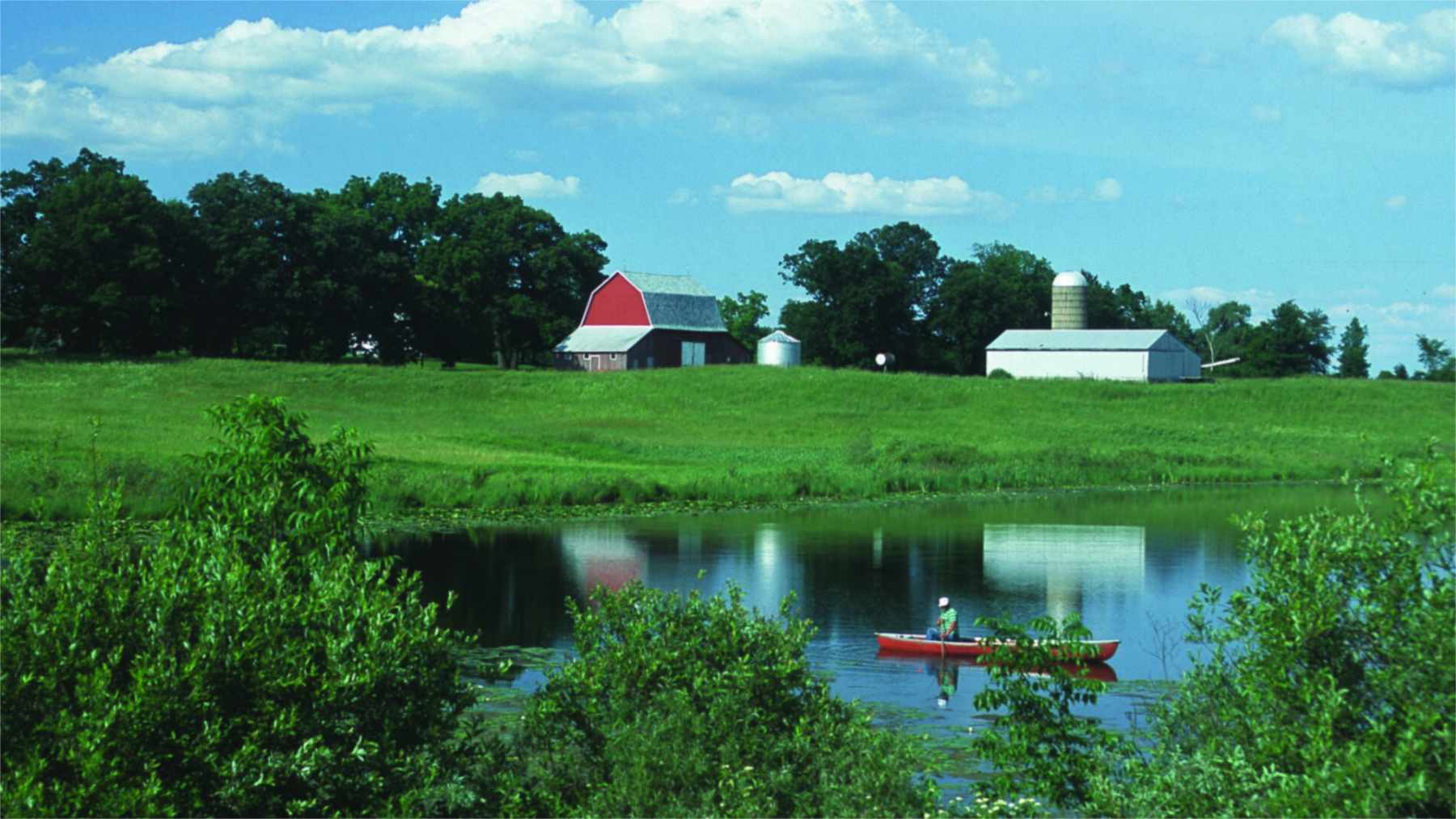
John Boyer grew up among corn, oats, and wheat fields on his family’s 131 acres (about 53 hectares) near the small town of East Jordan in northern Michigan (United States). In 2018 he bought back the farm and in 2026 he has sold his development rights to a conservation entity so that no one can urbanize it in the future.
His story was told by journalist Vivian La in a Grist report produced in collaboration with Interlochen Public Radio, the public radio station for northern Michigan. It arrives at a moment when the state is losing farmland and many families wonder what to do with their land when they can no longer work it.
A Farm That Left the Family and Returned in 2018
The farm changed ownership several times over the decades, always outside the family, until Boyer bought it back in 2018. According to Grist, he felt compelled to reclaim it and cultivate it to prevent development from creeping into a community of family farms.
“For any farmer, everything is personal,” Boyer told Grist. “Each plot, every stone you pick up, you spend countless hours out there.” In that sentence lies the accumulated labor on the same land, from the crops to the stones that must be cleared from the soil.
Sells Development Rights and Keeps the Farm
To protect the farm, Boyer signed what is known as a conservation easement. It is a voluntary agreement by which the owner limits the type or amount of development allowed on their land without ceasing to own it, according to Little Traverse Conservancy, a nonprofit organization in northern Michigan that acquires and protects land.
Boyer remains the owner, but he has sold to that entity the development rights to his 131 acres. The organization retains those rights even if he passes the land to his children or later decides to sell it to someone else, Grist explains.
The agreement is registered in the county property records and applies to all future owners, so the protection stays in place after an inheritance or a sale. In a farming operation, the farmer does not lose either ownership or the right to continue working the land, according to the entity itself.
Boyer Does Not Want to See the Farm Divided into Parcels
What worries Boyer most is what could happen to the property in a few years. He does not want it to end up divided and sold in smaller parcels “to reap a quick profit,” he told Grist.
When an acre becomes homes or commercial buildings, it typically ceases to be farmland, the report notes. “Then, suddenly, a productive field disappears, and it disappears for generations,” Boyer said. “It disappears forever.”
Michigan Lost 292,000 Acres of Farmland Between 2017 and 2022
Boyer’s case fits into a broader trend. The 2022 agricultural census from the United States Department of Agriculture (USDA) counted 9,472,069 acres on farm operations in Michigan, nearly a quarter of the state and 3% less than 2017, when it stood at about 9.76 million.
The difference amounts to roughly 292,000 acres, about 118,000 hectares. That figure represents all land included in farming operations, with crops, pastures and forests, so it does not prove that the land was converted into housing. At the same time, Michigan added 22,000 acres protected with easements between 2017 and 2022, according to USDA data Grist cites.
Behind this also lies generational turnover. The census counted 2022 a total of 80,473 producers in Michigan, of whom 27,429 were 65 years old or older, a little over a third.
Rebecca Carlson, who grows cherries and apples at Overlook Orchards in Northport, at the tip of the Leelanau Peninsula, sees the same risk in her county. Older farmers may pass the land to several children and leave a mosaic of owners that “breaks multigenerational farms,” she told Grist.
“It’s about trying to figure out what exactly best fits each situation. And there’s a lot of pressure. There’s a lot of money,” explained Jon LaPorte, an agricultural operations management educator with Michigan State University Extension (MSU Extension).
Michigan Farmlands Worth an Average of $7,000 per Acre
Land is often the farmer’s largest asset, something that can fund retirement or your children’s education, Joe Graham, chief financial and operations officer of Little Traverse Conservancy, told Grist. That is why signing an easement can be a tough decision.
“We offer them another option,” Graham said. “We offer a way to leverage part of the heritage and value they hold in that land without having to sell it and watch it stop being theirs.”
The sale of development rights has a price, because the entity pays only a portion of the land’s total value and the owner receives less than if they sold the entire farm. According to the USDA’s Land Values report released in July 2026, the average value of agricultural land and buildings in Michigan reached $7,000 per acre, up 2.9% from $6,800 in 2025.
The previous year the rise had been 7.8%, above the national average of 4.3%, according to USDA data Grist cites. “There might be a timing issue: ‘Is this the right thing? What might we be giving up later?’,” acknowledged Graham, who rarely sees farmers sign these agreements driven solely by economic yields.
351 Easements and More Than 29,000 Acres Protected
Little Traverse Conservancy already has 351 conservation easements that protect more than 29,000 acres (over 11,700 hectares), according to its 2026 easement newsletter, which records 10 new agreements covering 657 acres. Of the roughly 30,000 acres it protects with easements in five northern Michigan counties and the Upper Peninsula, about 6,000 are agricultural land, Grist notes.
The agreement does not end with signing. Each year the organization’s staff must review every easement, whether with satellite imagery or on-site visits on foot, by boat, or with a drone, according to the same newsletter. Graham has seen growing interest in these easements in small farming communities, Grist notes.
What One Easement Does Not Solve
An easement protects a specific farm, but it does not by itself halt the loss of farmland across the state. Nor are the figures of Boyer’s arrangement known, since the report does not state how much he charged for his rights, and the statewide average of $7,000 per acre does not allow calculating the value of his farm.
Moreover, other families choose different paths. Around 39% of Michigan’s farmland is leased, according to the 2022 census, and Carlson and her husband have moved from about 200 to 1,300 acres in eight years by purchasing nearby land and using long-term leases, most at 30-year terms. “There isn’t more land being manufactured anymore,” Carlson said.
The full report, written by Vivian La, was published in Grist on September 4, 2026, in collaboration with Interlochen Public Radio.
Image: Lynn Betts / USDA NRCS (public domain)