
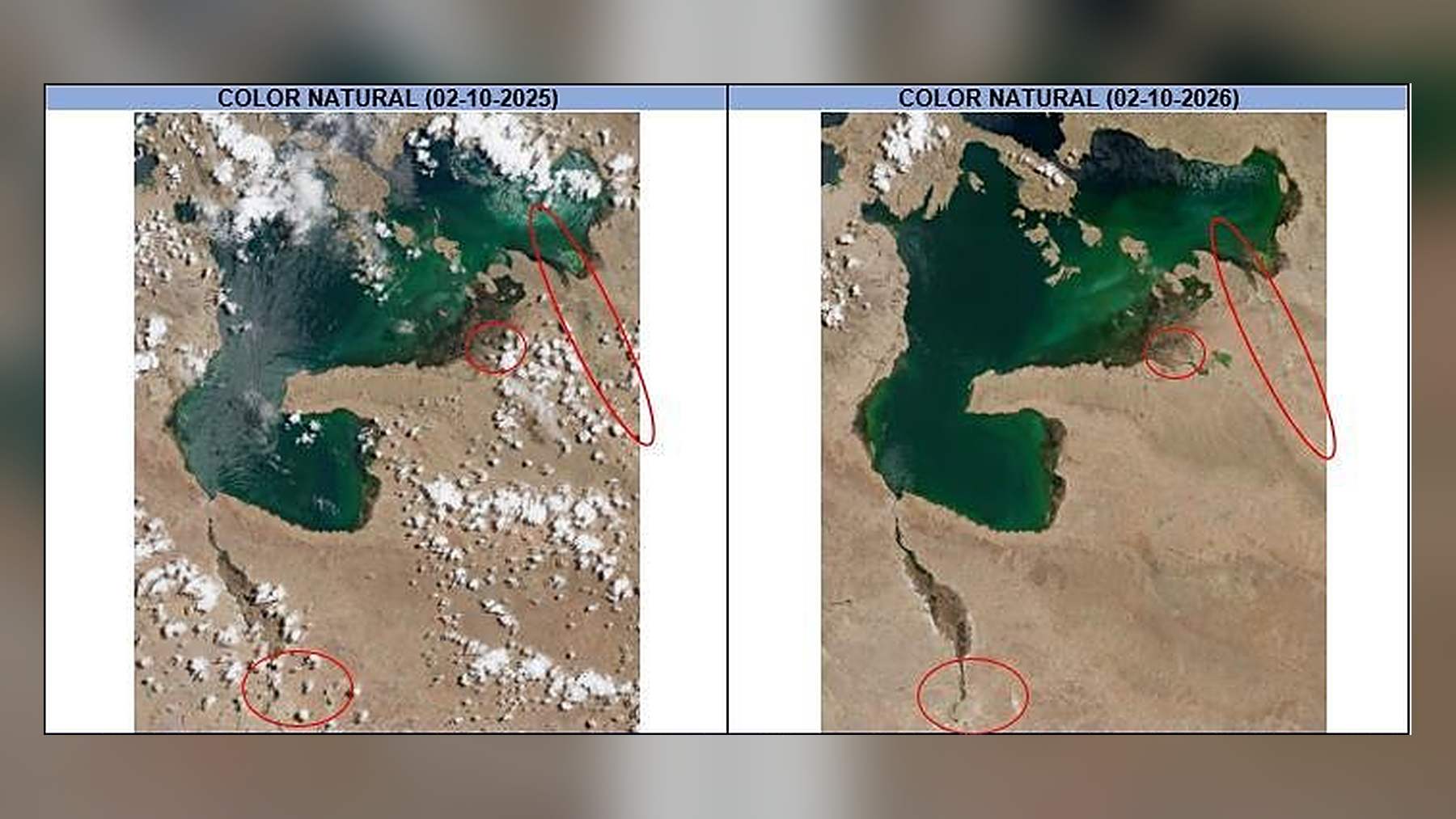
Lake Titicaca has dropped 59 centimeters at the Bolivian Huatajata station between April 24 and October 16, 2026. This is recorded by Bolivia’s National Service of Meteorology and Hydrology (SENAMHI). The gauge stood at 3.86 meters in April and 3.27 meters by mid-October.
On the Peruvian side, Peru’s SENAMHI foresees below-normal water in the lake’s rivers from December, and its Puno office also estimates that 2027 could begin with less rainfall than normal.
The Huatajata Gauge
Huatajata lies on the Bolivian shore, beside the Lesser Lake, and there SENAMHI reads each morning a hydrometric scale which it then converts into meters above sea level. On October 16 it read 3.27 meters, about 3,807.68 meters above sea level, which yields an average of roughly 2.4 centimeters per week over the 25 weeks since April.
According to the technical bulletin, the water is 28 centimeters lower than on October 16, 2025, though the weekly bulletin’s table lists 3.57 meters for that day and leaves the difference at 30. Compared to the same date in 2024, however, the lake is 47 centimeters higher.
After reviewing the highs and lows since 2000, Bolivian hydrologists conclude that the level «is trending downward and does not show a trend of improvement.» Since 2016, only the maximum of 2022 reached the historic average of 439 centimeters.
Record of 2.68 meters in 2025
In 2023, 2024 and 2025 the lake consecutively hit its historic minimum in the Huatajata series, which begins in 1973, and the record came on January 3 and 4, 2025, at 2.68 meters on the scale. SENAMHI attributes the minima of 2024 and 2025 to the scant rainfall of the hydrological year 2022/23.
The last wet season did not compensate either, as it ended with a rainfall deficit of about 25 millimeters. In the entire hydrological year 2025/26 the level moved only 48 centimeters, whereas in the previous year it had moved 138.
Three weaker Peruvian rivers
Peru’s SENAMHI, which falls under the Ministry of the Environment, publishes its own gauges, and since they do not align with Bolivia’s SENAMHI it’s better to compare declines rather than elevations. On April 20, the agency placed the year’s maximum near 3,808.96 meters. The rains in early April had soaked soils, wetlands, and headwaters, and that water gradually arrived at the lake.
From there, a gradual decline was expected during the dry season, then the SENAMHI warned. Even so, they thought the year would be better than 2023, when the water decline affected the “lake transport,” fishing, and the lake’s ecosystems.
The Peruvian rivers feeding Titicaca fell to normal levels in September, according to SENAMHI’s Hidroinforma news at the start of October. The forecast, however, worsens, because from December Huancané, Ramis and Ilave would carry on average below-normal discharge, and the agency asks to monitor water in the southern highlands «in view of a possible deficit scenario.»
A note from October 15 adds that the northwestern part of Puno experienced moderately dry areas in September and that in the southern highlands there were days without rain up to October 10. From October 11 to 16, SENAMHI also issued a wildfire risk alert that included Puno.
Puno faces a dry quarter
On October 8, in a virtual forum about El Niño 2026-2027, SENAMHI’s Zonal Directorate 13 presented its outlook for Puno. Between January and March, the high plateau has a 41 to 46% probability of rainfall below the average, compared with 39-40% for normal rainfall and 19% for a wetter quarter.
SENAMHI regards these probabilities as balanced between a dry quarter and a normal one, and it recalls that «El Niño does not necessarily imply a widespread drought.» In the forum, institutions and agricultural organizations called for reviewing contingency plans and identifying the most vulnerable zones and populations. In the Pacific, NOAA assigns a 75% probability to a record-breaking El Niño this autumn.
Nobody forecasts the December level
No bulletin yet states how much the lake will drop further, and although SENAMHI expected localized rains from October 19, the level will rise only if rivers contribute more water than is lost. A study by the Peruvian Geophysical Institute and other centers, published in 2025 in Frontiers in Climate, attributes about 90% of the lake’s outflows to evaporation and places the usual minimums between November and January.
There are also no official figures on the impact this year on navigation, fishing, or tourism. The main source of these data is Bolivia’s SENAMHI weekly Titicaca Lake bulletin, dated October 16, 2026.
Other large lakes are experiencing similar declines, as Lake Powell hit its historic low in September and the Caspian Sea’s decline threatens its shores. In Bolivia, Titicaca also carries a serious pollution problem.
Imagen: SENAMHI Bolivia
